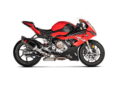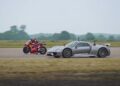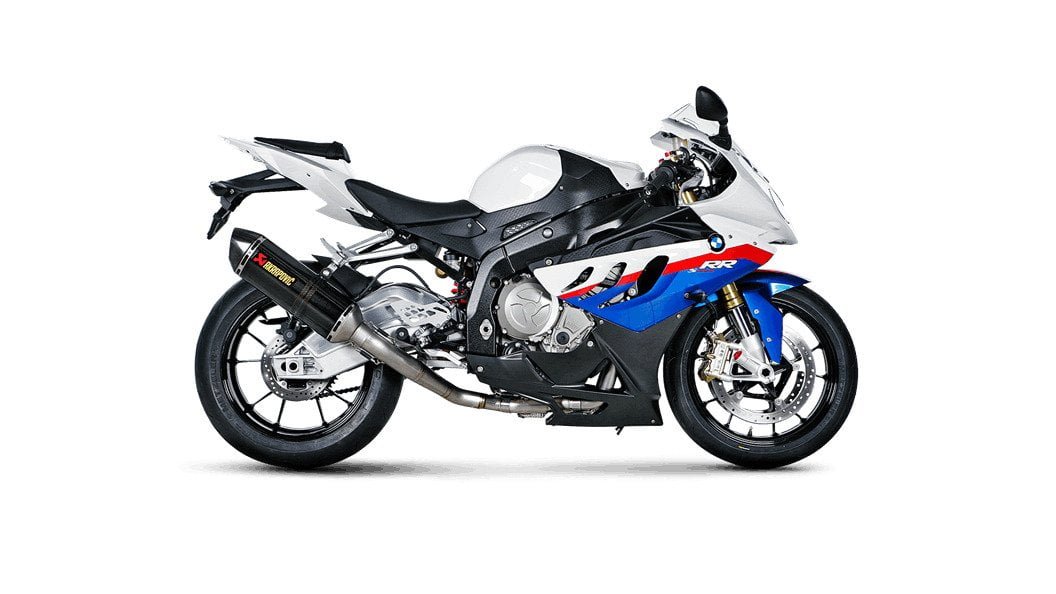
BMW S1000RR can accelerate from 0-180 mph in 16.13 seconds!
Introduced in 2008/09, BMW’s S1000RR came as a massive surprise to the industry and the public alike.
Not only was it BMW’s first proper sportbike, but it also turned the litre class on its head, something nobody saw coming.
We all knew how capable BMW is, with its rich motorsport history, hugely successful range of M-badged performance cars, and its stint in Formula One.
BMW clearly knows how to engineer and bring a competitive machine to market.
Given the brand’s reputation, we expected a proper BMW sportbike to be exceptionally good, but the German manufacturer’s first real attempt made virtually every rival from Japan and Europe second-best from the outset.
Designing and manufacturing a class-leading sportbike is not easy.
To have any hope of achieving this feat, the BMW S1000RR took significant inspiration from the once-dominant Suzuki GSX-R1000 of 2005, a bike that had outperformed everything that came before it.
The goal from the start was to beat the K5 GSX-R1000 in every area of engine performance and handling. BMW succeeded. The S1000RR produced 20-30 more horsepower at the wheel than its nearest rivals at the time and, as a result, dominated in a straight line.
The S1000RR dethroned Kawasaki’s 2008-2010 ZX-10R, which at the time was the fastest-accelerating motorcycle from 0-180 mph according to Cycle World magazine’s “Turn and Burn” feature.

Gen 1 BMW S1000RR Dyno Curve
How did the BMW S1000RR achieve such engine-performance supremacy?
The first-generation S1000RR delivered 180-190 hp at the wheel, giving it a clear 20 hp advantage over its nearest rival, the 2010 Kawasaki ZX-10R, which produced around 170 hp at best.
The S1000RR was truly impressive. It not only surpassed the K5 GSX-R1000, it was designed to beat in peak horsepower, but it also led the horsepower race right up until 2015, when Yamaha launched the new YZF-R1 and joined the 200-horsepower club.
It wasn’t all plain sailing, however….
BMW chose a very oversquare engine design with the widest bore and shortest stroke in the class at the time (80.0 mm x 49.7 mm).
This allowed the S1000RR to rev higher and produce more peak power than anything before it, but it came at the cost of mid-range and low-end torque.
Rivals such as the 2008+ Honda CBR1000RR and the GSX-R1000 offered better road engines. They delivered stronger acceleration lower in the rev range thanks to more usable torque.
Despite this drawback, the S1000RR’s 185 horsepower at the rear wheel could not be ignored. It simply destroyed everything else on the road at the time.
Below 7,000 rpm, there was little excitement, and below 4,000 rpm, the power was particularly flat.
But once the revs climbed above 7,000 rpm, the S1000RR took off like a two-stroke.
It offered a wide, ferocious powerband from 7,000 rpm all the way to 14,000 rpm. Keep the engine in that range, and nothing from that era could compete. Even today, very few bikes can match that rush.
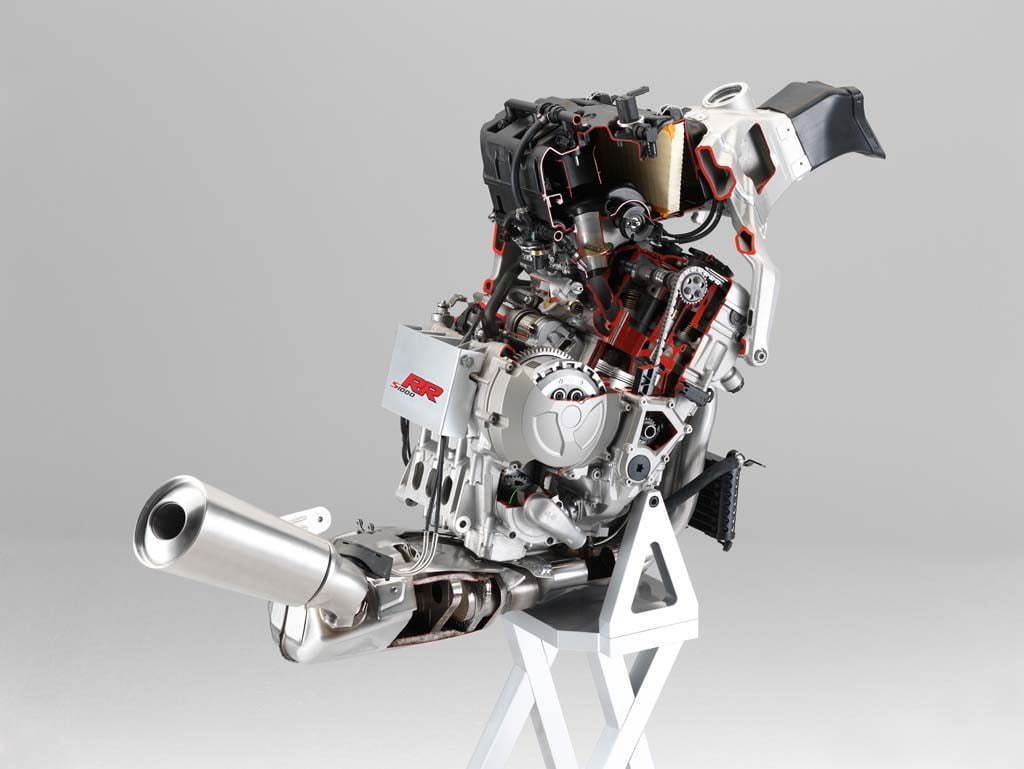
What BMW released to the public was effectively a race engine in road-legal form.
With a simple exhaust and a proper tune, the S1000RR could easily produce 200 horsepower at the wheel, enough to go racing in World Superbike at the time.
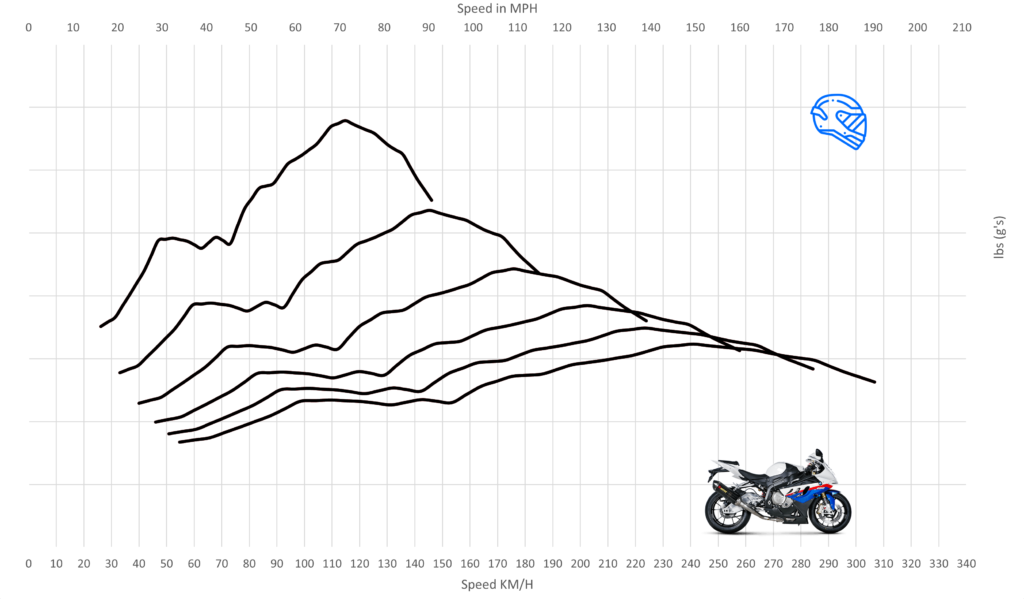
Gen 1 BMW S1000RR in-gear acceleration
While this lack of bottom-end torque compared with its immediate rivals might have shown up on the road under more sedate riding conditions, on the track it was largely meaningless.
When used properly, engines rarely drop below 8,000 rpm except in the slowest corners.
Either way, the BMW S1000RR engine was dominant on both road and track in almost any competitive situation, and it still matches or beats many much newer bikes today.
Taking a closer look at the dyno chart, the S1000RR produces a hugely impressive 185 hp at the wheels, a figure that still ranks highly even today.
Remarkably, the BMW S1000RR’s dyno curve looks eerily similar to that of the 2015 Yamaha YZF-R1, the bike Yamaha built as a direct response to the dominant S1000RR.
The S1000RR’s engine stayed largely the same in peak horsepower throughout its ten-year life cycle, but later models gained more power and torque lower in the rev range thanks to improved fuelling, camshafts, and exhaust changes.
The BMW S1000RR was a class-leading engine ten years ago, and it still makes more power than the 2017-2019 CBR1000RR while matching or coming very close to many 2021 models in both power and torque.
It remains an amazing achievement: BMW entered the superbike world and, on its first attempt, delivered a stock engine that was a full decade ahead of its time in terms of performance.
BMW S000RR Acceleration Review

The 2010 BMW S1000RR is faster than many new Superbikes
The BMW S1000RR is well known for its straight-line performance, the world over, and has long been a benchmark bike for the high-performance motorcycle and car tuning scene.
Litre bikes from around 2004 onward began to match and even beat their hyperbike siblings, such as the first-generation Hayabusa and ZX-12R, in acceleration.
From 2008 onward, with the new Kawasaki ZX-10R, litre bikes had acceleration firmly in the bag and now also possessed the top-end speed to surpass open-class machines, all other things being equal.
Even when the second-generation Hayabusa and the ZX-14R arrived, the stock BMW S1000RR still beat them in acceleration.
This was possible because both machines produced very similar peak power, but the S1000RR weighed around 50 kg less.
The BMW S1000RR has remained one of the fastest-accelerating stock motorcycles since its launch, arguably right up until the 2015 Yamaha R1 arrived.
This is especially true in the US, where strict emission regulations seem to have hurt Japanese manufacturers more. The S1000RR did not suffer as much on the dyno and still produced over 170 hp on most US runs.
It quickly became the fastest and most favoured bike in the street racing scene.
Here are the stats:
The BMW S1000RR delivers performance numbers that remain extremely competitive even today. It can accelerate from 0-60 mph in 2.96 seconds and from 0-100 mph in 5.27 seconds. It covers the standing-start quarter mile in under 10 seconds at 9.98 seconds and 154 mph.
That is a hugely impressive figure, though a difficult one to achieve consistently. Most of my own times were in the mid-tens with terminal speeds of 147-149 mph.
Many litre motorcycles from the last 15 years are capable of running under 10 seconds, but some are harder to launch and require expert control, especially if they lack electronics to help manage wheelies. In most cases, for the quickest ETs, skilled riders turn the electronics off.
While many older bikes that dip below 10 seconds often record much lower terminal speeds in the 140s, the BMW S1000RR shows its strong top-end power with an impressive terminal velocity of 154 mph.
The S1000RR can reach 0-300 km/h in 20.51 seconds.
It does not stop there: the bike covers 0-180 mph in an impressive 16.13 seconds. This puts it slightly ahead of the 2015 Yamaha R1, which managed 16.28 seconds to the same speed. The R1 reels the S1000RR in slowly after a slightly slower start.
The S1000RR also beats the Panigale 1299 to 180 mph by around 2 seconds, but it loses out to the formidable Ducati Panigale V4 by almost 1.5 seconds.
Top speed is typical of most litre bikes at 191 mph, though an unrestricted model could possibly nudge close to 200 mph.
The S1000RR suffers slightly in aerodynamics, but was close to the limiter and just a little over the rpm where it makes peak power.
Check out the latest S1000RR here.
| 2010 BMW S1000RR Acceleration | |
| Speed | Time |
| 0-10 mph | 0.49 |
| 0-20 mph | 0.97 |
| 0-30 mph | 1.46 |
| 0-40 mph | 1.96 |
| 0-50 mph | 2.46 |
| 0-60 mph | 2.97 |
| 0-70 mph | 3.49 |
| 0-80 mph | 4.03 |
| 0-90 mph | 4.58 |
| 0-100 mph | 5.27 |
| 0-110 mph | 5.87 |
| 0-120 mph | 6.63 |
| 0-130 mph | 7.32 |
| 0-140 mph | 8.32 |
| 0-150 mph | 9.34 |
| 0-160 mph | 10.88 |
| 0-170 mph | 12.71 |
| 0-180 mph | 16.13 |
| 0-190 mph | 22.00 |
| 0-200 mph | n/a |
| 60-120 mph | 4.31 |
| 100-160 mph | 5.60 |
| SS/QM | 9.98/154 mph |
| SS/KM | 17.78/183 mph |
| SS/Mile | 24.984/187 mph |
| Top Speed | 191 mph |
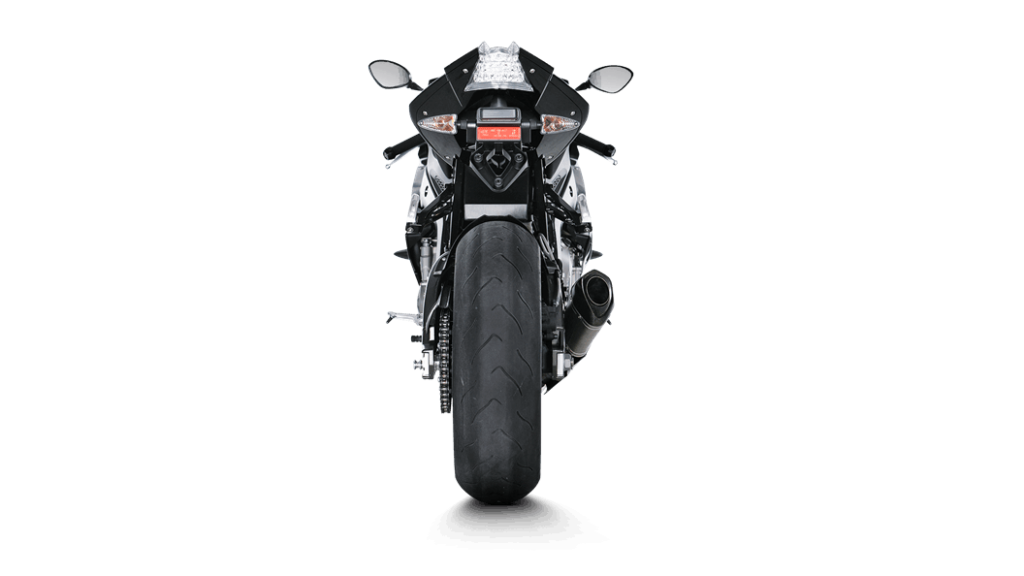
BMW S1000RR Specifications
| 2010 BMW S1000RR | |
| Engine | |
| Displacement: | 999.0 ccm (60.96 cubic inches) |
| Engine type: | In-line four, four-stroke |
| Compression: | 13.0:1 |
| Bore x stroke: | 80.0 x 49.7 mm |
| Fuel system: | Injection |
| Fuel control: | Double Overhead Cams/Twin Cam (DOHC) |
| Cooling system: | Liquid |
| Gearbox: | 6-speed |
| Transmission type | Chain |
| Chassis | |
| Frame type: | Bridge-type frame, cast aluminium, load-bearing engine |
| Front Suspension | 46 mm Upside-down fork, rebound and compression adjustable |
| Rear suspension: | Cast aluminium swing arm, Continuously adjustable rear inbound-rebound damping, high and low speed |
| Front tyre: | 120/70-ZR17 |
| Rear tyre: | 190/55-ZR17 |
| Front brakes: | Double disc |
| Rear brakes: | Single disc |
| Weights and Measurements | |
| Dry weight: | 183.0 kg (403.4 pounds) |
| Seat height: | 820 mm (32.3 inches) If adjustable, lowest setting. |
| Overall height: | 1138 mm (44.8 inches) |
| Overall length: | 2056 mm (80.9 inches) |
| Overall width: | 826 mm (32.5 inches) |
| Wheelbase: | 1432 mm (56.4 inches) |
| Fuel capacity: | 17.50 litres (4.62 gallons) |