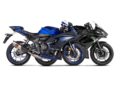
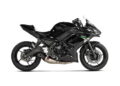
The Ninja 650 does 0-60 mph in 3.53 seconds and 0-100 km/h in 3.92 seconds
Kawasaki’s Ninja 650 has been around for quite a few years now in various forms and is also known as the ER-6 in some markets.
The engine is one of the most widely used on the road, powering many different Kawasaki models over the years in its various incarnations
Kawasaki has the entry-level motorcycle class thoroughly covered across all engine sizes with the Ninja 250, Ninja 300, Ninja 400, their naked counterparts (Z250, Z300, Z400, etc.), and many other offerings over the years.
The Ninja 650 is powered by a parallel-twin engine, a configuration that has become extremely common in entry-level and middleweight motorcycles.
Parallel twins are reliable, relatively cheap to produce, and therefore a favourite choice for manufacturers in the lower to mid-capacity segments.
They offer easy, L-twin-like power and torque delivery, but arguably without the pleasant sound of a 90-degree V-twin.
As a result, the Kawasaki Ninja 650 is not the nicest-sounding bike in its class.
The latest Ninja 650 competes against many alternatives, including Kawasaki’s own Ninja 400, as well as the Yamaha MT-07, Suzuki SV650, and the current class performance leader, the Honda CBR650R.
There are also numerous other current and discontinued models it must contend with.
So how does the Ninja 650 compare with the other competitors we have already tested?

Kawasaki Ninja 650 Power and Torque
The Ninja 650’s 62 hp at the wheels is exactly what you would expect for this class and engine configuration.
That power arrives at 8,500 rpm, with peak torque of a very respectable 43 ft/lb coming in at 7,000 rpm.
The relatively high rpm for peak torque might lead some to think the engine is peaky. In reality, the Kawasaki Ninja 650 produces very close to peak torque from as low as 4,000 rpm, with a nice flat curve right up to the torque peak.
That said, Aprilia’s new RS 660 shows what can be achieved with this same engine configuration and capacity.
To be fair to Kawasaki, the RS 660 is an all-new, much more focused machine that costs almost twice as much as the Ninja 650.
The Ninja 650 is a true entry-level sportbike, while the Aprilia RS 660 is sharper and is more likely to be compared with four-cylinder supersport bikes, given its similar power output.
Kawasaki has made steady incremental improvements over the years.
The latest version of the engine produces a little more peak power and offers a better spread of power and torque than earlier incarnations.
The Ninja 650 actually has a very good engine for real-world road riding. It delivers the power and acceleration exactly where you spend most of your time – in the bottom and middle of the rev range.
The engine provides a strong, instant drive from as low as 2,500 rpm.
There is a small flat spot around 3,500 rpm, but it is barely noticeable on the road.
From there all the way up to around 7,000 rpm, the performance is very similar to that of the Suzuki SV650 we tested recently.

Kawasaki Ninja 650 in-gear acceleration
It is only after 7,000 rpm that the Ninja 650 stops revving with the same enthusiasm as the SV650 or some other competitors.
It gets left behind by the CBR650R but remains closely matched with the FZ6R.
While the Ninja 650 will rev beyond 9,000 rpm, the sweet spot is clearly between 4,000 and 9,000 rpm – exactly where it delivers its best acceleration.
Revving beyond that point is mostly just making noise, and it is not the nicest noise, either.
That is usually a clear sign that it is time to shift up and bring the tachometer back into the strong part of the powerband.
Overall, it is a good engine with a character quite similar to the MT-07 and YZF-R7, but with less power and torque everywhere and none of the attitude or easy wheelies.
The Yamaha MT-07, despite also being a parallel-twin, sounds noticeably better thanks to its crossplane crankshaft; the same goes for the new YZF-R7.
On the road, the Ninja 650’s engine is excellent, especially in town and on slower roads. It has all the grunt you need, delivered with very little drama.
You can comfortably ride in higher gears and let the revs drop quite low; the torquey Kawasaki still provides more than enough performance to get the job done.
While the CBR650R is faster at lower speeds and lower rpm in every gear, the Kawasaki Ninja 650 is actually a little more accelerative in the first three gears.
The engine does a stellar job on the road and is more than fast enough to have fun.
Yamaha R7 vs Ninja 650 Speeds in each gear at 5000 rpm
| Speed at 5000 rpm | YZF-R7 | Ninja 650 |
| Speed 1st Gear | 25.6 mph | 23.3 mph |
| Speed 2nd Gear | 34.3 mph | 33.2 mph |
| Speed 3rd Gear | 44.7 mph | 42.6 mph |
| Speed 4th Gear | 56.1 mph | 51.2 mph |
| Speed 5th Gear | 66.9 mph | 58.9 mph |
| Speed 6th Gear | 75.7 mph | 66.7 mph |
Ninja 650 Versus Yamaha R7 Here
The Kawasaki Ninja 650 can really move.
Any vehicle that can sprint from 0-60 mph in under four seconds is objectively fast, and the Ninja 650 does it in a very respectable 3.53 seconds (0-100 km/h in 3.92 seconds).
That is impressive performance for an entry-level sporty motorcycle that can also tour in comfort.
The Ninja 650 charges on to 100 mph in just 9.5 seconds, and it covers the quarter mile in a solid 12.3 seconds at 110 mph.
These are close to optimum times.A decently skilled average rider will typically run 4.0 seconds flat to 60 mph and mid-to-high 12-second quarter miles with a terminal speed around 105 mph.
The Ninja 650 reaches 0-200 km/h in 18.5 seconds.
When riding hard, it is tempting to take the revs right to the redline every time, but that is not always the quickest way.
The best elapsed times depend on the engine’s power delivery and the gear ratios.
The Ninja 650 responds best to short-shifting. Shifting at around 8,500–9,000 rpm is the most effective way to achieve good times.
If you scream the engine to the redline in every gear, you can lose up to 0.3–0.4 seconds over a quarter mile.
Riding the Ninja 650 more like a revvy single, keeping the revs in the strong part of the curve, is how this engine likes to be ridden, and it will reward you for it.
Thanks to its full fairing, the Ninja 650 manages a decent top speed of 130 mph with elbows in and a full race tuck, despite being down on power compared with some rivals.
For most average-sized and average-weight riders who are less committed to the tuck, realistic top speed is closer to 120–125 mph.
Add a headwind, and you will struggle to reach even 110–115 mph.
While the bike is quick, its engine is clearly better suited to strong in-gear acceleration at lower and medium speeds rather than being revved like a two-stroke.
You can play with your classmates and stay on their heels, but the Ninja 650 will start to show its limitations once speeds climb above 100 mph.
Compared with sports cars, the Ninja 650 beats many of them, and its acceleration to 100 mph is in the same league as a BMW M2 or M4.
You can feel good knowing your Ninja can keep up with cars that cost many times more.
Excluding the ZX-6R, the Ninja 650 is the quickest entry-level motorcycle Kawasaki offers, and it has the legs on its smaller, more rev-hungry sibling, the Ninja 400.
It also convincingly beats the CBR500R and Yamaha R3.
If you prefer the naked version, the Z650 is essentially the same bike without the fairing.
That said, the MT-07, CBR650R, and SV650 all offer stronger straight-line performance.
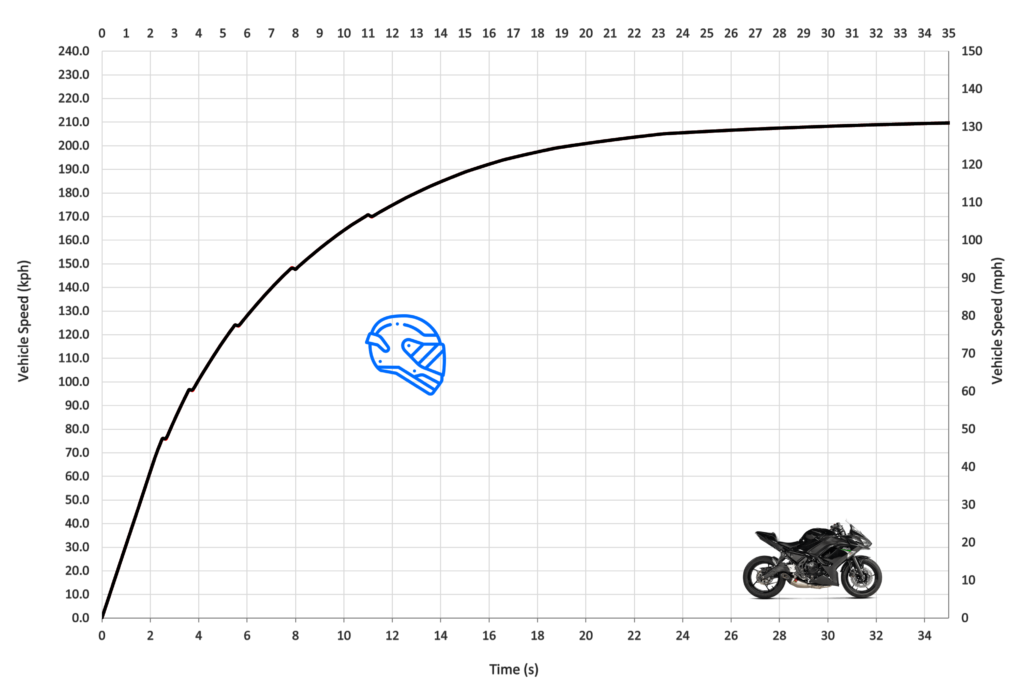
Kawasaki Ninja 650 Acceleration and Top Speed
| Kawasaki Ninja 650 Acceleration | |
| Speed | Time |
| 0-10 mph | 0.57 |
| 0-20 mph | 1..01 |
| 0-30 mph | 1.52 |
| 0-40 mph | 2.00 |
| 0-50 mph | 2.84 |
| 0-60 mph | 3.53 |
| 0-70 mph | 4.61 |
| 0-80 mph | 5.92 |
| 0-90 mph | 7.40 |
| 0-100 mph | 9.51 |
| 0-110 mph | 12.1 |
| 0-120 mph | 15.7 |
| 0-130 mph | 40.53 |
| 60-120 mph | 12.17 |
| 60-130 mph | 37.00 |
| SS/QM | 12.3/110.6 mph |
| SS/KM | 23.2/127.5mph |
| SS/Mile | 33.66/129.3mph |
| Top Speed | 130.5mph |