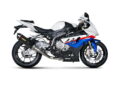
New S1000RR does 0-60 mph in 3.1 seconds
From the moment the S1000RR was first released in 2010, it has pretty much led the litre bike class on the road right up until now and has arguably been the best 1000 cc superbike of the period.
Combining class-leading power, comfort, and usability in one impressive package made the S1000RR the first choice for most riders wanting the ultimate superbike.
You can read more about the original S1000RR and see how it performs against the clock here.
In terms of engine performance, the S1000RR dominated the other 1000 cc bikes from the day it was launched and continued to do so until the Japanese manufacturers finally caught up.
When they did respond, the Japanese brands released motorcycles that could trade blows with the ballistic S1000RR both on the dyno and in a straight line.
BMW did not leave the S1000RR’s development static. It received various updates over the years in the form of engine, chassis, electronics, and styling changes.
These updates came mainly in 2012, 2015, and 2017 to keep the S1000RR ahead of its rivals.
We also saw the introduction of the HP4 homologation special in 2012, a more track-focused version of the S1000RR designed for WSBK racing.
There were some minor updates to the HP4 in 2013 as well.
Kawasaki was the first to respond to the S1000RR, landing a firm left hook with the announcement of its 197 hp (crank) 2011 ZX-10R.
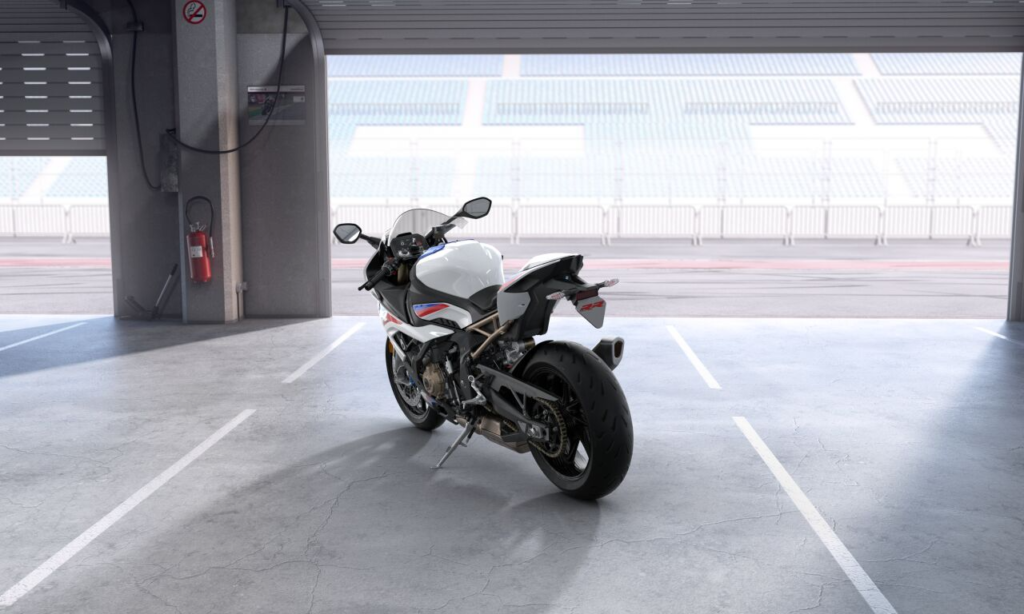
The Japanese manufacturers stayed relatively quiet for a while until 2015, when Yamaha launched its new 200 hp (crank) YZF-R1 – a bike that many viewed as an unofficial road-going version of their MotoGP M1.
Since then, we have seen a wave of new or heavily revised litre bikes from both Europe and Japan: updated ZX-10Rs, an all-new GSX-R1000, the Panigale V4 replacing the 1299.
The Aprilia RSV4 1000 (and later the RSV4 1100), and Honda’s fresh CBR1000RR-R with an all-new chassis and engine.
All of these are 200+ horsepower machines designed to dethrone the S1000RR.
Not only did they match or exceed the S1000RR in raw engine performance, but they also came equipped with the latest MotoGP-derived electronic rider aids.
This meant BMW engineers had their work cut out to create an all-new S1000RR from the ground up that would beat the previous model in every area while at least matching the new competition.
It was a monumental task, but BMW delivered.
The new S1000RR is arguably the best all-round mass-produced superbike on the road today.
BMW made incremental improvements to the S1000RR engine over the years with updates in 2012, 2015, and 2017.
While peak horsepower stayed largely the same until the latest model, the biggest gains came in bottom- and mid-range torque.
The original S1000RR engine was ballistic, but it behaved more like a supersport 600 on steroids. It really only came alive above 7,000 rpm.
Below that, while still quick, it felt lacking compared with some rivals when driven hard from lower revs.
The S1000RR engine was the 1000 cc benchmark for a long time. Kawasaki and Yamaha were the first Japanese brands to respond with all-new bikes aimed at dethroning it.
Yamaha, in particular, appears to have taken inspiration from the S1000RR.
If you compare the power and torque curves back-to-back, the 2015 YZF-R1 engine follows a very similar trajectory to the original S1000RR.
The latest S1000RR engine produces around 15–20 hp more at peak on most dynos than the previous model – a massive achievement given how strong the outgoing bike already was.
Even more impressive is how much extra power and torque the new engine delivers in the bottom and mid-range.
It dominates every other 1000 cc sportbike and feels like it has an extra 100 cc of capacity in the low-to-mid revs.
Much of the credit goes to BMW’s ShiftCam technology on the intake side.
It uses sliding concentric camshafts with two different profiles on a splined inner shaft.
An ECU-controlled actuator switches between a low-lift, short-duration cam for strong low- and mid-range torque and a more aggressive high-lift, long-duration cam for peak power. The switch happens at 9,000 rpm in under 10 milliseconds.
The result is an engine that delivers huge peak horsepower without sacrificing usable torque lower down.
Other manufacturers, such as Suzuki with the latest GSX-R1000, use similar variable valve timing technology, but many consider BMW’s ShiftCam implementation the best so far when looking at dyno charts.
As manufacturers chase ever-higher peak power figures, they are forced to use higher-revving, shorter-stroke engines.
This inevitably robs power and torque from the mid and lower parts of the rev range.
Clever variable cam systems like ShiftCam have therefore become crucial to maintaining a strong, usable spread of power and torque across the entire rpm range.

2019 BMWS1000RR Dyno Curve
– Gen 1 S1KRR – 19+ S1KRR
The dyno chart is quite amazing. What you are looking at is the original 2010 S1000RR plotted against the 2021 model.
BMW has managed to extract an extra 17 peak horsepower from the new engine, achieving an impressive 202 hp at 13,500 rpm compared with the 2010 model’s 185 hp at 13,000 rpm.
That alone is impressive, but the original bike is completely dominated across the entire rev range – especially below 7,000 rpm.
At that point, the new S1000RR is already 27 horsepower ahead.
The closest the original gets is around 11,000 rpm, where it trails by only about 5 hp.
From as low as 3,000 rpm the new S1000RR produces close to 60 ft/lb of torque, which builds nicely as the revs rise.
By 5,000 rpm, it is making 75 ft/lb, and from 7,000 rpm onward, it delivers a strong 80 ft/lb.
There is a slight dip that recovers quickly before the engine hits its peak torque of 85 ft/lb.
It is by far the most torquey 1000 cc superbike engine, both in peak figure and in the spread of torque across the rev range.
For context, the new S1000RR produces the same peak torque at 7,000 rpm that the original S1000RR only managed at its peak – some 4,000 rpm higher.
To see what this means on the road and through the gears, look at the thrust curve below. The new S1000RR dominates the older model in every gear at every speed.
New BMW S1000RR Thrust Curve

– Gen 1 S1KRR – 19+ S1KRR
Thrust curves are the graphs we should be paying much more attention to.
Typical power and torque curves only show what the engine is doing in isolation.
Engine performance, while obviously crucial, does not exist in a vacuum – it must be translated through the gearbox before the rider feels it.
As torque is delivered through each of the motorcycle’s six gears, we experience its real-world performance as forward thrust from the seat of our pants.
Think of gears simply as multipliers of torque. The engine produces torque, and the gears multiply it and apply it at road speed.
Correctly chosen gearing makes the best possible use of the engine’s torque at any given rpm, and the rider feels this as acceleration when twisting the throttle.
In the graph above, you are looking at the acceleration (thrust) available to both motorcycles in each gear, plotted against road speed.
There are six lines for each bike: blue for the 2019+ S1000RR and red for the first-generation (2010) S1000RR.
The highest line for each motorcycle represents first gear, as it is the lowest gear and therefore provides the most thrust/acceleration.
The second-highest line is second gear, and so on, with the lowest line being sixth gear.
The lower the gear, the more acceleration/thrust is available.
If you look at the shape of each thrust curve in every gear, you will notice they are all essentially the same for a given bike – just shifted along the speed axis.
If you compare the lines for all gears to the engine’s torque curve, they share the same shape, peaks, and troughs.
This is because the thrust curve is simply the torque curve multiplied by the gear ratio and translated into road speed.
| Speed at 5000 rpm | 19+ S1000RR | Gen 1 S1000RR |
| Speed 1st Gear | 33 mph | 33.2 mph |
| Speed 2nd Gear | 41.7 mph | 42 mph |
| Speed 3rd Gear | 50.5 mph | 50.8 mph |
| Speed 4th Gear | 58.2 mph | 58.5 mph |
| Speed 5th Gear | 64.2 mph | 64.5 mph |
| Speed 6th Gear | 69.2 mph | 69.6 mph |
Gearing for both the new and old BMW S1000RR is identical for the individual cogs, with the only difference being the rear sprocket size.
The 2019+ S1000RR runs a 45-tooth rear sprocket compared with the 44-tooth sprocket on the Gen 1 model, making the overall gearing on the new bike a fraction shorter.
Not only does the new S1000RR have significantly more power and torque throughout the entire rev range, but it also has slightly shorter gearing.
This further adds to its dominance in in-gear thrust and acceleration.
Between 110 km/h and 130 km/h in sixth gear, the new S1000RR actually produces more thrust than the original S1000RR does in fourth gear.
The new model dominates at any speed and in any gear. Its advantage is most pronounced for the first two-thirds of each gear’s thrust curve.
For the old bike to stay with the new one from a roll-on at almost any speed, it would have to be in a gear lower – otherwise it gets left behind.BMW has done an outstanding job.
The new S1000RR delivers the kind of in-gear thrust you would expect from an engine with an extra 100–200 cc, and it can trade blows with, or even beat, a Panigale V4 or RSV4 1100.
Since the new engine also revs a little higher than the old one, BMW could have geared it even shorter without sacrificing much top speed in each gear, making the in-gear performance even more potent.
Just to be clear, the thrust curves you are looking at do not account for the many in-gear ECU throttle restrictions and limitations that many modern motorcycles have from the factory.
These graphs represent a direct 1:1 translation of torque multiplied by gearing — essentially how the bike would perform after an ECU flash or if the stock ECU had no restrictions.
19-21 BMW S1000RR Acceleration Review
It is no surprise that the latest S1000RR is devastating in a straight line and noticeably quicker than the original.
The original BMW S1000RR, alongside the Gen 2 Hayabusa, was for a very long time one of the two benchmark motorcycles for straight-line performance.
Excluding the H2, H2R and other special machines, the new S1000RR now sits right at the top of the pile alongside the Ducati Panigale V4, Aprilia RSV4 1100, and the Honda CBR1000RR-R.
These four machines trade blows for straight-line supremacy, followed closely by the current GSX-R1000 and then the Yamaha R1.
Forget the Kawasaki ZX-14R and the Gen 2 (and lower-powered Gen 3) Hayabusa.
Thanks to their much greater weight, they may lead from a standing start, but on the highway, the latest litre bikes have those heavy hyperbikes convincingly beaten/
This is because modern litre bikes produce similar, and in some cases more horsepower, while weighing 40–60 kg less.
That weight difference makes a huge impact on acceleration.
Like all lightweight litre bikes, the S1000RR’s 0-60 mph times are always tricky.
Even with launch and wheelie control, it is difficult to dip consistently under the three-second mark.
Our test bike achieved 0-60 mph in 3.1 seconds (reaching 9,000 rpm in first gear).
A sub-three-second 0-60 mph time comes down more to rider skill, luck, and conditions on the day than to the bike itself.
Even after 60 mph and still in first gear, wheelies remain an issue.
That 200 hp cannot be put fully to the ground immediately.
The new S1000RR actually needs a shift into second gear to complete 0-100 mph, which it does in 5.50 seconds.
A 0-100 mph time between 5 and 6 seconds is something virtually all litre bikes of the last 20 years have been capable of.
For the latest litre bikes, including the S1000RR, it is once second and third gears are engaged that it becomes much easier to convert that insane power into forward motion.
At this point, older litre bikes are rapidly dispatched.
The new S1000RR reaches 0-200 km/h in 6.55 seconds and 150 mph in 9.43 seconds – before it has even passed the quarter-mile mark.
It covers the quarter mile in 10.12 seconds at a mind-boggling terminal speed of 156 mph.
Yes, a BMW S1000RR can run sub-ten-second quarter miles, and so can many older litre bikes.
However, achieving those times is far more about rider skill, size, weight, and conditions on the day than the bike’s raw capability alone.
Getting into the nines on a litre bike requires an impressive 60 ft time.
Most 150+ hp litre bikes I have tested run 60 ft times around 1.9 seconds. Generally, 1.7–1.8 seconds is needed to consistently break into the nines at this power level.
If you baby the launch, you will not see the nines unless the bike has significantly more power than the S1000RR to compensate.
With its insane trap speed of 156 mph, a better launch on the new S1000RR could easily deliver a 9.8-second quarter mile at 156+ mph, all other things being equal.
If we are measuring superbike performance from a standing start, 0-180 mph is the real benchmark.
The 2019+ S1000RR is the fastest bike we have tested (excluding the H2R).
It beats the Panigale V4 by a few tenths with an astonishing 14.27 seconds – almost two full seconds quicker than the original Gen 1 S1000RR we tested.
The BMW S1000RR can accelerate from 0-300 km/h in 16.50 seconds.
With the new S1000RR, you can pretty much confidently play with anything on the road and be guaranteed to win, other than a few Hypercars like the 765LT or some crazy fast-tuned cars with 1000 hp plus.
New BMW S1000 RR Top Speed is 197.4mph
If you remove the ECU speed limiter, the new S1000RR is pretty much a 200 mph motorcycle.
If you decat it and dyno-tune it, drop the mirrors and go down a few teeth on the rear, we are talking a 210 mph motorcycle on the right day with a jockey onboard.
We managed 197.4 mph on this de-restricted BMW S1000RR, but your results may vary!

| 2019 BMW S1000RR Acceleration | |
| Speed | Time |
| 0-10 mph | 0.58 |
| 0-20 mph | 1.01 |
| 0-30 mph | 1.52 |
| 0-40 mph | 2.04 |
| 0-50 mph | 2.56 |
| 0-60 mph | 3.10 |
| 0-70 mph | 3.64 |
| 0-80 mph | 4.20 |
| 0-90 mph | 4.78 |
| 0-100 mph | 5.50 |
| 0-110 mph | 6.13 |
| 0-120 mph | 6.93 |
| 0-130 mph | 7.26 |
| 0-140 mph | 8.37 |
| 0-150 mph | 9.43 |
| 0-160 mph | 10.51 |
| 0-170 mph | 12.29 |
| 0-180 mph | 14.37 |
| 0-190 mph | 18.89 |
| 0-200 mph | N/A |
| 60-130 mph | 4.52 |
| 100-150 mph | 3.92 |
| SS/QM | 10.1/156 mph |
| SS/KM | 17.73/188 mph |
| SS/Mile | 24.70/195 mph |
| Top Speed | 197.4 mph |