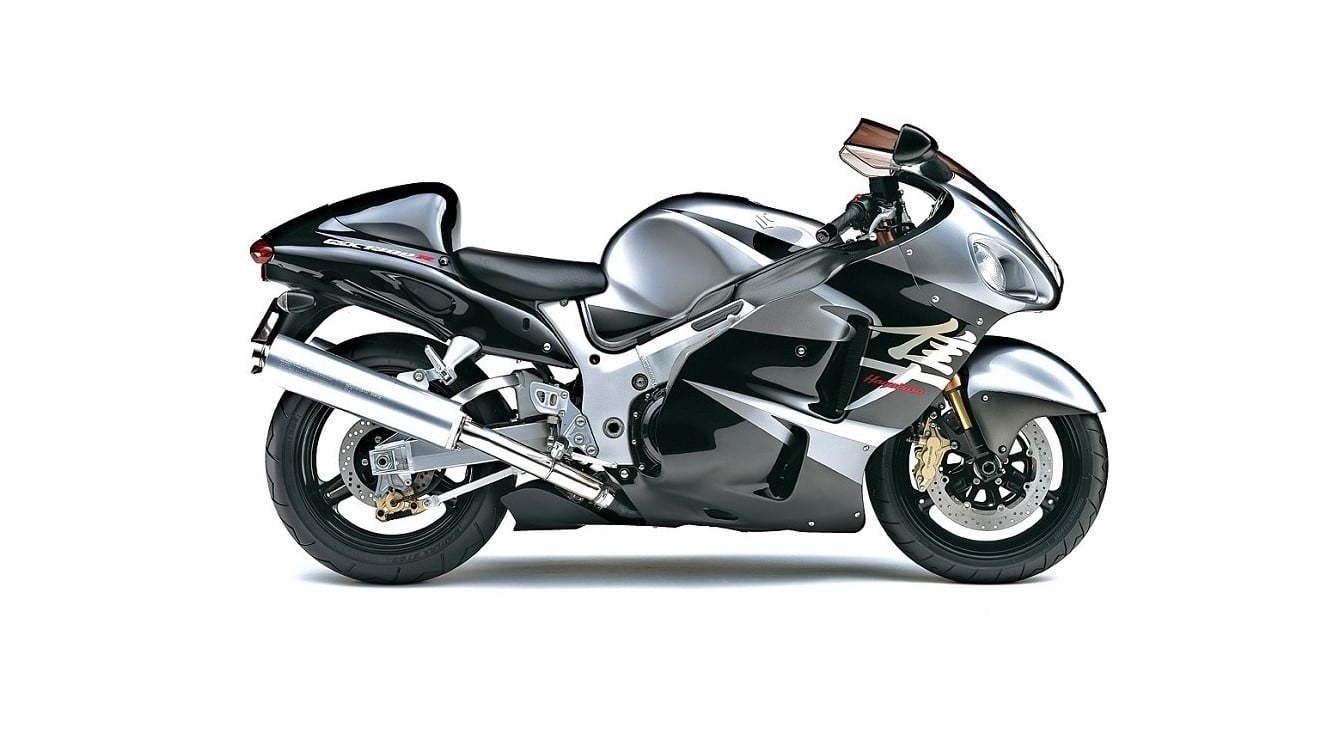
The OG Hayabusa is ballistic even today
We are all familiar with Suzuki’s legendary GSX-R1300R Hayabusa, the motorcycle that arguably created the hyperbike class we know and love today.
The Hayabusa was a direct response to Honda’s CBR1100XX Super Blackbird and Kawasaki’s ZZR1100, two machines that had traded blows in the pursuit of the top-speed crown in the late 1990s.
With class-leading aerodynamic bodywork and a 1,298 cc engine producing a claimed 173 horsepower at the crank, the Hayabusa set a new standard.
For a hyperbike, it was also relatively light at 215 kg dry. This undercut the Blackbird’s 223 kg weight by 8 kg while delivering 9 horsepower more than Honda claimed.
When measured at the rear wheel, the difference was even greater. The CBR1100XX lost more than the typical 12% through the drivetrain, closer to 15%, making the Hayabusa’s advantage on the road and strip even larger.
The moment the motorcycle press took the bike to the road and the drag strip, it became clear that the Hayabusa was the new fastest production motorcycle in the world.“Hayabusa” means peregrine falcon in Japanese – a bird of prey famous for its incredible dive speeds when hunting.
In a steep dive, the falcon can reach 180 to 202 mph, making it the fastest bird on the planet.
Suzuki chose the name because one of the falcon’s natural prey is the blackbird. This was a symbolic way of declaring the designers’ intent to unseat the Honda CBR1100XX Super Blackbird as the world’s fastest production motorcycle.
Depending on the magazine, reported top speeds for the Hayabusa ranged from 180 to 200 mph, so take your pick.
For the most part, unrestricted models sat somewhere in the middle, around 10 mph faster than the Honda Blackbird and Kawasaki ZZR1100 on average.
The first-generation Hayabusa was powered by a 1,299 cc liquid-cooled inline-four engine with sixteen valves and double overhead cams.
Despite being the most powerful production motorcycle engine of its time, its design was not particularly revolutionary.
The engine’s DNA had existed for years in the GSX-R1100, whose final version displaced 1,127 cc.
In many ways, the 1,299 cc Hayabusa engine can be seen as an updated, larger-capacity, and more powerful evolution of the legendary GSX-R1100 motor.
Suzuki claimed a record-setting 173 horsepower at the crankshaft, thanks largely to it being the biggest-capacity engine ever fitted to a sportbike at the time.
It also featured a ram-air system that delivered additional power at high speeds, although the exact gain was never officially disclosed or accurately measured.
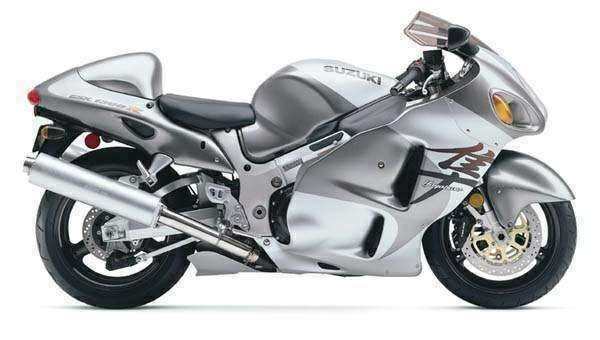
The Hayabusa easily dislodged the Blackbird from the top spot, but Suzuki was not left unchallenged for long.
Kawasaki was clearly unhappy that its ageing ZZR1100 had been pushed into third place in the emerging speed war between three of the big four Japanese manufacturers.
Introduced in 2000 and arguably faster, Kawasaki’s more powerful ZX-12R turned the hyperbike class into a contest between just two machines.
At the time, the fastest production car was the McLaren F1 at 241 mph, a car far beyond the reach of most people. Even cars capable of reaching or exceeding 180 mph were very expensive and inaccessible to the average buyer.
As the speed war between Suzuki and Kawasaki escalated, it became obvious to everyone that a 190-200 mph motorcycle could be bought for the price of an economy car
Rumours began to circulate that EU authorities were preparing to introduce speed or power limits. Before any government could rush through restrictive legislation, the motorcycle manufacturers quietly reached an agreement to electronically limit the top speed of their fastest models.
That limit was set at an arbitrary 186 mph (300 km/h), a figure that could not be exceeded.
This informal understanding, often called the gentlemen’s agreement, did not fully take effect until 2000 and is still honoured by manufacturers to this day.

Suzuki GSX1300R Hayabusa Power
The Hayabusa produced 158 horsepower at the wheels, not including the ram-air effect.
That was roughly 20 hp more than its nearest rivals, the Blackbird and the ZZR1100.
By today’s standards, 158 hp at the wheels may seem average, but at the time, this figure was unheard of for a stock motorcycle. It was delivered in the grunty, effortless way that only a 1,300 cc engine could manage.
The engine is smooth and flexible, producing more power and torque throughout the rev range than any of its rivals at the time.
In-gear roll-on acceleration was among the best in the class and easily beat the Kawasaki ZZR1100 and Honda CBR1100XX Super Blackbird.
Yamaha’s newly introduced 1998 R1 was the only motorcycle that could match the Hayabusa’s in-gear grunt, but it ultimately lost out as speeds climbed higher.
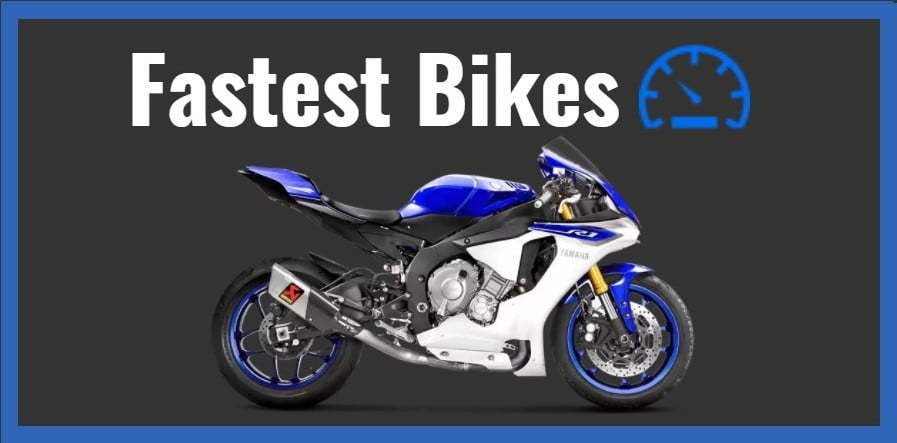
Despite the monster engine and its status as the most powerful production motorcycle of the era, the Hayabusa did not feel dramatically quicker in the lower gears than an R1 or ZX-9R of the time.
Those bikes had 20-30 hp less at the wheels but were significantly lighter.
The extra 30-40 kg that the Hayabusa carried may have made it feel a little less urgent off the line, but in reality, it wasn’t slower. The added weight actually made the Suzuki more stable and well-mannered under hard acceleration in the lower gears.
In contrast, the litre bikes were more nervous and prone to wheelies or violent bar flapping, which often made them feel faster than they actually were.

Suzuki Hayabusa in-gear acceleration
From a standstill, the Hayabusa was surprisingly easy to launch for such a big bike, thanks to its slick Suzuki gearbox and progressive clutch.
In the right hands, the Hayabusa can consistently run the quarter-mile in under 10 seconds. At the time, this was a benchmark that only a couple of stock motorcycles had unofficially achieved, and those times were often one-offs that were difficult to repeat.
Being lighter and making around 20 horsepower more at the wheels than Honda’s Super Blackbird gave the Hayabusa a clear advantage.
Its main rival in straight-line speed was actually the 1998/99 Yamaha YZF-R1.
The R1 was more accelerative than both the Blackbird and the ZZR1100. It only lost out to them at the very top end by a few mph, due to its worse aerodynamics and small fairing.
While the Hayabusa had the edge over the R1 at higher speeds, the R1’s 150 hp and 177 kg package made it hugely accelerative in any gear and at almost any speed.
The Hayabusa would only really pull away from the R1 above 140 mph, and then it would disappear into the distance.
The Gen 1 Suzuki GXS1300R Hayabusa can accelerate from 0-300 km/h in 26 seconds.
Fast Bikes magazine was the first to nickname the Hayabusa the “Highwayabusa” for obvious reasons.
The Hayabusa consistently delivered the best times at the drag strip compared to any other machine of its era.
Our test Hayabusa was a strong example and did not disappoint, running the quarter mile in 9.98 seconds with a terminal speed of 145 mph.
It achieved 0-60 mph in 2.75 seconds before relentlessly pulling away to complete 0-180 mph in 20.88 seconds.
This time is slightly quicker than that of the similarly powerful but much lighter Suzuki K5 GSX-R1000. The difference comes down to the Hayabusa’s excellent aerodynamics, which come into their own at very high speeds.
The Hayabusa was particularly impressive above 140 mph, where its strong power and class-leading aerodynamics allowed it to gap and pull away from rivals.
On the quarter mile, the Hayabusa can still match or beat many of today’s litre bikes that produce more peak horsepower and weigh significantly less.
This is thanks to its generous weight and long wheelbase, which make the power easier to deploy for consistent launches.
While the Suzuki Hayabusa remains hugely strong above 140 mph, it is convincingly left behind by the latest 180-200 horsepower superbikes.
For example, the Gen 1 Hayabusa takes 11.6 seconds to accelerate from 140-180 mph, which falls short of the 2015 Yamaha R1’s time of around 8 seconds.
As much as we love the original Hayabusa and still regard it as almost unbeatable in many ways, modern litre bikes easily pull away from it once speeds get really high.
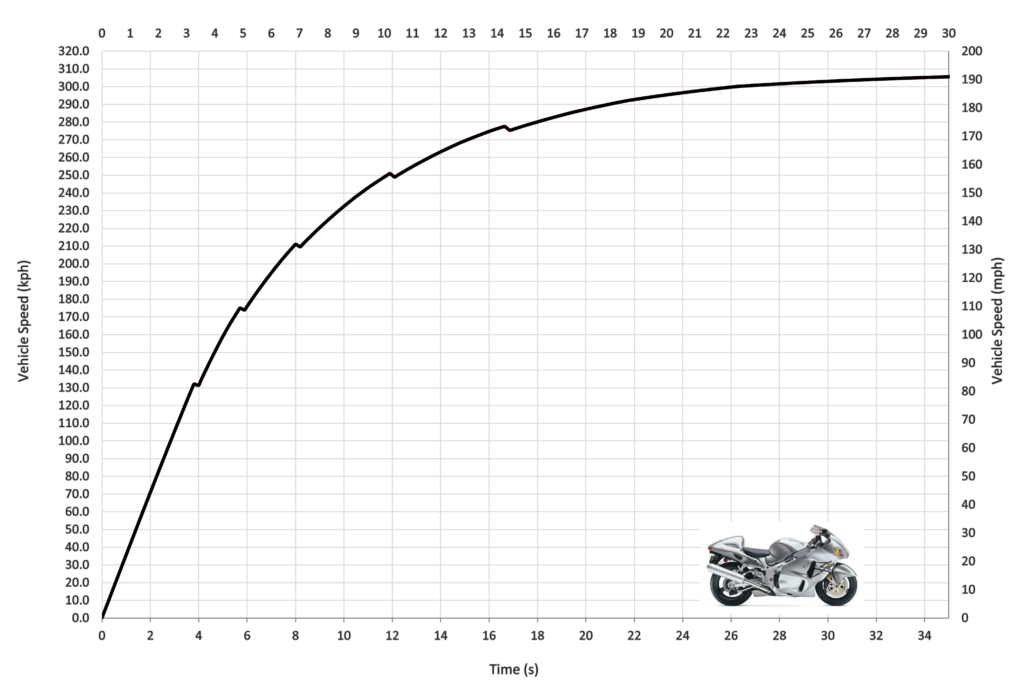
Suzuki Hayabusa Top Speed is 190.77 mph
Top speeds for the unrestricted (pre-gentlemen’s agreement) Suzuki Hayabusa remain a contentious subject.
Unofficial figures have ranged from under 180 mph to as high as 200 mph. Of course, different atmospheric conditions, small variations between individual bikes, and riders of different sizes all play a role in the numbers recorded.
Some magazine testers were known to remove the mirrors to squeeze out an extra few mph from the Hayabusa.
For the sake of argument, we can safely say that a stock unrestricted Hayabusa is a 190 mph-plus motorcycle.
Our test bike achieved an impressive top speed of 190.77 mph.
Most runways are around two miles long, so a few extra mph could certainly be gained at a place like Nardo or on a dead-straight, empty highway in the early hours.
In the age of 200-plus-horsepower motorcycles, the original Hayabusa still commands fear and respect more than twenty years after its launch.
New Hayabusa vs H2R HERE
| 99-07 Suzuki GSX-R1300 Acceleration | |
| Speed | Time |
| 0-10 mph | 0.40 |
| 0-20 mph | 0.88 |
| 0-30 mph | 1.30 |
| 0-40 mph | 1.81 |
| 0-50 mph | 2.31 |
| 0-60 mph | 2.75 |
| 0-70 mph | 3.25 |
| 0-80 mph | 3.74 |
| 0-90 mph | 4.40 |
| 0-100 mph | 5.01 |
| 0-110 mph | 5.98 |
| 0-120 mph | 6.83 |
| 0-130 mph | 7.81 |
| 0-140 mph | 9.33 |
| 0-150 mph | 10.78 |
| 0-160 mph | 13.02 |
| 0-170 mph | 15.62 |
| 0-180 mph | 20.89 |
| 0-190 mph | 35.70 |
| 0-200 mph | n/a |
| 60-120 mph | 4.06 |
| 100-160 mph | 10.25 |
| SS/QM | 9.98/145 mph |
| SS/KM | 18.24/176 mph |
| SS/Mile | 25.60/185 mph |
| Top Speed | 190.77 mph |