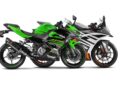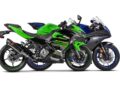
YZF-R3 vs Ninja 400
The entry-level sportsbike class is hugely competitive, with many capable options available at different engine sizes, configurations, and price points.
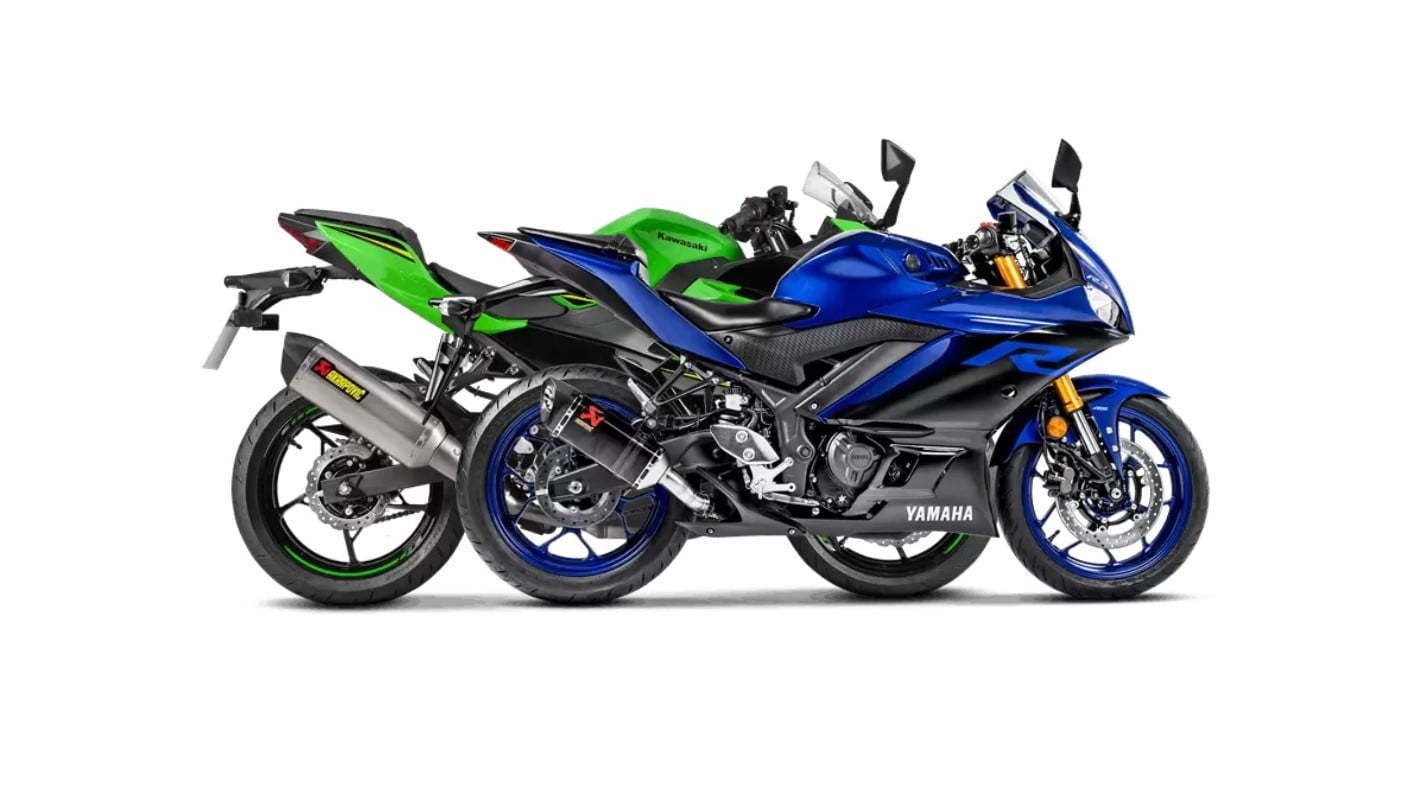
Two of the strongest contenders leading the pack are the Kawasaki Ninja 400 and the Yamaha YZF-R3.
Both motorcycles use similar sub-400 cc parallel-twin engines. They are lightweight and agile, with attractive sporty styling that clearly echoes their larger siblings.
If you are reading this and considering either bike, you probably want to know how they compare in terms of acceleration from 0-60 mph, 0-100 km/h, top speed, and more.
We have already tested the acceleration and top speed of both motorcycles independently (you can find those reviews linked here and here, along with a comparison against the YZF-R7.
In this article, we will compare the two directly, so let’s get straight into the performance comparison: Ninja 400 vs YZF-R3.

Ninja 400 vs YZF-R3 Power and Torque on the Dyno
– Ninja – YZF
The Kawasaki Ninja 400 enjoys a 78 cc engine capacity advantage over the Yamaha YZF-R3, and it certainly shows on the dyno, as seen in the graph comparison below.
The Kawasaki Ninja 400 features a 399 cc parallel-twin engine, producing a claimed 49 horsepower and 28 ft-lb of torque.
On the dyno, it delivers an impressive 44 horsepower and 26 ft-lb of torque at the rear wheel.
This is not far off Kawasaki’s crank figures, especially when you consider that we typically expect to lose between 10% and 12% through transmission losses.
By contrast, the Yamaha YZF-R3 has a smaller 321 cc parallel-twin engine, with claimed outputs of 41 horsepower and 22 ft-lb of torque.
On the dyno, it produces 37 horsepower and 20 ft-lb of torque at the rear wheel.
Both motorcycles deliver their power in a fairly similar and smooth manner. While the Kawasaki Ninja 400’s dyno curve does not look quite as smooth, with small peaks and troughs visible, these are barely noticeable on the road.
The Yamaha YZF-R3 has a strong little engine that produces good power. It is noticeably better than the Kawasaki Ninja 300 that came before the Ninja 400.
However, it simply cannot fully compensate for its 78 cc displacement disadvantage against the 400.
This becomes clear when you see that at 3,500 rpm, the Kawasaki Ninja 400 produces the same torque as the Yamaha YZF-R3 does at its peak.
In isolation, the YZF-R3 is a responsive engine with a decent spread of power and torque.
That said, to make real progress or keep up with equally quick or faster machinery, you need to keep the revs above 7,000 rpm, where it really comes alive and delivers its best performance.
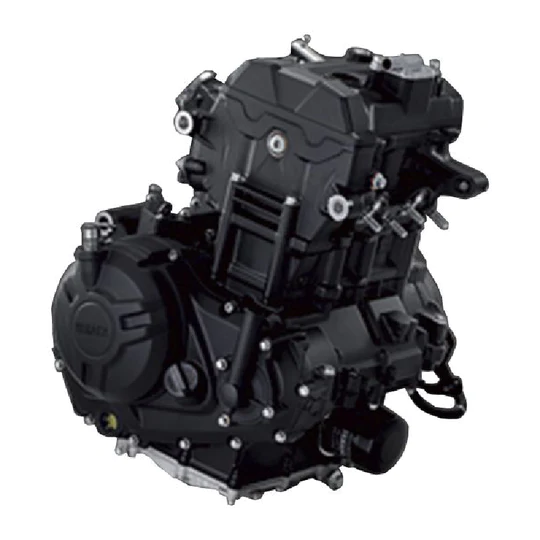
The Kawasaki Ninja 400’s engine, on the other hand, sits just below the imaginary border between small and big-bike performance.
It delivers a more substantial, big-bike feel when you twist the throttle and feels noticeably less frantic than the Yamaha.
Like the YZF-R3, the Ninja 400 has a clear sweet spot if you want to make rapid progress.
That sweet spot begins around 6,000 rpm — roughly 1,000 rpm lower than the Yamaha.
This means you can be lazier with your gear changes on the Kawasaki. It offers stronger drive and is far less rev-dependent as a result.
Both engines are extremely rewarding and love being worked hard through the gears. Ultimately, however, the Kawasaki Ninja 400 provides more usable performance thanks to its extra capacity.
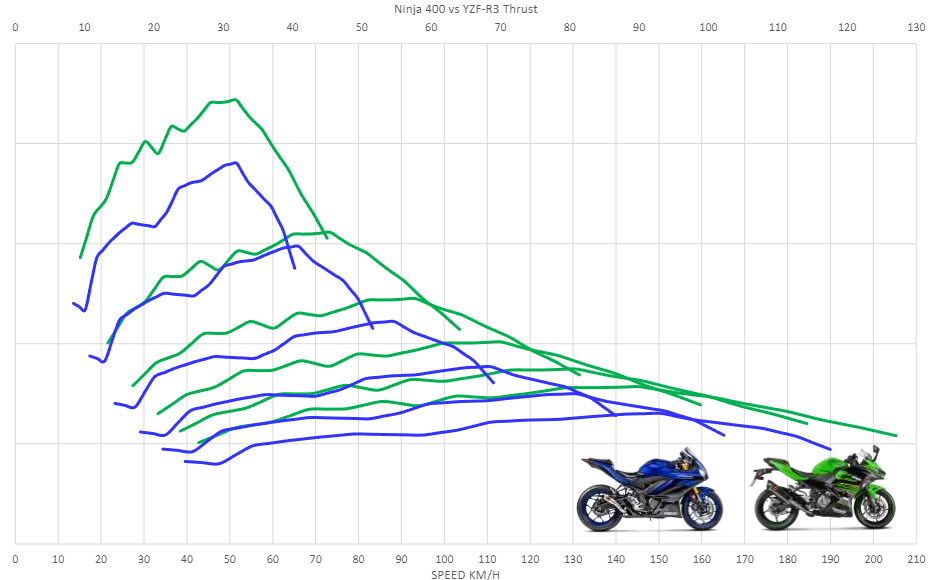
Ninja 400 vs YZF-R3 In-gear thrust/acceleration
– Ninja – YZF
In terms of engine performance, the Kawasaki Ninja 400’s 78 cc capacity advantage gives it a clear and significant edge.
The real question, however, is how this advantage translates through the gearbox and onto the road.
As the dyno graphs clearly show, the Kawasaki Ninja 400 produces more power and torque throughout the entire rev range.
This advantage carries over directly through the gears and is equally noticeable when riding on the road.
That said, it is not all bad news for the Yamaha YZF-R3. By running lower gearing, Yamaha has managed to close the performance gap slightly.
Unfortunately, the YZF-R3 is also a little heavier than the Ninja 400, which largely cancels out the benefit gained from the shorter gearing.
Comparing first gear highlights the difference dramatically.
The Kawasaki Ninja 400 delivers far stronger accelerative thrust across the entire speed range of first gear and also reaches a slightly higher top speed in that gear.
As a result, the Yamaha YZF-R3 has virtually no chance to compete in first gear.
Interestingly, the picture changes in second gear.
Here, the Kawasaki’s big power and torque advantage is much less pronounced.
Acceleration and thrust are remarkably similar between the two bikes, with the Ninja 400 holding only a small edge between 30–50 km/h and again from 50–60 km/h, before pulling ahead more clearly above 65 km/h.
Below 30 km/h in second gear, the Yamaha actually matches the Kawasaki for thrust and acceleration despite its lower power and torque outputs.
In third gear, the Kawasaki reasserts its advantage, although the Yamaha remains reasonably competitive and is not far behind.
From fourth gear onwards, however, the Kawasaki Ninja 400’s superior engine performance becomes much more obvious.
It delivers noticeably stronger acceleration and drive from any given speed when comparing gear for gear.
– Ninja – YZF
| Speed at 5000 rpm | YZF-R3 | Ninja 400 |
| Speed 1st Gear | 15.7 mph | 18.8 mph |
| Speed 2nd Gear | 21.6 mph | 26.8 mph |
| Speed 3rd Gear | 29.2 mph | 34.1 mph |
| Speed 4th Gear | 36.2 mph | 41.4 mph |
| Speed 5th Gear | 42.8 mph | 47.8 mph |
| Speed 6th Gear | 49.2 mph | 53.2 mph |
The Yamaha YZF-R3’s competitive performance in second gear shows that even when significantly down on power and torque, cleverly chosen lower gearing can help close the gap.
However, lower gearing comes with a trade-off: the top speed in that gear often suffers compared with a rival running taller gearing – unless the smaller engine can rev significantly higher to compensate, which the Yamaha YZF-R3 does not.
In general, higher-revving engines can run shorter gearing than similar-powered rivals that produce peak power at lower rpm.
As noted earlier, in the higher gears, the Kawasaki Ninja 400 is clearly dominant across all speeds.
For example, if both motorcycles were cruising at 70 mph (113 km/h) in sixth gear, the Kawasaki Ninja 400 would be turning at a relaxed 6,600 rpm, while the lower-geared Yamaha YZF-R3 would be spinning at a busier 7,200 rpm.
Still, despite the lower gearing of the Yamaha YZF-R3 if both were to look for a fast overtake the Kawasaki Ninja 400 would clear off.
To accelerate ahead of a hypothetical slow-moving car as quickly as the Kawasaki Ninja 400 could in sixth gear, the Yamaha YZF-R3 would be required to kick it down to 5th gear which would bring the revs up to 8100 rpm.
If we look at the thrust curve we will see that the Yamaha YZF-R3 in fifth roughly matches the Kawasaki Ninja 400 for thrust/acceleration in sixth.
But it’s only up until around 130 km/h when the Kawasaki Ninja 400 clears off once again.
On the road, pretty much the Yamaha YZF-R3 requires a gear lower (where possible) than the Kawasaki Ninja 400 to keep it in sight.
So be prepared to work that gearbox if you own a Yamaha YZF-R3 and your friend owns a Kawasaki Ninja 400.
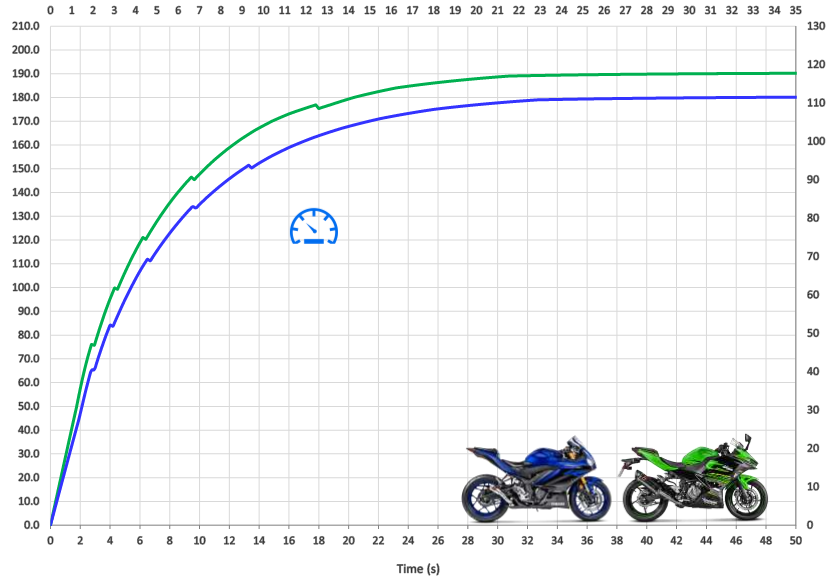
Ninja 400 vs YZF-R3 acceleration 0-60 and 0-100
– Ninja – YZF
We have tested both motorcycles previously, and they recorded very similar times with only minor variations between runs.
It comes as no surprise that the Kawasaki Ninja 400 is the faster-accelerating machine compared with the Yamaha YZF-R3.
The Ninja 400 produces more power and torque on the dyno, and it is also slightly lighter, giving it the edge in any same-gear roll-on situation.
Launching both bikes off the line is fairly straightforward, but for the quickest times, you need to be quite abrupt with the clutch rather than slipping it gently.
In our testing, the Kawasaki Ninja 400 achieved 0-60 mph in 4.07 seconds, slightly better than its previous best. It covers 0-100 km/h in 4.35 seconds.
By comparison, the Yamaha YZF-R3 is a full second slower, taking 5.17 seconds to reach 0-60 mph and 5.45 seconds for 0-100 km/h.
Unfortunately for the Yamaha, it requires an extra gear change to hit 60 mph or 100 km/h, which costs it valuable time. Quick, clutchless upshifts are definitely needed to minimise the deficit.

From 60 mph onwards, the Kawasaki Ninja 400 extends its advantage. It reaches 100 mph in 12.58 seconds – slightly slower than in our previous test.
The Yamaha YZF-R3 improved on its earlier result, hitting 100 mph in 16.80 seconds, but it remains some way behind the Kawasaki.
The 60–100 mph sprint through the gears takes the Ninja 400 just 8.5 seconds, while the Yamaha is around 3.1 seconds slower at 11.67 seconds.
In the quarter-mile test, the Kawasaki Ninja 400 stormed through in 13.02 seconds with a terminal speed of 101.2 mph.
That is a full second quicker than the Yamaha YZF-R3, which managed 14.00 seconds flat with a terminal speed of 94.9 mph.

The Kawasaki Ninja 400 maintains roughly a one-second lead to 60 mph and beats the Yamaha YZF-R3 by a similar margin in the quarter mile.
The Yamaha is convincingly beaten from a standstill and in any same-gear roll-on at the same speed, regardless of which gear you choose.
As a Yamaha YZF-R3 rider, your best chance against the Ninja 400 comes from a second-gear roll starting around 30 km/h.
From that speed up to about 70 km/h, you might stay only a bike length or two behind.
Beyond that point, however, the Kawasaki will pull away convincingly, all else being equal.
YZF-R3 vs Ninja 400 Top Speed
The Kawasaki Ninja 400 has a slightly larger frontal area than the Yamaha YZF-R3, but with an extra 7 hp, it easily wins the top-speed battle.
If you are of a petite build and able to tuck in tightly, you can expect to see a genuine 120 mph from the Ninja 400.
In our test, we recorded 118.3 mph.
A simple exhaust and tune can push the little Ninja to 125 mph, and with a favourable tailwind and a slight decline, 130 mph is even possible, very impressive for an entry-level 400 cc parallel-twin.
The Yamaha YZF-R3 performs well too, reaching 112.1 mph in our test.
With a good riding position, 115 mph is achievable, and an aftermarket exhaust plus tune could realistically see 120 mph.
That is also highly impressive from a 321 cc parallel-twin.
The fact that the Kawasaki Ninja 400 is faster from a standstill, in-gear, and at top speed should not put you off the Yamaha YZF-R3.
The little Yamaha is still quick and delivers an abundance of thrills. It is very much a baby R6/R1, making it an excellent choice if you are a Yamaha fan.
The same can be said for the Kawasaki Ninja 400 and its family heritage. It offers a very similar experience to the YZF-R3, but with a little extra performance if you want the faster bike.
Both are excellent little machines.
YZF-R3 vs Ninja 400 Acceleration
| Speed | YZF-R3 | Ninja 400 |
| Time | Time | |
| 0-10 mph | 0.68 | 0.56 |
| 0-20 mph | 1.37 | 1.13 |
| 0-30 mph | 2.05 | 1.69 |
| 0-40 mph | 2.04 | 2.23 |
| 0-50 mph | 3.76 | 3.17 |
| 0-60 mph | 5.17 | 4.07 |
| 0-70 mph | 6.83 | 4.56 |
| 0-80 mph | 8.74 | 5.46 |
| 0-90 mph | 11.79 | 9.25 |
| 0-100 mph | 16.80 | 12.58 |
| 0-110 mph | 28.793 | 18.98 |
| 60-100 mph | 11.67 | 8.50 |
| SS/QM | 14.00/94.9 mph | 13.02/101.2 mph |
| SS/KM | 26.909/109 mph | 25.226/115.5 mph |
| SS/Mile | 39.012/111.5 mph | 36.690/117.5 mph |
| Top Speed | 112.1 mph | 118.3 mph |