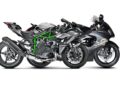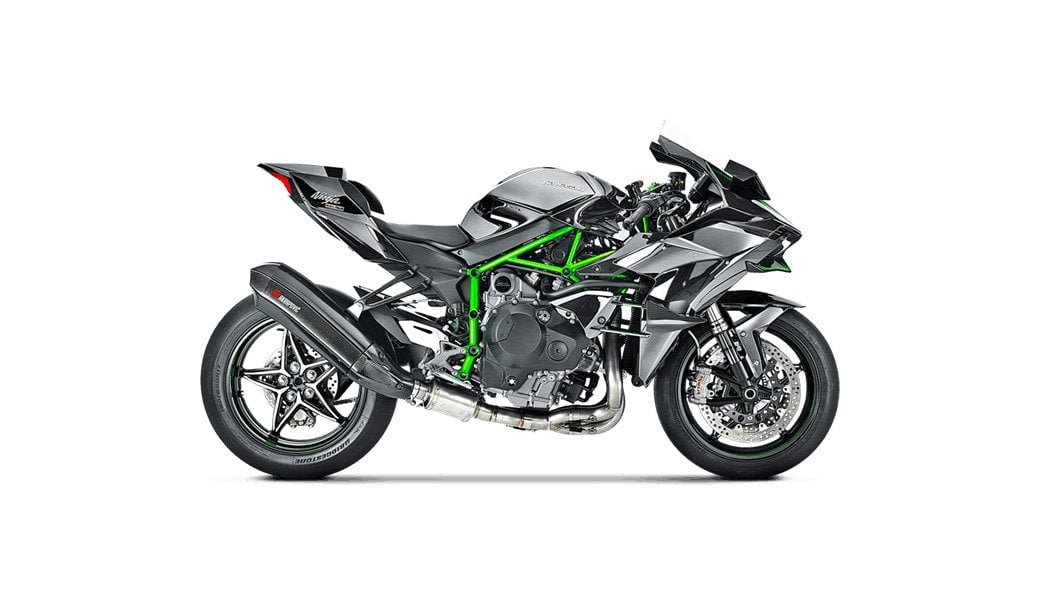
The H2R is still the fastest-accelerating Motorcycle in the world
Kawasaki H2R 0-200 mph in 16.83 seconds
The Kawasaki H2R is no stranger to the motoring world.Its launch in 2015 came as a big surprise.
Most of us thought the hyperbike top-speed war had ended when manufacturers agreed to limit motorcycles to 300 km/h.
From that point onward, not much radical happened in that segment, other than Kawasaki slightly one-upping Suzuki when they replaced the ZX-12R with the ZX-14R in 2006.
Then, in 2008, Suzuki revamped their legendary Hayabusa with a larger engine and a claimed 200 horsepower at the crank.
Still, both motorcycles were restricted to 300 km/h, so it became a question of who could reach that speed first.
Arguably, stock for stock, both variants of the ZX-14R probably held a slight edge outright, but that comparison is for another day.
Kawasaki, having a “slight” edge, was apparently not enough. Either way, Kawasaki went left-field and, with the full might and engineering prowess of Kawasaki Heavy Industries, unexpectedly gifted us the Kawasaki H2R.
What was truly shocking about the H2R was its crazy claimed power output of over 300 horsepower and the fact that it was a supercharged motorcycle — something that surprised everyone.
The last supercharged two-wheeler before it was, quite bizarrely, a French scooter. The Peugeot JetForce 125 Compressor, launched in 2003 (with production from around 2002–2009), was powered by a supercharged 125 cc four-stroke engine. It was said to deliver the performance of a typical 250 cc scooter and was the first factory supercharged two-wheeler since the 1930s.
Before that, the supercharged BMW Type 255 Kompressor – a 1930s supercharged boxer-twin race motorcycle – is a notable historical example.
Litre bikes do not need superchargers – they are already fast enough, you might say. But Kawasaki clearly had other ideas.
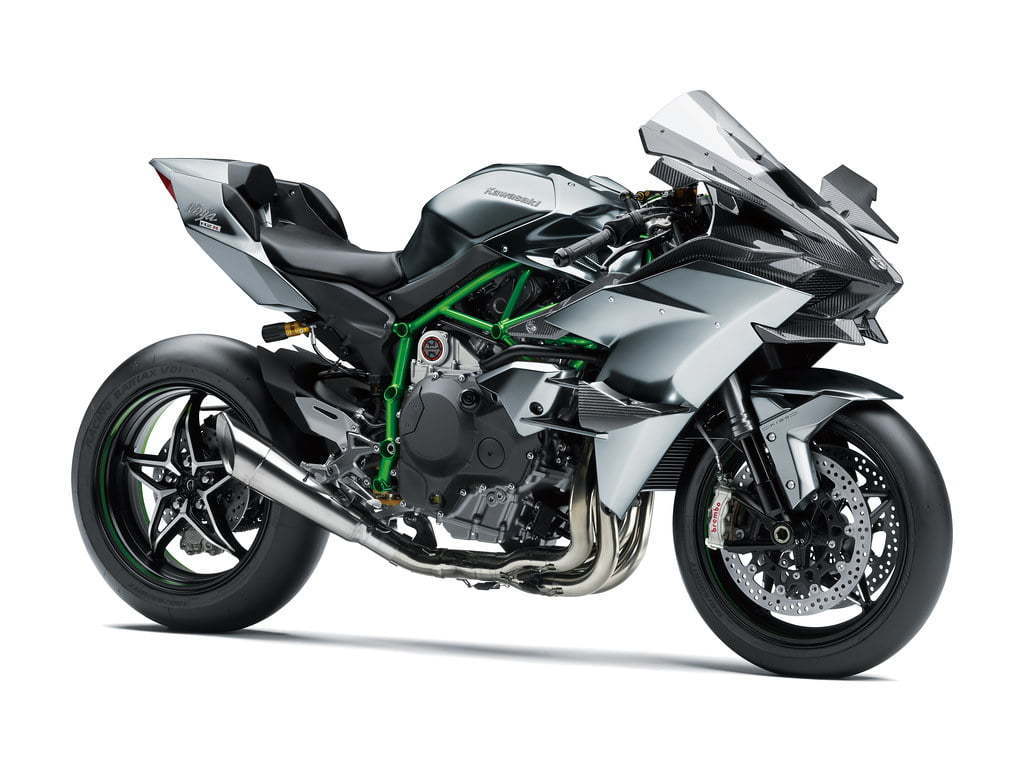
While the Kawasaki H2R is pretty much the fastest motorcycle you can buy, it is not officially classed as the fastest production motorcycle because it is not road-legal.
It would not be difficult in most markets to make an H2R road-legal simply by swapping in parts from the road-going version.
Kawasaki also produced a road-legal model with a claimed 200 hp at the crank, simply called the Kawasaki H2. The latest version is even more powerful, with a claimed 230 hp at the crank.
If you want H2R levels of power and madness legally on the road, it makes far more sense to buy a standard Kawasaki H2 for less than half the price and modify it to H2R specification rather than purchasing the H2R itself.
There are already plenty of highly modified H2s out there, many of which produce significantly more power than the H2R.
These bikes are often stretched and fitted with other performance upgrades, allowing them to accelerate much harder than a stock H2R, both from a standstill and in roll-on situations.
Here are some of the popular builds, all making close to or well over 300 horsepower at the wheels. Given a long enough stretch of tarmac, they are genuine 400 km/h (248 mph) motorcycles.
How fast is a Kawasaki H2R?
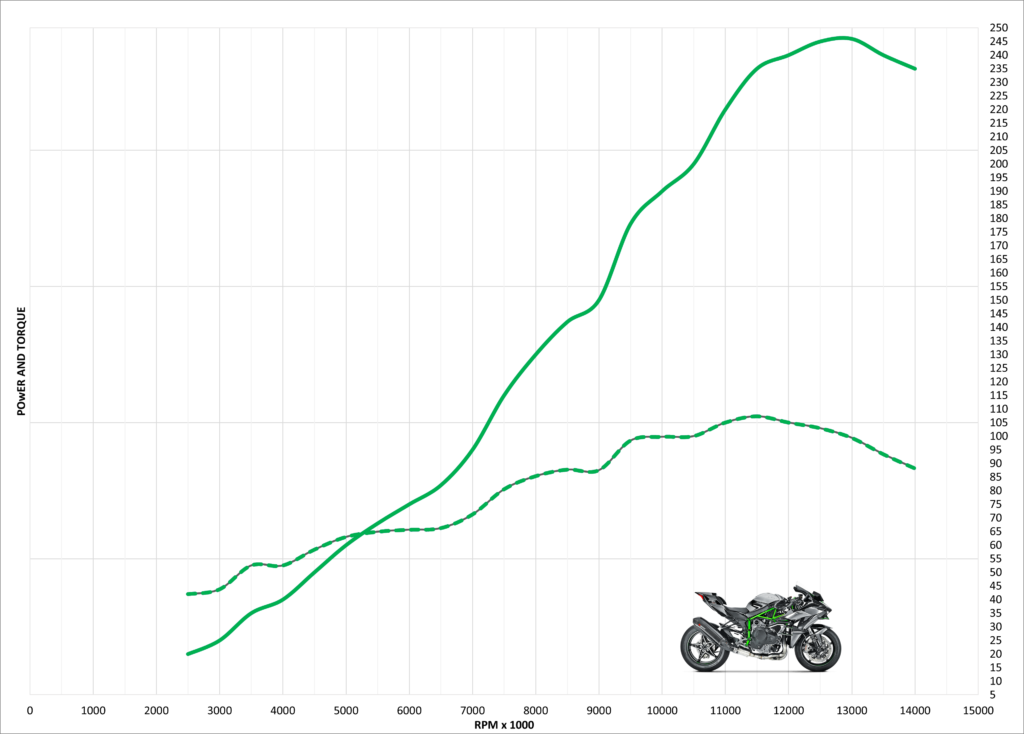
Kawasaki H2R Dyno Curve
Despite Kawasaki’s claims of 310 hp (and 326 hp with ram air) at the crank, the H2R typically produces between 230 and 240 horsepower at the wheels on a Dynojet dynamometer.
Sure, the H2R would likely make a little more power once on the move – perhaps another 10 hp at the wheels – but we cannot escape the fact that it delivers noticeably less than Kawasaki’s claimed figures.
The H2R produces significantly less rear-wheel power than we would expect based on those crank-horsepower claims.
Typically, a motorcycle engine loses around 10% of its power through transmission losses from crank to rear wheel.
This means a bike claiming 310–326 hp at the crank should produce roughly 280–290 hp at the rear wheel.
We simply do not see those kinds of numbers from the H2R.

There are varying opinions and conflicting data online about how fast a stock Kawasaki H2R actually is.
H2R fans often point to Kenan Sofuoglu’s 400 km/h record run across the Osman Gazi Bridge in his home country of Turkey. Here
That attempt was largely a PR exercise. The speed was taken only from the H2R’s speedometer, with no independent GPS or timing equipment used for an official figure.
Motorcycle speedometers are notoriously inaccurate and can over-read by as much as 12%. This is often a deliberate design choice rather than a flaw.
Besides, it makes for a much better story when telling your friends at the motorcycle meet.
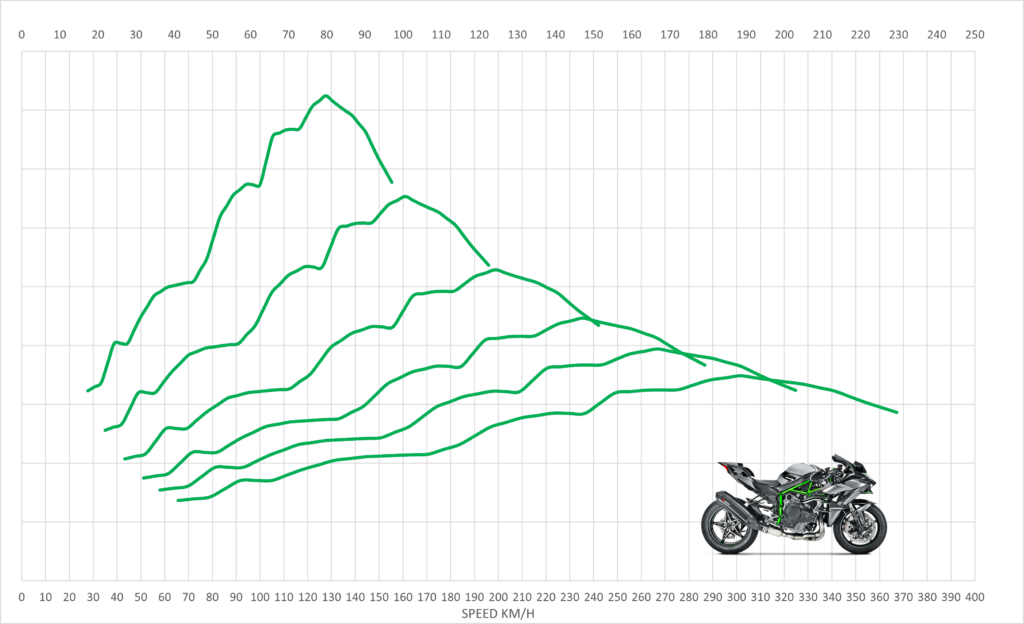
Kawasaki H2R in-gear thrust curve
While I cannot say for certain, given that it was a PR exercise, it would not be unreasonable to assume that the particular H2R used was fettled and more powerful than a completely stock bike.
A stock Kawasaki H2R is not even geared to reach a genuine 400 km/h.
The H2R typically makes its peak power of 230–240 hp at 12,500 rpm.
In sixth gear, that equates to a real-world speed of around 327 km/h (a little over 200 mph).
On a static dyno, the H2R holds its power until roughly 13,000 rpm before it starts to tail off.
At speed, it may hold power longer thanks to the ram-air effect, but this is impossible to replicate accurately on a dyno because we cannot create a 200 mph headwind.
On stock gearing, an H2R would need to rev and pull all the way to 15,250 rpm to reach the magic 400 km/h mark, but the engine simply does not rev that high
Even in sixth gear, the H2R can barely pull beyond 14,000 rpm, despite the optimistic tachometer showing higher numbers.
At 14,000 rpm in top gear on stock gearing, the bike would theoretically be doing 367 km/h (228.2 mph).
Unfortunately, a stock H2R does not have enough power or aerodynamic efficiency to actually reach 14,000 rpm in sixth gear.
| Speed at 14,000 rpm | Kawasaki H2R |
| Speed 1st Gear | 96.5 mph |
| Speed 2nd Gear | 121.7 mph |
| Speed 3rd Gear | 150.4 mph |
| Speed 4th Gear | 178.1 mph |
| Speed 5th Gear | 201.8 mph |
| Speed 6th Gear | 228.2 mph |
Kevin Cameron of Cycle World magazine once suggested that the H2R, with the right gearing, could theoretically hit 400 km/h or more.
With all due respect to him, he was wrong – though he was likely basing that opinion on Kawasaki’s claimed 326 hp at the crank with ram air.
If that figure were accurate, it would translate to roughly 290 hp at the wheels after the typical 10% transmission losses.
A 290 hp motorcycle, even one with the H2R’s less-than-slippery aerodynamics, could plausibly muscle its way to 400 km/h. However, that does not apply to a real-world H2R producing only 230–240 hp at the wheels.
Cameron was technically correct in saying it was “theoretically possible,” but only if the H2R actually produced the power he was assuming. In reality, it falls well short of those figures.
The best-case scenario for a stock H2R is around 350 km/h. More typically, it will reach somewhere between
Speeds in gear at 5000rpm
| Speed at 5000 rpm | Kawasaki H2R |
| Speed 1st Gear | 34.5 mph |
| Speed 2nd Gear | 43.5 mph |
| Speed 3rd Gear | 53.7 mph |
| Speed 4th Gear | 63.6 mph |
| Speed 5th Gear | 72.1 mph |
| Speed 6th Gear | 81.5 mph |
Kawasaki H2R Acceleration Review
Even though the H2R makes less peak power than Kawasaki claims, it remains a ballistic motorcycle that no other production bike can touch.
With 230–240 hp at the wheels and a short wheelbase, the H2R behaves like every current superbike: Only worse! You cannot begin to put all the power down until you are at least 100 mph (160 km/h) plus.
On the H2R, you really need to be above 125 mph (200 km/h) and in third or fourth gear before the bike settles.
Even then, the front end still wants to lift, or the rear tyre wants to spin.
Off the line, the H2R is not dramatically faster than a typical litre bike. With plenty of fluffed launches and wheelies, it can run 0-60 mph in 2.93 seconds and 0-100 mph in 5.12 seconds.
These numbers sit comfortably in the same ballpark as most modern litre and litre-plus superbikes.
Wheelies and traction control only hinder the H2R’s progress. The best results come with everything switched off and a skilful hand on the clutch and throttle.
You would be foolish to expect to win every traffic-light grand prix on this bike. The H2R is extremely difficult to launch cleanly from a standstill.
Of course, the only traffic-light GPs you would actually participate in would be on a track or drag strip, as the H2R is not road-legal.
What the H2R really needs is a long highway or runway to show its true dominance over other motorcycles.
Despite the difficulty and delicacy required to launch it properly, the H2R can still dip into the sub-10-second quarter-mile bracket. Our best run was a very impressive 9.64 seconds at 164 mph. Most of my other runs were a mess of wheelies and mid-tens at 150-plus mph.
Nine times out of ten, I could beat myself on an H2R with an R6.From the quarter mile onward, the H2R storms to 0-180 mph in 11.77 seconds and 0-200 mph in 16.83 seconds.
The standard Dragy benchmark of 60-130 mph is dispatched in a flat four seconds. That is an excellent time by any standard, but it would be significantly quicker without having to manage violent wheelies in fourth gear and wheelspin.
With a stretched swingarm, lowered stance and proper launch control, I would guess it could run 60-130 mph in a touch under three seconds and the quarter mile in the flat 8s at over 170 mph.
The Kawasaki H2R can accelerate from 0-300 km/h in 12.50 seconds.
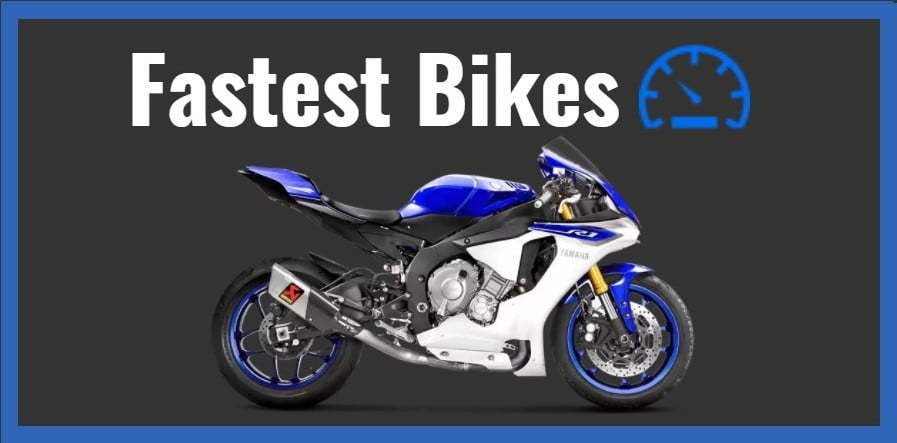
For comparison, even the fastest litre motorcycles, such as the Yamaha R1, will reach 180 mph from a standing start in around 15–22 seconds, depending on the specific bike and conditions.
Most modern litre bikes can also run just under 10 seconds in the quarter mile, albeit with terminal speeds 15–20 mph lower than the Kawasaki H2R.
Here is an S1000RR for reference – a motorcycle that needs no introduction.
Litre bikes generally run out of steam a little after 180 mph, while the H2R continues pulling all the way to a top speed of 212 mph (342 km/h).
That is still a long way from the mythical 400 km/h figure, which was never realistic in the first place.
The H2R will go down in history as one of the most bonkers bikes ever sold to the public.
There is nothing two-wheeled – and very little four-wheeled – that you can buy from a dealership that is faster than an H2R.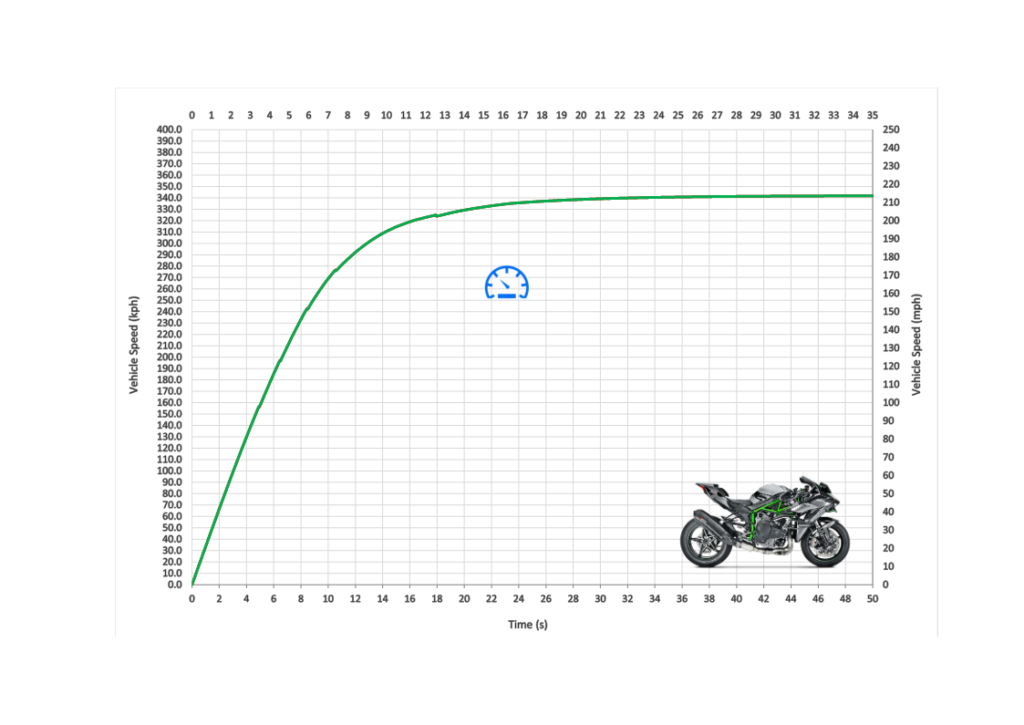 Kawasaki H2R Acceleration Review
| 2015 Kawasaki Acceleration / Top Speed | |
| Speed | Time |
| 0-10 mph | 0.48 |
| 0-20 mph | 0.96 |
| 0-30 mph | 1.44 |
| 0-40 mph | 1.93 |
| 0-50 mph | 2.43 |
| 0-60 mph | 2.93 |
| 0-70 mph | 3.44 |
| 0-80 mph | 3.97 |
| 0-90 mph | 4.50 |
| 0-100 mph | 5.12 |
| 0-110 mph | 5.70 |
| 0-120 mph | 6.30 |
| 0-130 mph | 6.99 |
| 0-140 mph | 7.66 |
| 0-150 mph | 8.38 |
| 0-160 mph | 9.31 |
| 0-170 mph | 10.31 |
| 0-180 mph | 11.77 |
| 0-190 mph | 13.57 |
| 0-200 mph | 16.83 |
| 60-130 mph | 4.01 |
| 100-160 mph | 4.18 |
| SS/QM | 9.76/164 mph |
| SS/KM | 17.01/201mph |
| SS/Mile | 23.508/208 mph |
| Top Speed | 212 mph |