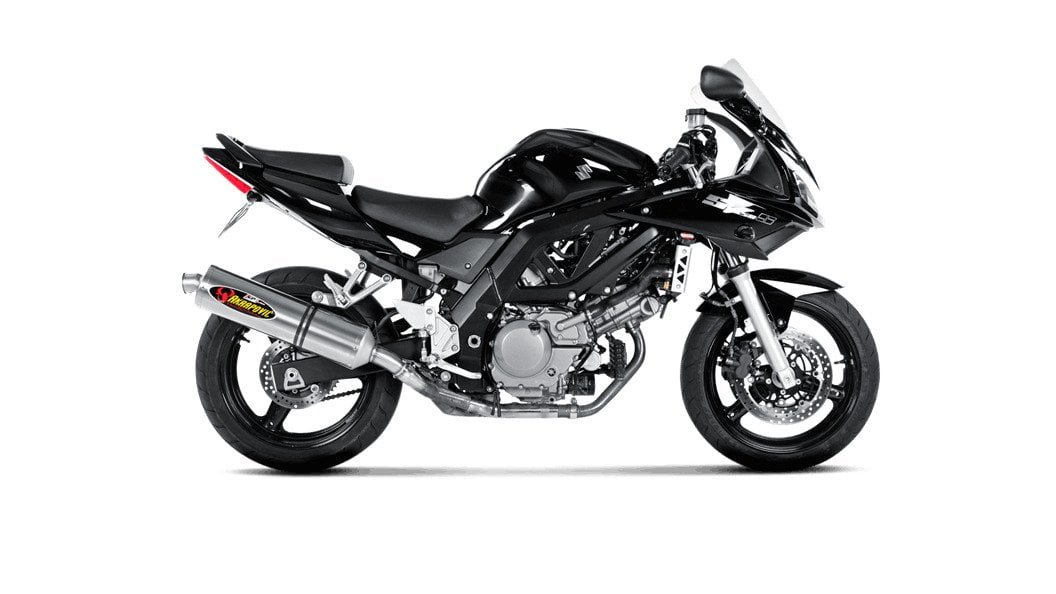
SV650 0-60 mph in 3.39 seconds 0-100 km/h in 3.50 seconds
The Suzuki SV650 arrived in 1999. In many ways, it was a smaller, friendlier version of the wild Suzuki TL1000S.
It borrowed the same 90-degree L-twin engine configuration and much of the styling, but with softer, more approachable looks.
I doubt Suzuki fully realised just how massively successful the SV650 would become, or maybe they did. Either way, they hit the perfect sweet spot of looks, sound, performance, user-friendliness, and, crucially, price.
It was a winning formula that has been copied many times since, most notably by Yamaha’s MT-07.
You could argue the MT-07 is the spiritual successor to the SV650, even though it comes from a rival brand and the SV650 is still in production today.
So what made the SV650 so successful? It was simple: it looked good, went well, sounded great, and was cheap and reliable.
Powered by a 649 cc 90-degree L-twin engine producing a claimed 72 hp, the SV650 was cradled in a distinctive aluminium trellis frame similar to its bigger sister, the TL1000S.
At just 169 kg dry, it made excellent use of that power.
The engine delivered an impressive (and class-leading at the time) 47.2 ft/lb of torque with a strong spread across the rev range.
This made it responsive in any gear and any situation.
Like the TL1000S, there was a nice kick in power and torque as the tachometer swept past 6,000 rpm, giving the engine a really exciting and fun character.
It didn’t have the peak horsepower of some four-cylinder rivals such as the Yamaha Fazer 600 or Honda Hornet 600, but its delivery was meatier and far more responsive in real-world riding.
The SV650 wasn’t perfect. It was often criticised for its soft, user-friendly suspension, but this was easily fixed with a fork re-valve and springs plus a stiffer rear shock.
The SV650 even had its own race series called Mini-Twins, which is still active today.
The first-generation SV650 (1999–2002) remains the most loved and popular version in many riders’ hearts. It was offered in both faired and naked versions.
From 2003 to 2017 came a heavily revised SV650 that was almost all new, with a new frame, sharper styling, and fuel injection.
While technically a more refined bike and still very popular, it never quite recaptured the same magic as the original for many fans.
Between 2009 and 2016, Suzuki also offered the Gladius, which looked like an attempt to recapture some of that original spark. It was a good motorcycle, but it never took off like the first SV650.
By then, learner laws had changed in many markets, and there were many strong new competitors offering similar appeal.
In 2017, Suzuki launched an all-new SV650. In styling terms, it took the best elements that made the original so successful and updated them for the 21st century. Suzuki also offered an “X” version with a factory café-racer look.
It is a very nice bike, but it now competes in a crowded market full of excellent alternatives.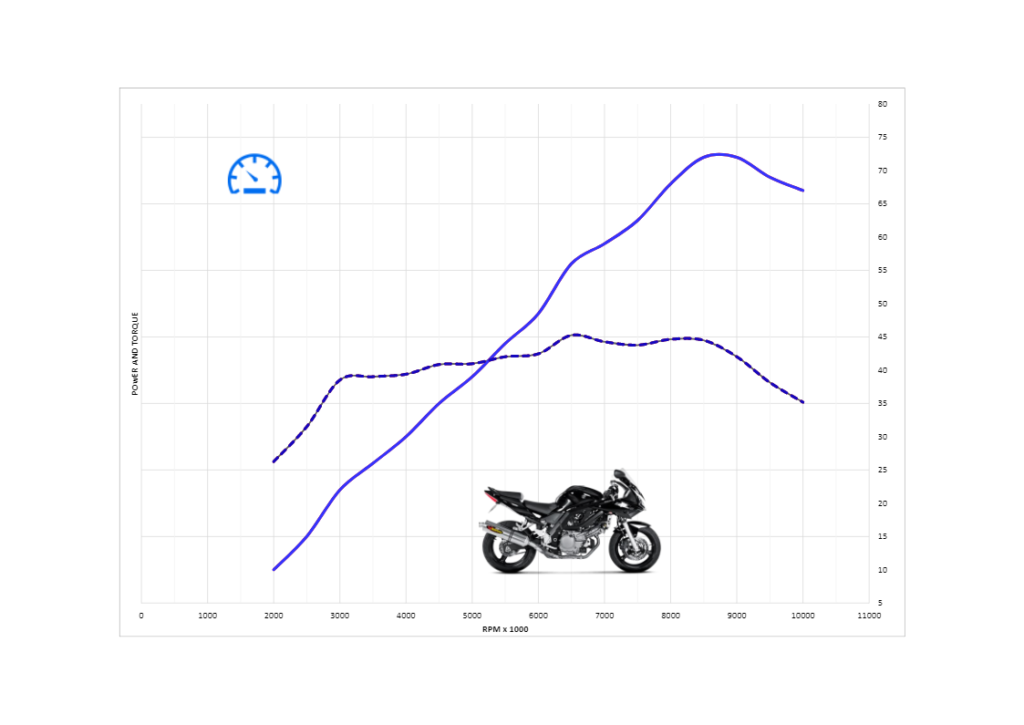
Suzuki SV650 Power and Torque
72 horsepower might not sound like a lot, but the SV650 makes excellent use of it thanks to its relatively light weight and well-chosen gearing.
Torque is a very respectable 45 ft/lb, peaking at 6,000 rpm and holding strong until around 8,500 rpm before tailing off – typical behaviour for most L-twins.
At the rear wheel, SV650s usually produce between 65 and 70+ hp. This particular bike is a strong example.
Like most L-twins of this capacity, the SV650 feels a little chuggy below 3,000 rpm. From there onward, it delivers a nice, linear, and fairly flat torque curve that builds progressively until 6,000 rpm.
At that point, you get a pleasant surge in acceleration as it comes on cam. In first gear, this is where the front wheel lifts cleanly under power, although an aggressive throttle snap can bring the wheel up even earlier.
This is especially true on the naked version, which runs slightly shorter gearing than the faired model.
The SV650’s engine performance is most closely matched with the Yamaha MT-07.
Arguably, the MT-07 needs fewer revs to get moving, while the SV650 rewards you more when you work the gearbox and take the engine right out to 10,000 rpm and beyond.
The sound is also excellent, especially once the stock muffler is replaced with a slip-on or full exhaust system.
In most real-world situations, the SV650 delivers smooth, accessible power and acceleration with just the right amount of spice.
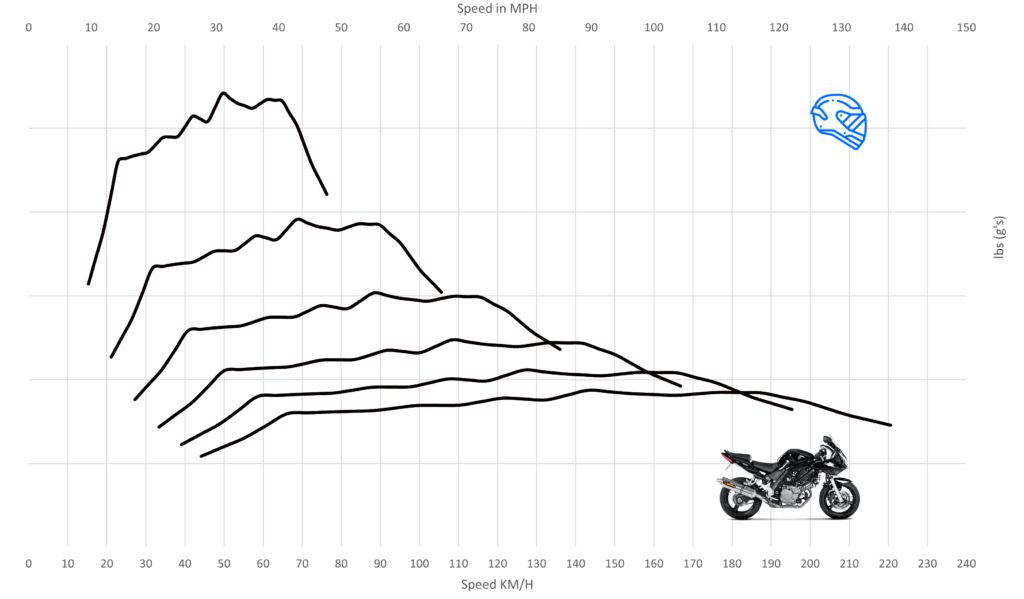
Suzuki SV650 In gear acceleration
The Suzuki SV650 is a proper little sleeper.
Having spent plenty of time on SV650s over the years – and with a good friend owning one, I’m well aware of how rapid these bikes can be in the right hands, despite their relatively modest power.
It is often said that you can only effectively use around 70-80 hp when launching a stock-height, stock-wheelbase motorcycle.
This is largely true. On litre bikes, you cannot simply dump the clutch and pin the throttle with all 180+ hp; it just isn’t possible.
The clutch has to be used to modulate and transfer as much power as possible to the tyre without looping or spinning the rear.
What makes the SV650 so effective is that it produces almost the perfect amount of power (around 70 hp) for launching from a standstill.
You still cannot rev it to 10,000 rpm and dump the clutch, but with its good clutch, light weight, and ideal power level, it is one of the easiest bikes to get nearly all of that 70 hp down effectively for rapid forward motion.
This makes SV650s excellent traffic-light grand prix bikes.I have watched my friend on his SV650 smoke just about anything off the line.
It didn’t matter what bike he lined up against; he won most of the time.
Sure, many larger motorcycles have more outright capability, but they require far more skill to launch cleanly because of their massive power.
On the 70 hp SV650, a skilled rider can be far more consistent.
Your results may vary, but our test SV650 sprinted to 60 mph in 3.39 seconds. It does require a gear change into second, which costs a few tenths. It reaches 0-100 mph in a very impressive 8.14 seconds, the same as the MT-07.
The quarter mile is covered in 11.82 seconds at 115 mph. That is a very strong performance and close to the optimum for this bike.
Most average-weight, competent riders will run low 12-second times at around 110 mph terminal speed.
The SV650 manages 0-200 km/h in 16.40 seconds.
If you hold on long enough, the Suzuki SV650 will reach a genuine top speed of 134.2 mph, but only with a good tuck and if you are small enough not to hurt the aerodynamics.
Top speed comes up in around 35 seconds, though in realistic riding, you will mostly see a flat 130 mph.
There is plenty of power to keep up with bigger, faster bikes at sensible speeds.
Below 100 mph, the SV650 stays easily in touch.
On big, fast highway sweepers, you will eventually struggle against larger bikes, but that is true of any middleweight.
The SV650’s flexible engine means there is rarely any need to drop down to 4th or 5th gear for highway overtakes. You can often stay in top gear, open the throttle, and surge past effortlessly.
If you want more performance, the SV650 responds extremely well to tuning.
This is partly why the model remains so popular; there are many race series, a huge selection of tuning parts, active forums, and plenty of experienced people who know how to get the most from these bikes.
For relatively little money, you can easily push an SV650 to 80+ hp at the wheel. Big-bore kits are also available that deliver even more significant gains in power and torque.
If you are looking for your first motorcycle and want something cheap to buy and maintain, fast, fun, reliable, and with a great sound, you really cannot go wrong with an SV650.
You can also save a lot of money by buying a used older SV rather than a newer alternative, such as the MT-07.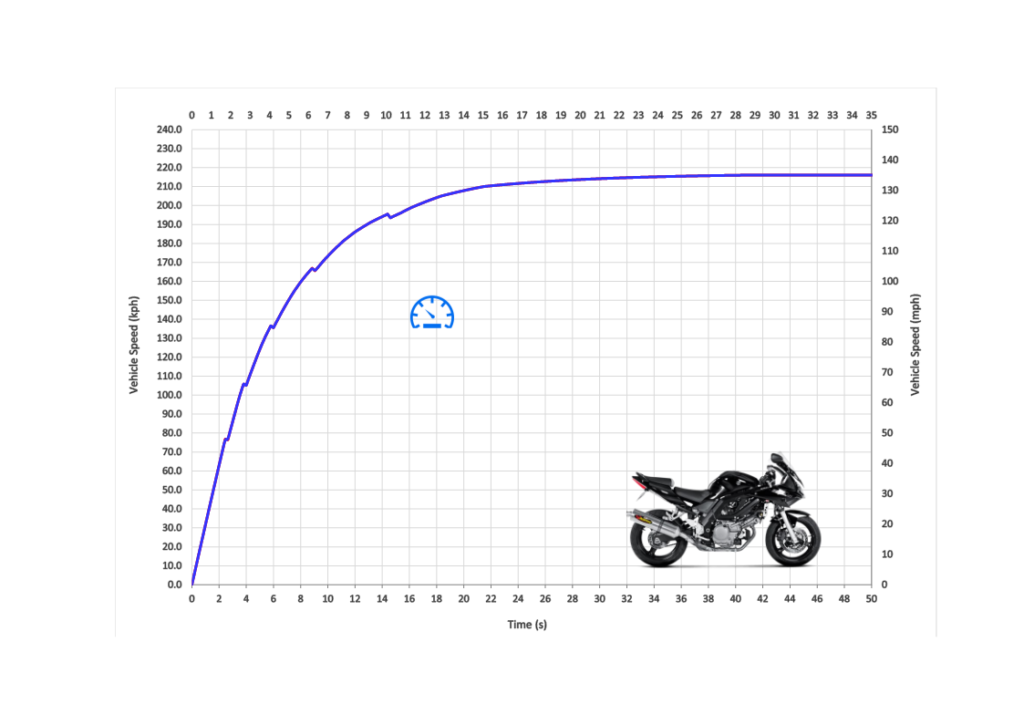
Suzuki SV650 Acceleration and Top Speed
| Suzuki SV650 Acceleration | |
| Speed | Time |
| 0-10 mph | 0.50 |
| 0-20 mph | 1..05 |
| 0-30 mph | 1.52 |
| 0-40 mph | 2.04 |
| 0-50 mph | 2.79 |
| 0-60 mph | 3.39 |
| 0-70 mph | 4.38 |
| 0-80 mph | 5.24 |
| 0-90 mph | 6.69 |
| 0-100 mph | 8.14 |
| 0-110 mph | 10.50 |
| 0-120 mph | 13.70 |
| 0-130 mph | 20.91 |
| 60-120 mph | 10.31 |
| 60-130 mph | 17.52 |
| SS/QM | 11.82/115 mph |
| SS/KM | 22.570/131mph |
| SS/Mile | 32.71/132.5mph |
| Top Speed | 134.2mph |