Suzuki GSX250R 0-60 mph in 8.59 seconds
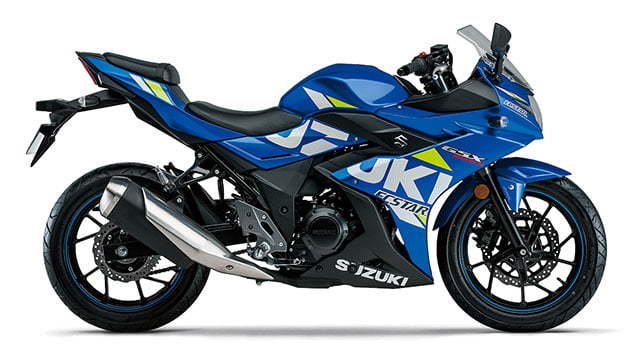
The Suzuki GSX250R was released in 2017 to compete in the ultra-competitive small-capacity sportbike learner category.
Like its rivals, Suzuki wanted to offer a small sports bike that shared some DNA with the GSX-R series – even if that shared DNA was only skin deep.
Many young and new riders dream of owning one of Suzuki’s flagship sports motorcycles, such as the GSX-R1000, GSX-R750, or GSX-R600.
It therefore made perfect sense for Suzuki to create a smaller-capacity version that visually resembled its bigger brothers.
Suzuki was a little slow to introduce a new sportbike in the 250 cc class, which handed its competitors a significant advantage.
Honda’s CBR250R and Kawasaki’s Ninja 250 had already been on the market for years — released in 2011 and 2014, respectively.
Suzuki did offer the naked Inazuma 250, but it was never a true rival to the fully-faired models from Honda and Kawasaki.
By the time Suzuki finally launched its sporty, learner-friendly 250, other manufacturers were already moving on to larger-capacity motorcycles with more power.
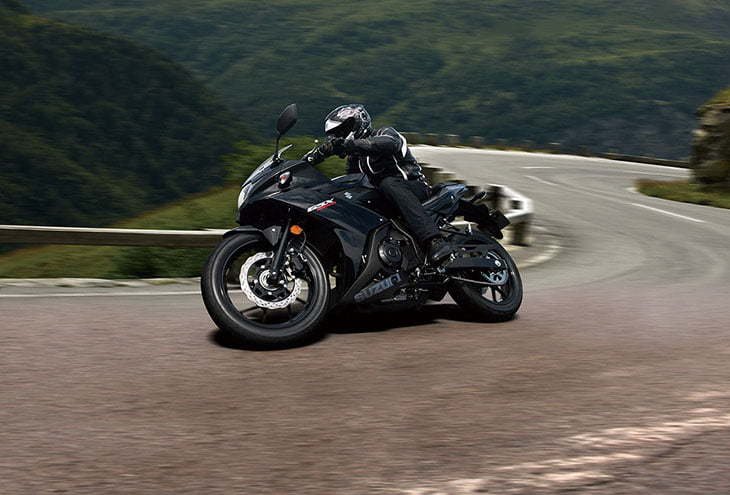
The Suzuki GSX250R is primarily focused on Asian markets, but it has been sold worldwide as a great-looking sporty commuter and learner bike for new riders.
It is powered by a 248 cc parallel-twin engine based on the earlier naked Inazuma 250.
Suzuki claimed they designed the engine for strong low – and mid-range performance, and I’ll take their word for it.
The engine does deliver reasonable zip below 8,000 rpm, but the power does fizzle out noticeably past that point – unlike some other 250 cc parallel twins.
It is a smooth engine, especially for a parallel twin. Suzuki attributes this smoothness to their camshaft profile design.
However, the little GSX250R has its work cut out for it.
The entry-level small-capacity class (250 cc and above) is remarkably diverse, with motorcycles ranging all the way up to 500 cc.
Because the Suzuki’s engine sits at the lower end of the capacity spectrum, it is likely one of the slowest bikes in the class – and possibly even slower than its direct 250 cc rivals, the Kawasaki Ninja 250 and Honda CBR250R.


Suzuki GSX250R Dyno Curve
The little Suzuki makes just 21 horsepower at the wheels.
This figure sits at the bottom end of the Japanese 250 cc class and is comfortably eclipsed by some slightly larger-capacity bikes such as the Ninja 300 and CBR300R.
You might argue it is unfair to compare them with the 248 cc GSX250R, but unfortunately for Suzuki, these larger-capacity machines are exactly what prospective buyers consider when shopping for an entry-level sports bike.
Looking at the dyno graph in isolation, the Suzuki shows respectable low-end power and torque. It pulls smoothly from as low as 2,000 rpm and delivers a small but noticeable kick at 4,500 rpm.
Power then builds steadily up to around 8,000 rpm before starting to tail off toward 9,000 rpm and dropping sharply after that.
There is little point revving beyond 8,000–8,500 rpm except in first gear. In the higher gears, you will actually make slower progress by holding the revs longer.
This is clearly visible where the thrust curves for each gear overlap.
You still need to work the engine and use the gears to make any meaningful progress.
Surprisingly, Honda’s single-cylinder CBR250R actually makes more top-end power than the twin-cylinder Suzuki GSX250R.
It appears Suzuki did not take full advantage of the multi-cylinder engine’s potential to rev higher and produce more power.
For example, the parallel-twin Ninja 250 revs all the way to 13,000 rpm, while the GSX250R can barely reach 10,000 rpm.

Suzuki GSX250R thrust curve
Out on the road, the little GSX250R is much better suited to commuter duties than to going fast.
After all, there is only so much 250 cc and 21 horsepower can do.250 cc engines generally lack strong bottom-end or midrange power.
You usually have to rev them hard to reach their peak output.
The GSX250R has less power than both the Honda CBR250R and the Kawasaki Ninja 250R.
It is geared a little higher than the Ninja 250R and slightly lower than the Honda CBR250R. As a result, it is weaker than the Ninja 250R at almost every speed in every gear.
Against the Honda CBR250R, it is dominated in the first three gears but does have a slight edge at certain speeds in fourth, fifth, and sixth.
This is mainly because the Honda runs much longer gearing in the top three gears compared with the GSX250R.
For the most part, the engine does a reasonable job on the road. At speeds below 60 mph, you can get past traffic easily enough.
However, on faster roads or at highway speeds, the little Suzuki begins to struggle. You are left with only fifth, and sixth gear for overtaking.
Fifth gear is largely pointless — from 70 mph onward, there is actually less acceleration available in fifth than in sixth.
In the end, sixth gear is all you have, and even then, the thrust continues to fade the faster you go.
Still, the little GSX250R digs deep and will eventually get you past that annoying slow-moving car.
Speed in gears at 5000rpm
| Speed at 5000 rpm | GSX250R | Ninja 250R | CBR 250R |
| First | 14.3 mph | 13.9 mph | 14.5 mph |
| Second | 22.6 mph | 20.2 mph | 22.8 mph |
| Third | 29.2 mph | 25.7 mph | 30.7 mph |
| Fourth | 33.1 mph | 31.2 mph | 37 mph |
| Fifth | 38 mph | 36.2 mph | 43.3 mph |
| Sixth | 42.8 mph | 40.6 mph | 50.1 mph |

Suzuki GSX250R Acceleration Review
In terms of numbers, the GSX250R needs three gear changes to reach 0-60 mph, which it does in a respectable 8.59 seconds.
A more relevant figure for the kind of riding this bike is built for is the 0-30 mph time of 2.67 seconds.
Many everyday vehicles that reach 60 mph in three seconds take a similar time to reach 30 mph.
If you push on, the GSX250R covers the quarter mile in 16.70 seconds at 76 mph and reaches a top speed of 85.5 mph in a full racer tuck with chin on the tank.
The top speed is actually rev-limited to 85.5 mph — we were hitting the limiter. Slightly longer gearing could allow a few extra mph.
Changing gears at the right rpm is important for the best times. The ideal shift point is around 8,000–8,500 rpm.
While the GSX250R will happily cruise on the highway if traffic is moving at or slightly above legal speeds, you need to plan overtakes carefully. If traffic is flowing above 80 mph, it is best to stay out of the overtaking lane.
Because the motorcycle is only 248 cc and produces just 21 hp at the wheels, the performance difference between a heavy rider and a light rider is significant.
To achieve acceleration times similar to those listed, you will need favourable conditions and a rider weight of 80 kg or less.
If you want a “fast” 250, this is not the bike for you. That said, it is still quicker to 60 mph than a current entry-level Volkswagen Golf.
If straight-line performance matters to you while remaining a learner, you would be better off with a Kawasaki Ninja 250, Ninja 300, or Ninja 400.
These offer noticeably more thrills while maintaining similar comfort and practicality.
| Suzuki GSX250R Acceleration | |
| Speed | Time |
| 0-10 mph | 0.86 |
| 0-20 mph | 1.67 |
| 0-30 mph | 2.68 |
| 0-40 mph | 3.90 |
| 0-50 mph | 5.78 |
| 0-60 mph | 8.47 |
| 0-70 mph | 12.40 |
| 0-80 mph | 19.43 |
| SS/QM | 16.71/76.5 mph |
| SS/KM | 32.90/85 mph |
| SS/Mile | 48.56/85.77 mph |
| Top Speed | 85.77 mph |
Suzuki GSX250R Specficiations
| Suzuki GSX250R | |
| Engine | |
| Engine type | 4-stroke, 2-cylinder, liquid-cooled |
| Capacity | 248 cc |
| Bore x stroke | 53.5 mm × 55.2 mm |
| Compression ratio | 11.5 : 1 |
| Maximum power | 24 HP 9000 RPM |
| Maximum torque | 17 ft.lbs) @ 6500 RPM |
| Lubrication system | Wet sump |
| Ignition system | Fuel injection |
| Starter system | Electric |
| Transmission system | Constant Mesh, 6-speed |
| Final transmission | Chain |
| Chassis | |
| Frame | Semi-double cradle, high-tensile steel |
| Front suspension system | 37mm hydraulic telescopic fork/4.7 in |
| Rear suspension system | Uni-Trak® with 5-way adjustable preload/5.2 in |
| Front brake | Disc |
| Rear brake | Disc |
| Front tyre | 110/80×17 |
| Rear tyre | 140/70×17 |
| Dimensions | |
| Wheel base | 1430 mm |
| Wet weight (including full oil and fuel tank | 181 KG |
| Fuel tank capacity | 15 litres |