The Kawasaki Ninja 250R 0-60 in 7 seconds.
Kawasaki’s entry-level 250 cc sportbikes have been around in various forms since as far back as 1986, known in many markets as the GPX/GPZ 250.
All incarnations have been hugely popular wherever they were sold.
From the original GPX/GPZ 250 right through to the Ninja 250, these bikes have consistently delivered a great package of value, fun performance, and ease of use.
The Kawasaki Ninja 250R arrived in 2008 and was produced until 2012. It was then revised in 2013, adopting styling cues from its bigger and faster sibling, the Ninja 300.
As of today, the Kawasaki Ninja 250R is still sold in some markets alongside the Ninja 300 and Ninja 400.
The Ninja 300 and 400 are evolutions of the Ninja 250R, developed in response to changing learner laws and increasingly competitive machines from rival manufacturers.
In its current form, the Kawasaki Ninja 250R is powered by a 248 cc parallel-twin engine producing 32 hp at the crank (depending on the market).
That is only 4 hp less than the larger-capacity Ninja 300.
For reference, the old GPX 250 was actually more powerful and considerably lighter than the current Ninja 250R.
Today, the little Ninja 250R is no longer the lightest 250 in its class; it is only 4 kg lighter than its bigger sister, the Ninja 300.
On the positive side, it is 11 kg lighter than one of its most recent rivals, the Suzuki GSX250R.
It certainly seems that newer motorcycles are getting heavier these days.
The relevance of 250 cc bikes has changed in recent years as learner laws have evolved in many markets.
As a result, 250s now often compete against motorcycles up to 660 cc (even when restricted) as well as larger-engined models from the same manufacturers.
However, thanks to their strong value and performance proposition, 250 cc bikes remain very relevant – particularly in Asian countries where larger-capacity machines are often out of financial reach for many buyers.
The Kawasaki Ninja 250R faces considerable competition.
So how does it stack up against the other similar-capacity models we have already tested, as well as the much larger-engined competitors in the class?
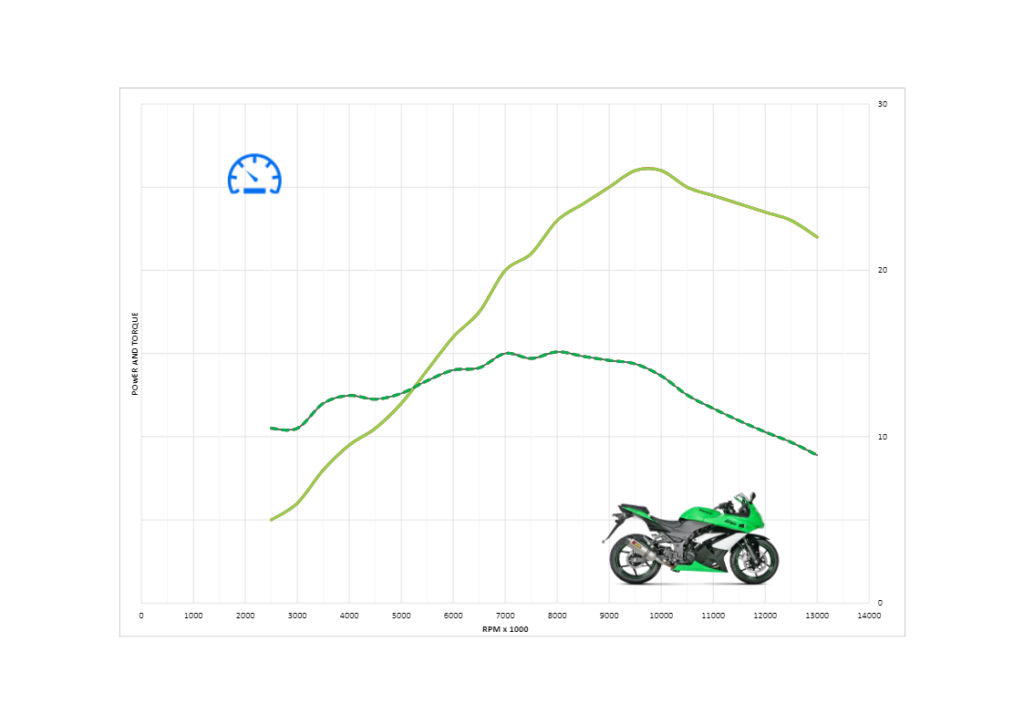
Kawasaki Ninja 250R Dyno | Power and Torque
There is only so much power that can be extracted from a budget liquid-cooled 249 cc parallel-twin engine.
Kawasaki’s claimed figures for the Ninja 250R are actually pretty decent: 32 horsepower at 10,000 rpm and 16.2 ft/lb of torque at 8,800 rpm at the crank.
Compared with its direct 250 cc rivals, such as the Honda CBR250R and Suzuki GSX250R, these numbers stack up very well.
At the rear wheel, the Ninja 250R produces a respectable 26 hp at just under 10,000 rpm. Torque is a modest 15 ft/lb at 7,000 rpm, which is typical for most bikes in the 250 cc class.
Some single-cylinder rivals, such as the Honda CBR250R and CBR300R, offer a little more peak torque and deliver it more consistently across the rev range.
It makes sense that the CBR300R has the advantage thanks to its larger capacity.
Even by 250 cc standards, you don’t have to work the Ninja 250R’s engine quite as hard as some others.
However, like all small-capacity bikes, you still need to keep the revs up to make meaningful progress.
In the case of the Ninja 250R, that means keeping the tachometer needle above 7,000 rpm most of the time.
That said, in most real-world situations and at the same road speed in the same gear, it feels more flexible than the Suzuki GSX250R.
Surprisingly, the little Ninja 250 gets quite close to the Ninja 300 in low- to mid-speed in-gear acceleration despite giving away 45 cc.
The Ninja 250R also has a strong top-end overrun. Although peak power arrives just under 10,000 rpm, the engine continues to make power all the way to 13,000 rpm if you choose to rev it out.
Even at those high revs, power only tails off to around 22 hp at the rear wheel.
Speed in gears at 5000 rpm
| Speed at 5000 rpm | GSX250R | Ninja 250R | CBR 250R |
| First | 14.3 mph | 13.9 mph | 14.5 mph |
| Second | 22.6 mph | 20.2 mph | 22.8 mph |
| Third | 29.2 mph | 25.7 mph | 30.7 mph |
| Fourth | 33.1 mph | 31.2 mph | 37 mph |
| Fifth | 38 mph | 36.2 mph | 43.3 mph |
| Sixth | 42.8 mph | 40.6 mph | 50.1 mph |
Making a respectable amount of power from around 3,000 rpm all the way past its peak of 26 hp allows the rider to hold onto a gear a little longer when riding on track or favourite twisty back roads.
This strong overrun makes the engine more usable and flexible, so it’s easier to make smooth progress without constantly shifting up and down the gearbox.
You won’t break any speed records with the Kawasaki Ninja 250R, after all, it is only a 250 cc motorcycle with a curb weight of 170 kg.
It could certainly benefit from a little more power. However, if you feed the little screamer gears properly, it accelerates surprisingly well for its size.

In Gear Thrust Curve
If this is your first motorcycle and you’re young, you’re probably keen to know how the Ninja 250R compares with other bikes, and perhaps even with some of the cars your mates might drive.
The Kawasaki Ninja 250R accelerates from 0-60 mph in a flat 7 seconds and from 0-100 km/h in 7.52 seconds (for our Euro, Canadian, and Australian readers).
Like all small-capacity bikes with low gearing and buzzy engines, it needs two gear changes and third gear to reach 60 mph.
Those extra shifts cost a little time, as larger motorcycles can often hit 60 mph with just one gear change.
With a quickshifter, you could easily dip the Ninja 250R under 7 seconds to 60 mph, since you would save time on every shift.
Even without one, the clutch and gearbox are good enough that fast shifts are still possible.
The Ninja 250R is not overly fussy about shift points for the best results. Shifting anywhere between 10,000 rpm and 13,000 rpm generally gives very similar times.
For the quickest launches, you need plenty of clutch slip and should keep the revs from dropping below 7,000 rpm.
The Ninja 250R covers the quarter mile in 15.86 seconds at a respectable 83.7 mph. Your times may vary depending on rider weight, size, and weather conditions.
These figures would have been considered decent for a sporty hatchback 10–15 years ago, but today, many entry-level economy cars can match the Ninja to 60 mph and then pull away from it afterwards.
Kawasaki Ninja 250R’s top speed is 97.56 mph
A Volkswagen Tiguan 2.0T can beat a Ninja 250R over the quarter mile and will easily exceed the Ninja’s top speed of 97.56 mph, which is reached in around 50 seconds from a standstill.
In real-world conditions, most riders will see a more realistic top speed of around 90 mph.
You can squeeze out a few extra mph by tucking in with your chin on the tank and pulling the mirrors in, but even then, the speedo may show 110 mph or more.
Like almost all motorcycles, the Ninja’s speedometer over-reads by 10-15%.
The fact that many ordinary cars can match or beat the Ninja 250R at the traffic lights does not mean you should be disappointed.
A 0-60 mph time of 7 seconds was considered quick, not so long ago, and it still feels respectable, especially when the Ninja 250R is all you have to compare it to.
Sure, if you jump straight off a Yamaha YZF-R1 or out of a Porsche 911 Turbo, the little Ninja will feel slow, but that comparison is unfair.
Against its closest 250 cc rivals, such as the Suzuki GSX250R, the Ninja 250R walks it convincingly.
In the real world, at the traffic light grand prix, the Kawasaki Ninja 250R does exactly what it is supposed to do.
You can blast off the line, win some and lose some, while screaming the little 249 cc engine to 13,000 rpm with a huge smile on your face.
On slow, twisty country roads, the 26 hp is more than enough to have fun as you work the engine hard.
The Ninja only shows its limitations on big, fast roads or the highway, especially when trying to keep up with or overtake faster traffic – there is not much “go” left above 80 mph.
This weakness is common to all 250 cc motorcycles, and the Ninja 250R is certainly far from the weakest in the class.
In fact, it sits near the top, something further testing of other 250 cc bikes will likely confirm.
The Kawasaki Ninja 250R also responds very well to tuning.
Because these bikes are raced in many series, there is a wide range of tuning parts available and plenty of experienced tuners.
With the right modifications, it is relatively easy to get the Ninja making 35 hp at the wheels, transforming its performance.
A well-tuned Ninja 250R could realistically achieve low six-second, or even high five-second – 0-60 mph times.
Kawasaki Ninja 250R Acceleration and Top Speed Review
| Kawasaki Ninja 250R Acceleration | |
| Speed | Time |
| 0-10 mph | 0.92 |
| 0-20 mph | 1.83 |
| 0-30 mph | 2.76 |
| 0-40 mph | 3.90 |
| 0-50 mph | 5.17 |
| 0-60 mph | 7.08 |
| 0-70 mph | 9.77 |
| 0-80 mph | 13.50 |
| 0-90 mph | 21.02 |
| SS/QM | 15.86 @ 83.7 mph |
| SS/KM | 30.60 @ 94 mph |
| SS/Mile | 44.71 @ 97.5mph |
| Top Speed | 97.56 mph |