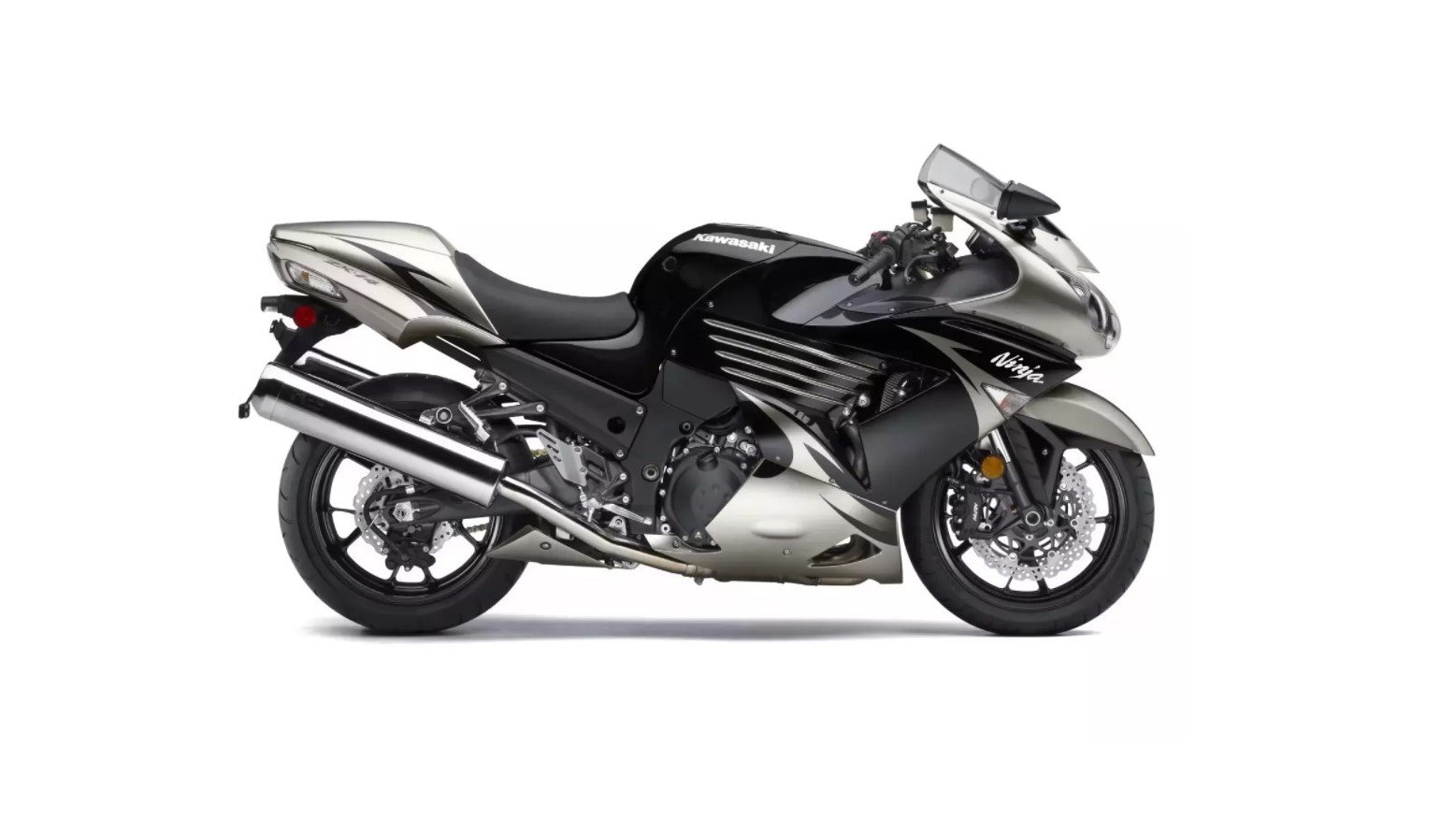
ZX-14R 0-60 mph in 2.85 seconds
Kawasaki’s ZX-12R was the company’s direct answer to the Suzuki Hayabusa in the fierce top-speed war of the late 1990s and early 2000s.
Which of the two machines truly held the crown was never entirely clear and became the subject of heated debates down thre pub and on motorcycle forums on the netet.
The ZX-12R was slightly more powerful, but the Hayabusa was more aerodynamically efficient.
During independent top-speed tests in the magazines, both machines traded blows, with perhaps the Hayabusa more often than not topping the Ninja 12R by a few mph.
That was not enough to determine a true winner, so to settle the matter once and for all and claim the outright top-speed title, Kawasaki released the ZX-14R.
This new flagship featured a larger engine and produced a claimed 187 horsepower. With ram-air assistance, the figure rose even higher to 197 horsepower.
In reality, both the first-generation Hayabusa and the ZX-14R delivered around 175 and 178 horsepower at the crank.
If those on-paper power advantages for the new ZX-14R translated cleanly to the dyno, there would have been no further ambiguity about which motorcycle was fastest.
Unfortunately for Kawasaki, the gentleman’s agreement limiting production motorcycles to 300 km/h (186 mph) was already in place, so they never got the chance to categorically prove and claim the top speed title.
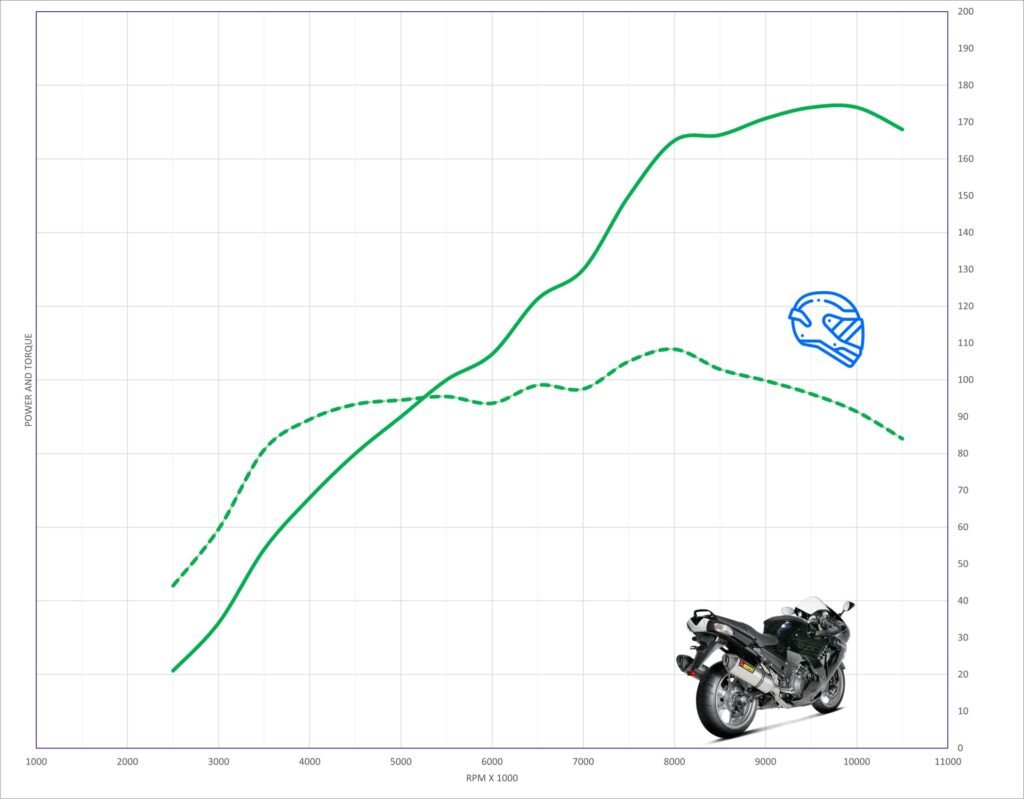
Kawasaki ZX-14R Dyno Curve
At the time of its launch, the ZX-14R engine was the most powerful in any production motorcycle, producing 174 horsepower at the rear wheel at 9,800 rpm.
Peak torque is equally impressive at 108 ft-lb at 8,000 rpm.
The engine is significantly stronger than the first-generation Suzuki Hayabusa it was designed to surpass, delivering around 15–20 horsepower more at the peak.
The ZX-14R is extraordinarily strong almost everywhere, offering exceptionally good drive throughout the entire rev range thanks to its huge displacement and abundant torque.
As an example, from 3000 rpm, the ZX-14R produces 80ft-lb of torque, a number that most Superbikes produce at peak.
The only real criticism is a slight lack of torque below 3,500 rpm.
This is not a major issue for most riding, but it becomes noticeable if you try to be very lazy and trickle along in a high gear with the revs sitting around that point or below.
That gaping hole in the torque curve only clears as you pass 4,000 rpm and the engine starts to pull cleanly again.
This minor shortfall is easily remedied with a full exhaust system and a simple ECU tune. Doing so will push the ZX-14-R 190 plus horsepower at the wheels, making it a formidable force in a straight line

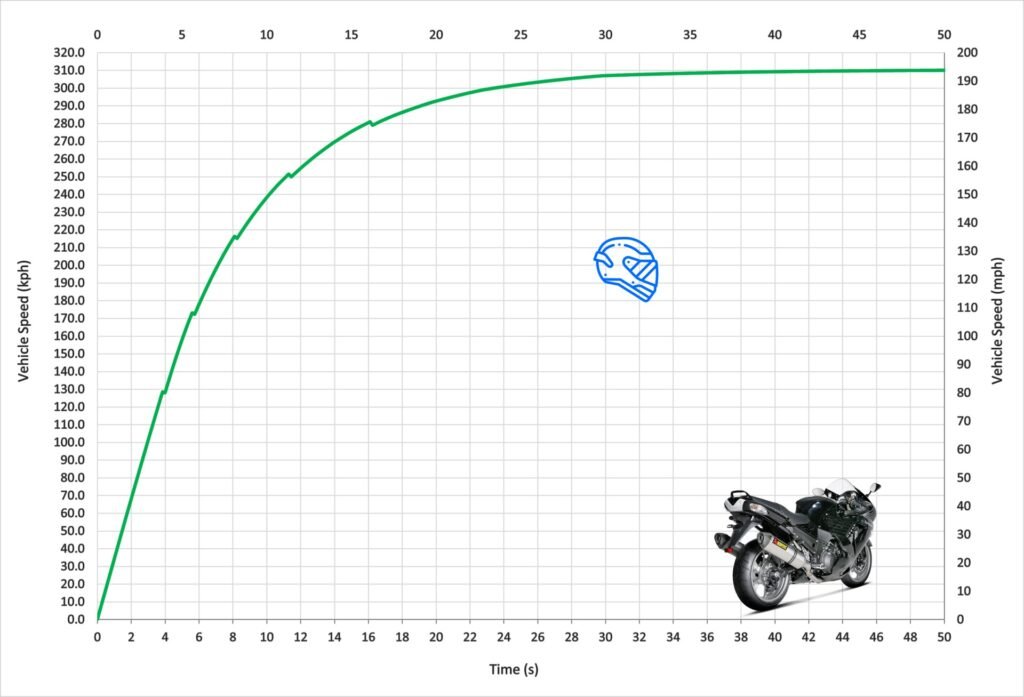
Kawasaki ZX-14R Thrust Curve
Despite this minor issue, few engines can accelerate so strongly with so little rpm showing on the tachometer.
Some litre bikes may be able to out-accelerate the ZX-14R in a top-gear roll thanks to their lower gearing and weight, but they usually need higher rpm showing to do so, while the ZX-14R remains relaxed and unstressed.
Even for such a large, low-revving engine, you are rewarded with ballistic acceleration as expected.
If you stretch any gear, you get a noticeable kick as the revs pass 7,000 rpm. This is clearly visible on both the dyno curve and the in-gear thrust curve as a distinct jump in acceleration.
The earlier ZX-12R is similar, though not quite as brutal as the ZX-14R.
Power does flatten off slightly above 8,000 rpm, but there is still an impressive spread of peak power from 8,000 to 10,500 rpm, with only a 9-horsepower difference across that range.
This means there is no need to rev the ZX-14R all the way to 10,500 rpm to make progress. Changing up at 9,000 rpm still delivers almost identical outright acceleration.
But of course, as you paid for the tacho, you can use it all. And when you do, you’re rewarded with acceleration that up until not too long ago was unbeatable.
The ZX-14R reclaimed the top-speed crown from the Hayabusa and also out-accelerated it once moving, thanks to its extra power.
The 0–60 mph sprint was dispatched in a rapid 2.85 seconds, while 0–100 mph took just 5.11 seconds.
Cracking the sub-five-second 0–100 mph time was possible but difficult, given the ZX-14R’s rowdy nature and its eagerness to spin the rear tyre.
The 0–200 km/h benchmark, which is a common supercar reference, is achieved in only 7.11 seconds, putting the first-generation ZX-14R among some of the quicker cars on the road.
The quarter-mile is covered in 9.99 seconds at a terminal speed of 148 mph.
From there, the Kawasaki pulls away more strongly than the first-generation Hayabusa, reaching 0–180 mph in an impressive 18.43 seconds and 0–300 km/h in 23.85 seconds.
If you hold sixth gear long enough, the ZX-14R will eventually hit a top speed of 195 mph after around 35 seconds from a standing start.
The 60 to 130 mph time is very impressive and is actually up there with some of the latest litrebikes that are much lighter and more powerful.
This ZX-14R’s competitiveness comes down to its extra weight and wheelbase length, allowing for a full power attempt in first gear.
Doing so on a litrebike means battling wheelies, doing so in second gear, while calmer is slower. The ZX-14R does not suffer from that problem and uses it to its advantage.
The litre bikes can only claww back at higher speeds where wheelies are not an issue. But by then the race may already be over!
| 06-11 Kawasaki ZX-14R Acceleration and Top Speed | |
| Speed | Time |
| 0-10 mph | 0.47 |
| 0-20 mph | 0.96 |
| 0-30 mph | 141 |
| 0-40 mph | 1.83 |
| 0-50 mph | 2.37 |
| 0-60 mph | 2.85 |
| 0-70 mph | 3.53 |
| 0-80 mph | 4.01 |
| 0-90 mph | 4.53 |
| 0-100 mph | 5.11 |
| 0-110 mph | 5.95 |
| 0-120 mph | 6.74 |
| 0-130 mph | 7.64 |
| 0-140 mph | 8.96 |
| 0-150 mph | 10.27 |
| 0-160 mph | 12.33 |
| 0-170 mph | 14.65 |
| 0-180 mph | 18.43 |
| 0-190 mph | 28.77 |
| 60-130 mph | 4.75 |
| 100-150 mph | 5.16 |
| SS/QM | 9.99 @148 mph |
| SS/KM | 18.10 @179 mph |
| SS/Mile | 25.41 @187 mph |
| Top Speed | 195 mph |