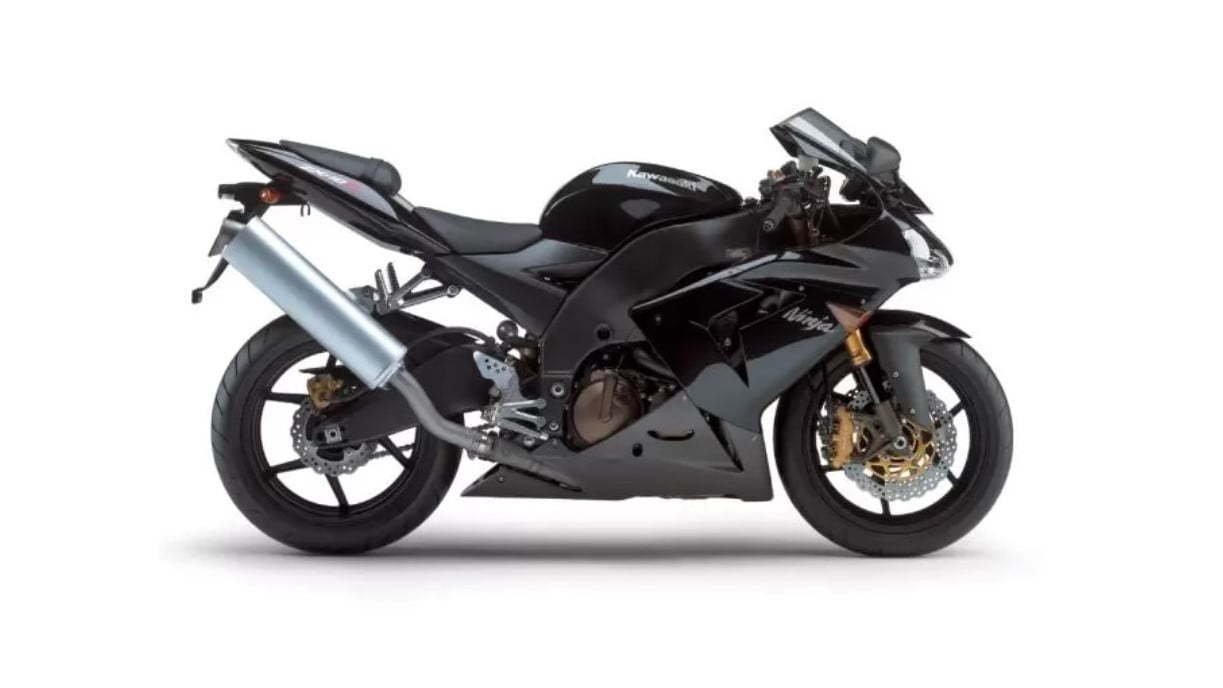
Gen 1 Kawasaki ZX-10R Acceleration Times and Top Speed Data
04-05 Kawasaki ZX-10R (Gen 1) – Top Speed and Acceleration Data Through the Gears, with Dyno Curve and Thrust Curve Graphs
Kawasaki, like some other Japanese manufacturers, arrived a little late to the fully fledged 1000 cc superbike class.
Yamaha had already been offering a 1000 cc superbike for several years, but the early models were becoming long in the tooth and leaned more towards sports-tourer than pure superbike.
That all changed in 1998 when Yamaha released the groundbreaking YZF-R1, which rattled the entire superbike class.
The other manufacturers soon followed, updating existing models or launching new ones, though most still lagged behind the R1 until Suzuki’s groundbreaking K1 GSX-R1000 arrived.
During this period, Kawasaki continued with its ageing but very capable ZX-9R.
The ZX-9R was a fast and excellent road bike, but it lacked the sharpness required on the track.
In a straight line, it remained extremely quick and could trade blows with the R1 and CBR954RR, yet its 899 cc engine simply didn’t have the grunt of its rivals and could only really compete at the very top end.
In 2004 Kawasaki held nothing back and unleashed a true monster upon the world.
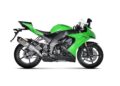
By then, the company was a couple of years into its MotoGP campaign, and the new ZX-10R could easily have been marketed as a MotoGP replica; the resemblance was that striking.
Its aggressive lines, large ram-air intake and overall stance made the shared DNA with the race bike plain to see.
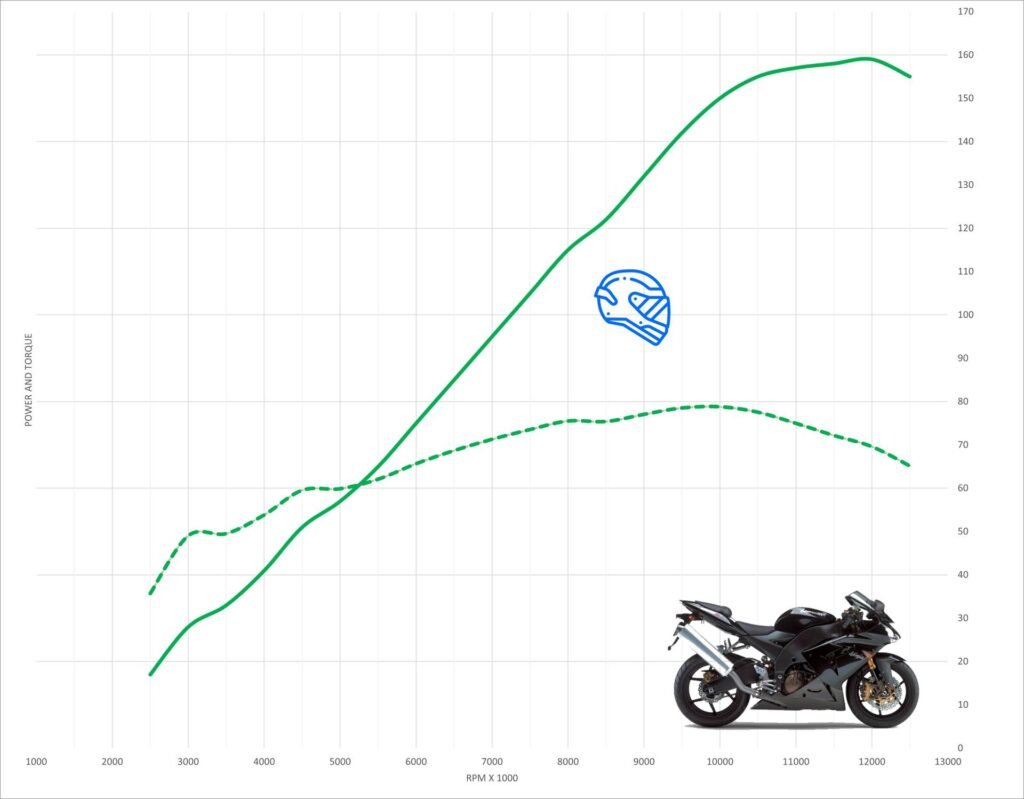 04-05 Kawasaki ZX-10R Dyno Curve
Arguably, the new Kawasaki ZX-10R was the first production motorcycle to achieve a power-to-weight ratio of over 1,000 horsepower per tonne. Or 1 HP per KG
Back then, manufacturers quoted dry weights, which often meant no fuel, oil or battery. Today, they publish curb (wet) weights, which makes the on-paper figures appear a little less extreme.
Kawasaki claimed 175 horsepower at the crank at 11,700 rpm for the 2004-2005 ZX-10R, with a peak torque figure of 84 ft-lb at 9,500 rpm.
The claimed dry weight was just 170 kg.
Using the old dry-weight method, this gave Kawasaki the headline figure of more than 1,000 hp per tonne – or 1 horsepower per kilogram.
In reality, and by today’s standards, the ZX-10R’s power-to-weight ratio falls short once realistic curb weight is considered.
A typical wet weight is around 195 kg.
Even so, the numbers remain crazy. They still look impressive today in a world full of 200-plus horsepower motorcycles.
At the rear wheel, allowing for transmission losses, the 2004–2005 ZX-10R produces 159 horsepower at 11,900 rpm and 79 ft-lb of torque at 9,900 rpm.
At the time, these figures were right at the sharp end. The ZX-10R beat the K3–K4 GSX-R1000 and traded blows with the new K5 GSX-R1000 and Yamaha YZF-R1.
That big power and torque are delivered in a very smooth and linear fashion that builds progressively.
Kawasaki superbikes have shared this similar power and torque delivery for many years, right up to the present day.
The engine is very impressive, but it does lack a little low-rpm drive compared with its peers of the era and some rival superbikes that came before it.
There is usable drive from around 4,500 rpm, but the ZX-10R really comes alive from 7,000 rpm upwards, where it delivers monstrous power.
On the dyno, the 2004–2005 ZX-10R was often the second-most powerful bike in its class, with the K5 GSX-R1000 holding the edge on many occasions when tested together on the same day.
Compared with the outgoing ZX-9R, the new ZX-10R dominates across the entire rev range and produces around 30 horsepower more at peak.
 04-05 Kawasaki ZX-10R Thrust Curve
The 2004-2005 Kawasaki ZX-10R has exceptionally long gearing. It can almost reach a genuine 100 mph in first gear and 125 mph in second gear.
The graph above shows in-gear thrust plotted against road speed.
This represents the actual thrust delivered to the rear wheel in each gear once the engine’s torque has been multiplied through the gearbox.
The more thrust available, the stronger the acceleration when you open the throttle.
The 2004–2005 ZX-10R delivers excellent thrust in all gears, but it is not class-leading.
This is mainly because it produces less power and torque at lower rpm than some rivals, combined with its relatively long gearing for the class.
If it were not for the K5 Suzuki GSX-R1000, the ZX-10R would sit right at the top.
The 2004-2006 Yamaha YZF-R1 is a little weaker at low rpm, and it would be interesting to compare it directly with the 2004–2006 Honda CBR1000RR.
Speeds in gears at 5000 rpm
| Speed at 5000 rpm | 04-05 CBR1000RR | 04-06 YZF-R1 | K5 GSX-R1000 | 04-05 ZX-10R |
| 1st | 34.1 mph | 35.9 mph | 37 mph | 38.9 mph |
| 2nd | 44.6 mph | 44.1 mph | 46.2 mph | 48 mph |
| 3rd | 54.8 mph | 51.6 mph | 55.4 mph | 56.7 mph |
| 4th | 62.8 mph | 59.8 mph | 63.3 mph | 64.7 mph |
| 5th | 69.2 mph | 66.7 mph | 69.8 mph | 71.4 mph |
| 6th | 74.6mph | 71.7mph | 74.8 mph | 75.5 mph |
Kawasaki did not have to gear the 2004-2005 ZX-10R quite so tall, though I suspect the decision was made with the racetrack more in mind than the road.
It may also have been influenced by the bike’s monster power and extremely light 170 kg dry weight.
The early ZX-10R is a very frisky motorcycle, and the longer gearing helped keep things just a little more manageable.
Remember, in 2004, superbikes were still fully analogue – there was no wheelie control or traction control to keep things in check.
Although the ZX-10R produces slightly less average thrust than the K5 GSX-R1000 in each gear on paper, on the road, it feels every bit as explosive.
Much of that sensation comes from the taut chassis and sharp geometry.
The bike is extremely rapid and will lift the front wheel with ease in second gear – and even third – just like the K5 GSX-R1000.Down low, most rivals (apart from the 2004–2006 YZF-R1) have the edge.
However, once the ZX-10R is into the second half of any gear and around the 7,000 rpm mark, the acceleration and throttle response become absolutely ballistic.
Regardless of what the power, torque or thrust curves say, in the upper mid-range and top end, where the 2004–2005 ZX-10R is at its strongest, it feels faster than most rivals and matches the K5 Suzuki GSX-R1000.
Like any litre bike, you rarely have to worry about which gear you are in. Overtaking on the highway in top gear is effortless.
If you wanted to, you could drop to first and blast from 70 mph to 100 mph for fun, but the job would actually be done quicker by staying in sixth gear.
Out on country roads, the 2004-2005 ZX-10R behaves like a big scooter.
The long gearing combined with strong mid-range drive means second gear covers the vast majority of bends and straights.
Only when the revs drop below 4,500 rpm is there a slight lull in acceleration, but there is still enough drive to get you out of corners cleanly. Once the revs rise above 4,500 rpm, the speed piles on very rapidly.

The ZX-10R is an extremely fast motorcycle even by today’s standards. Despite the long gearing, it reaches 0–60 mph in 3.15 seconds and 0–100 mph in 5.44 seconds.
The taller gearing actually helps a little by taking the edge off the power delivery, allowing the rider to get harder on the throttle sooner.
Of course, the ZX-10R will still wheelie effortlessly in first gear, but the extra length in the gears does make it slightly more manageable.
Long gearing also benefits elapsed times because it often means fewer gear changes are required to reach a given speed.
Sometimes a specific acceleration benchmark can be hindered by an unwanted gear change right before hitting the target.
For example, many motorcycles need to shift into second gear to reach 100 mph, whereas the 2004-2005 ZX-10R can exceed 100 mph in first gear without needing to change up and lose time.
Keep feeding the ZX-10R through those long gears and it will hit 0–150 mph in just 10.39 seconds.
It also manages 0–100 km/h in 3.3 seconds and 0–200 km/h in 7.47 seconds. The quarter-mile is dispatched in a very impressive 10.21 seconds at a terminal speed of 148 mph.
The first-generation ZX-10R is a very small and compact motorcycle that offers limited protection from the elements. Even so, its top speed is highly impressive at 185.2 mph, which it can achieve in just a little over a mile from a standing start.
With the top-speed restrictor removed, I have little doubt that the ZX-10R would hit the rev limiter in top gear at well over 195 mph.
04-05 Kawasaki ZX-10R Acceleration
| 04-05 Kawasaki ZX-10R Acceleration | |
| Speed | Time |
| 0-10 mph | 0.50 |
| 0-20 mph | 1.01 |
| 0-30 mph | 1.47 |
| 0-40 mph | 2.10 |
| 0-50 mph | 2.41 |
| 0-60 mph | 3.15 |
| 0-70 mph | 3.64 |
| 0-80 mph | 4.19 |
| 0-90 mph | 4.77 |
| 0-100 mph | 5.44 |
| 0-110 mph | 6.11 |
| 0-120 mph | 6.82 |
| 0-130 mph | 7.82 |
| 0-140 mph | 8.87 |
| 0-150 mph | 10.39 |
| 0-160 mph | 12.45 |
| 0-170 mph | 15.23 |
| 0-180 mph | 21.81 |
| 60-130 mph | 4.73 |
| 100-150 mph | 4.90 |
| SS/QM | 10.21@148 mph |
| SS/KM | 18.31@177 mph |
| SS/Mile | 25.77@181 mph |
| Top Speed | 185.2 mph |