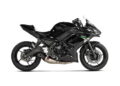
Honda CBR600RR does 0-60 mph in 3.28 seconds
Honda’s CBR600 has been with us for what feels like an eternity. In reality, it first appeared in 1987 and has now been around for almost 40 years as of writing.
Around the halfway point of its life, in 2003, the CBR range took a sharp turn and became much racier.
You could argue that the new model was not really the same bike as the original; even though it kept the CBR600 name, it simply gained the double “RR” at the end.
The original CBR600F series was a highly competent all-rounder that excelled at almost anything you could throw at it. That versatility was a huge part of its appeal.
However, as the World Supersport Championship became increasingly competitive and focused, the road bikes that formed the basis of the race machines followed suit.
Much of the blame (or credit) lies with Suzuki and Yamaha, whose uncompromising GSX-R and YZF-R6 models raised the bar dramatically.
This pressure forced Honda to abandon the easy-going, all-rounder ethos of the CBR600F and create a more single-minded, race-oriented machine.
So, in 2003, the Honda CBR600RR was born. It marked a complete departure from the CBR600F it replaced.
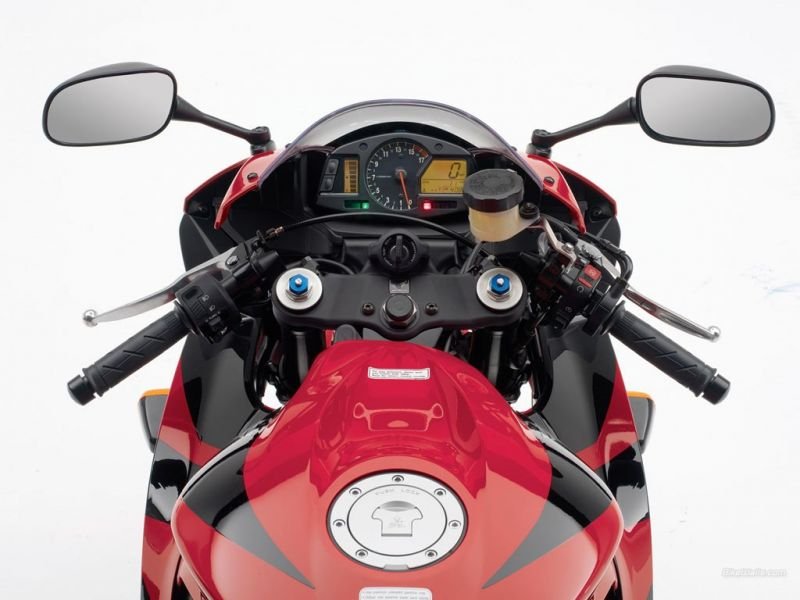
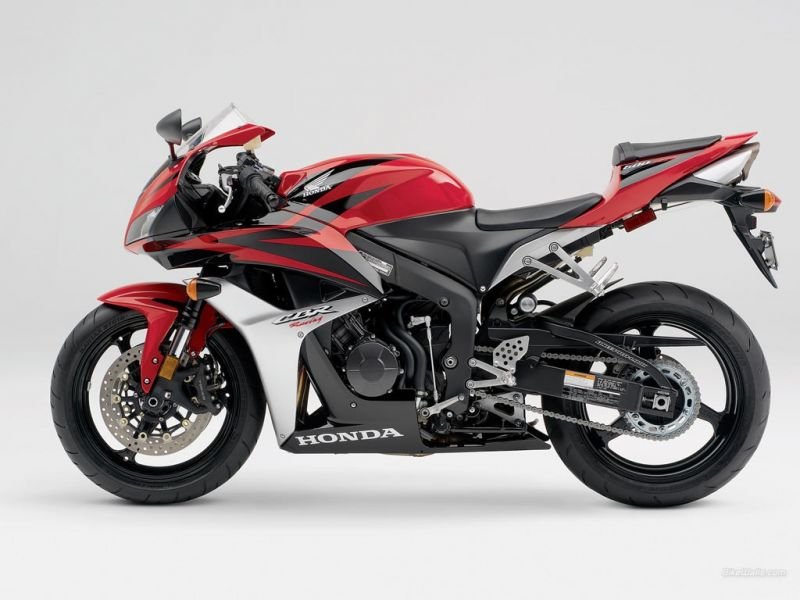
The new bike looked entirely different, featuring sharp, RCV211V MotoGP-inspired styling and a distinctive under-seat exhaust.
It was and still is a stunning motorcycle that perfectly embodies the spirit of a pure race bike.
Honda continued to cater for riders who preferred the more versatile character of the original CBR600F series by reintroducing the CBR600F in 2011.
That rather uninspiring re-imagining of the classic model remained in production until 2018, sold alongside its larger-engined sibling, the CBR650F.
Then, in 2019, Honda launched the CBR650R, a sharper-looking and sportier evolution of the F model it replaced.
It moved closer in spirit, character, and performance to the much-loved CBR600F4i, which many still regard as one of the best in the lineage (alongside the excellent F3).Confused yet?
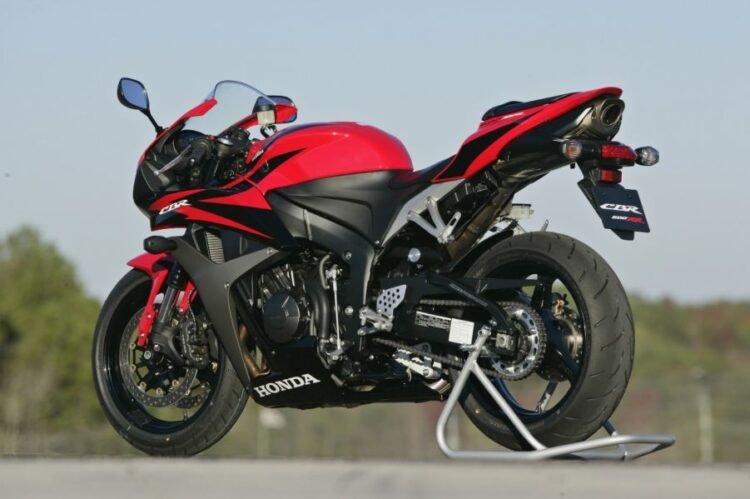
Anyway, the model we are testing here is the 2017 Honda CBR600RR.
This Supersport machine is powered by a conventional 599 cc inline-four engine producing a claimed 118 horsepower at 13,500 rpm and 48 ft-lb of torque at 11,250 rpm.
Thanks in part to Euro 3 emissions regulations, it makes slightly less power than earlier versions and is probably one of the least powerful bikes in its class.
That class includes some formidable rivals: the Yamaha YZF-R6, Triumph Daytona 675, Kawasaki ZX-6R (often referred to as the ZX-636) and Suzuki GSX-R600.

CBR600RR dyno chart and engine performance
Like the CBR600RR itself, its 599 cc inline-four engine is the very epitome of a high-revving four-cylinder unit and arguably one of the best ever made.
The engine proved so strong and reliable that it was chosen as the official Moto2 powerplant from 2010 to 2018.
Even with the strict regulations and restrictions of the class, Moto2 bikes were reported to rev beyond 16,000 rpm and produce well over 140 horsepower at the rear wheel, with top speeds approaching 300 km/h on the faster circuits.
So we know the CBR600RR engine has huge potential, but how does it perform in stock road form?
On the dyno, the 2017 Honda CBR600RR delivers 106 hp just shy of 14,000 rpm and 45 ft-lb of torque at 11,000 rpm.
With peak torque arriving so high in the rev range, it is clear what this engine was designed for: powering out of corners on the racetrack while sitting right in the meat of the powerband.
Power below 7,000 rpm is largely irrelevant on a proper racetrack, as revs rarely drop that low except on the slowest corners (or a kart track).
In truth, the CBR600RR has a very typical 600 cc Supersport engine. It is extremely fast, but only if you are prepared to work it hard. It needs to be revved mercilessly to make it perform like the single-purpose machine it is.
The engine truly comes alive above 7,000 rpm, howling eagerly all the way to 15,000 rpm and beyond. However, the real sweet spot lies from 9,000 rpm upwards.

CBR600RR in-gear acceleration
For street use and commuting, keeping the engine spinning above 7,000 rpm can feel anti-social and will also take a noticeable toll on fuel consumption.
That does not mean there is no usable power or acceleration below 7,000 rpm; there is, but the bottom-end response is rather tepid.
This is not a criticism of the Honda CBR600RR. Almost every Supersport bike behaves this way.
The CBR is a relatively small 600 cc engine that must deliver its peak power at the very top of the rev range to meet Supersport regulations, and that inevitably comes at the expense of low- and mid-range punch.
The same trade-off applies to the Suzuki GSX-R600 and Yamaha YZF-R6.
In fact, the Yamaha is even weaker down low and really needs to be kept above 10,000 rpm before it starts to make meaningful progress.
Kawasaki has “cheated” for years by using a 636 cc engine, which makes it the most flexible of the inline-fours. Triumph, with its three-cylinder 675 cc unit, produces the strongest torque in the class.
If you want a more street-friendly engine while staying within the Honda family, the CBR650R or CBR650F are excellent alternatives.
You gain noticeably more low- and mid-range drive, although you sacrifice some of that glorious, howling top-end character that defines the CBR600RR.
Honda CBR600RR Gearing
| Speed at 5000 rpm | Honda CBR600RR |
| First | 24.4 mph |
| Second | 33.6 mph |
| Third | 40.4 mph |
| Fourth | 46.1 mph |
| Fifth | 51.6 mph |
| Sixth | 55.7 mph |
Honda CBR600RR acceleration and top speed
The Honda CBR600RR is a genuinely fast motorcycle, but like all 600 cc Supersport bikes, you have to work for the performance, and that is precisely part of the fun and the attraction.
The great appeal of 600 cc Supersport machines is that they are wickedly quick without being stupidly fast.
Their performance is far more usable on the road compared with 1000 cc superbikes that can produce 200 horsepower and reach close to 130 mph in second gear or 150 mph in third.
On the CBR600RR, first gear alone will take you well over 70 mph. That is impressive for such a small engine with relatively modest torque.
Because of this, a good launch requires plenty of clutch slip to prevent the engine from bogging down, which would ruin your start and your elapsed time.
600 cc Supersport bikes, including the Honda CBR600RR, are not machines where you can fluff the start and simply drive away from low revs.
If you want optimum 0-60 mph or 0-100 km/h times, these machines generally do not wake up until the revs climb above 7,000 rpm.
For the best launches, you need to keep the engine at least at 8,000 rpm, and ideally in the 10,000–11,000 rpm range.
With decent clutch skills and smooth throttle control, you can consistently achieve sub-4-second 0-60 mph times.
On the Honda CBR600RR, we recorded an impressive 3.28 seconds for 0-60 mph and 3.37 seconds for 0-100 km/h.
Your own times may vary depending on conditions and rider technique.
The bike will wheelie, but it is rarely a major problem. You know you are charging hard when the front wheel skims the tarmac for most of first gear.
You can even power wheelie it from low revs — once the engine hits 7,000–8,000 rpm, it lifts quite willingly.
The CBR600RR covers 0-100 mph in 6.25 seconds and 0-200 km/h in 10.73 seconds.
In the quarter-mile, it runs 10.92 seconds with a terminal speed of 131 mph.
The CBR600RR is quick, but it is narrowly pipped by the more powerful Yamaha YZF-R6.
Most of my own times fell in the low to mid-11-second range. Breaking into the 10s is only realistic if you are light, nail the launch, and execute every gear change perfectly.
For the quickest times, take first gear right up to 14,000 rpm or beyond, then shift the remaining gears at around 13,000 rpm or slightly higher.
Stretching each gear for a higher terminal speed will cost you a little in elapsed time.
The 60–130 mph time on the Dragy is a respectable 7.30 seconds. For context, that is about 0.4 seconds slower than the Yamaha YZF-R6 and roughly 2.5 seconds slower than a current 1000 cc superbike.
On the road, the Honda CBR600RR engine is smooth and delivers more than enough power for everyday use.
If you are in third or fourth gear around town, overtaking power is limited, so it is better to drop a gear and keep the revs a little higher when you need stronger acceleration.
From 70–100 mph in top gear, the CBR600RR takes 5.10 seconds, a decent time that is more than enough to pass slower traffic.
For comparison, the Yamaha YZF-R6 takes 5.90 seconds in the same situation, so there is rarely any need to change down.
Honda CBR600RR Top Speed: 160 mph
We achieved a flat 160 mph, which equates to around 14,200 rpm in top gear.
At this point, the power begins to taper off quite abruptly on our example, more so than on some other CBR600RRs I have ridden.
With its small frontal area, the CBR600RR could theoretically go faster, but the low screen offers little protection, especially for taller riders.
Most modern 600 cc Supersport bikes have top speeds ranging from 155 to 165 mph.
The CBR600RR responds well to tuning. It is not uncommon for bikes of this generation to produce close to 120 horsepower at the rear wheel after an ECU flash removes the restrictions.
On a good day with favourable conditions, speeds approaching or exceeding 170 mph become realistic.
All in all, the Honda CBR600RR delivers thrilling, typical 600 cc Supersport performance in a straight line.
If you are prepared to work the engine, it will keep up with most things on the road and can even surprise the occasional older 750 or 900 cc machine from years gone by.
Honda CBR600RR acceleration and top speed
| 2017 Honda CBR600RR Acceleration | |
| Speed | Time |
| 0-10 mph | 0.51 |
| 0-20 mph | 1.02 |
| 0-30 mph | 1.54 |
| 0-40 mph | 2.07 |
| 0-50 mph | 2.65 |
| 0-60 mph | 3.28 |
| 0-70 mph | 3.68 |
| 0-80 mph | 4.47 |
| 0-90 mph | 5.20 |
| 0-100 mph | 6.25 |
| 0-110 mph | 7.30 |
| 0-120 mph | 8.89 |
| 0-130 mph | 10.70 |
| 0-140 mph | 13.50 |
| 0-150 mph | 18.59 |
| 0-160 mph | 41.78 |
| 60-130 mph | 7.30 |
| 100-150 mph | 12.247 |
| SS/QM | 10.92 @ 131 mph |
| SS/KM | 20.18 @1 52.5 mph |
| SS/Mile | 28.79 @ 58 mph |
| Top Speed | 160.1 mph |