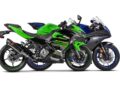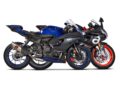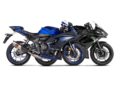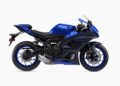
Yamaha YZF-R6 vs YZF-R7 Performance Review
With the legendary Yamaha YZF-R6 now discontinued in many markets, it would be easy for those not in the know to assume that the new YZF-R7 is its direct replacement.
Yamaha has also recently announced the arrival of the long-awaited YZF-R9.
So which motorcycle actually replaces the R6, and is either machine a genuine successor?
Both the YZF-R7 and YZF-R9 can be considered replacements, but not in the way you might expect.
They are built on very different platforms and are aimed at quite different types of riders.
It feels strange that Yamaha chose to revive the “R7” name for an entry-level sportbike based on the MT-07 platform.
After all, the original YZF-R7 from more than 20 years ago was Yamaha’s exotic, homologation-special World Superbike machine – the bike that Noriyuki Haga made famous.
Many riders might logically assume that the new R7 (numerically) sits one step below the R1, just as the old R7 did. In reality, the YZF-R9 makes far more sense in that role.
In my opinion, Yamaha should have given the new bike a different name, perhaps adding an “S” somewhere to distinguish it from the legendary 1999 OW-02 YZF-R7.
That said, the new YZF-R7 is here, and many of you will be wondering exactly how it stacks up in terms of engine performance, acceleration and top speed.
R7 test Here
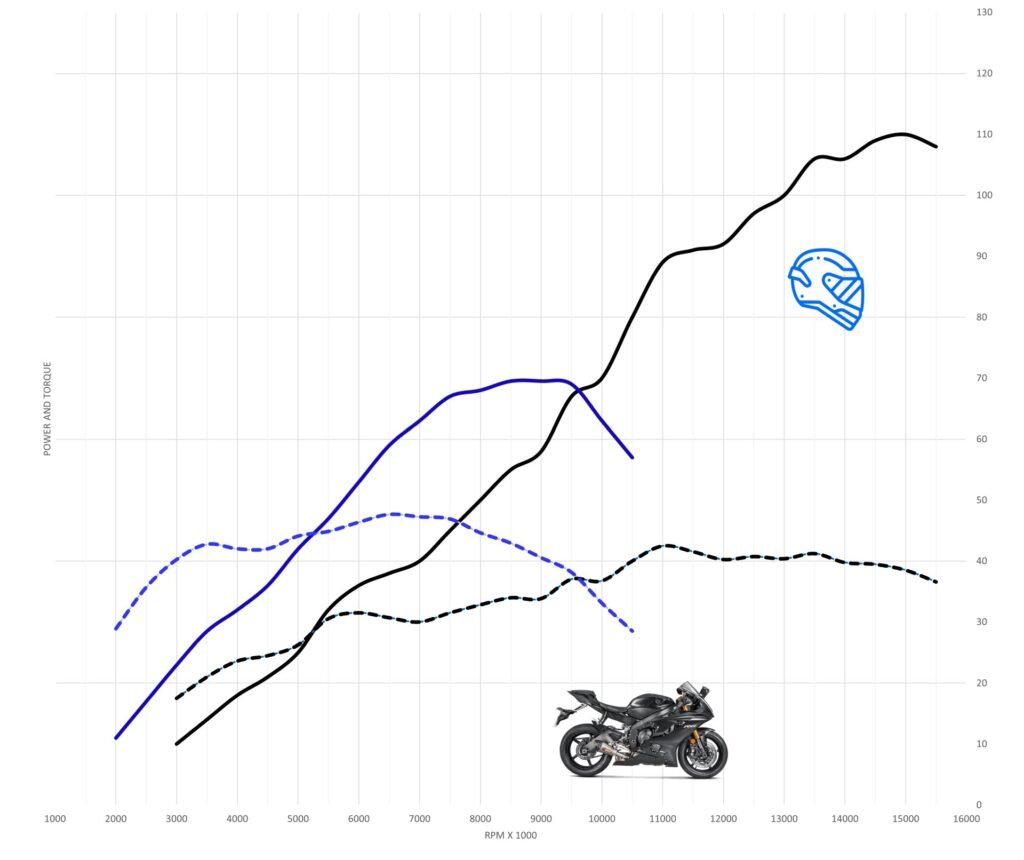
– YZF-R7 – YZF-R6
Yamaha YZF-R7 vs Yamaha YZF-R6 on the Dyno
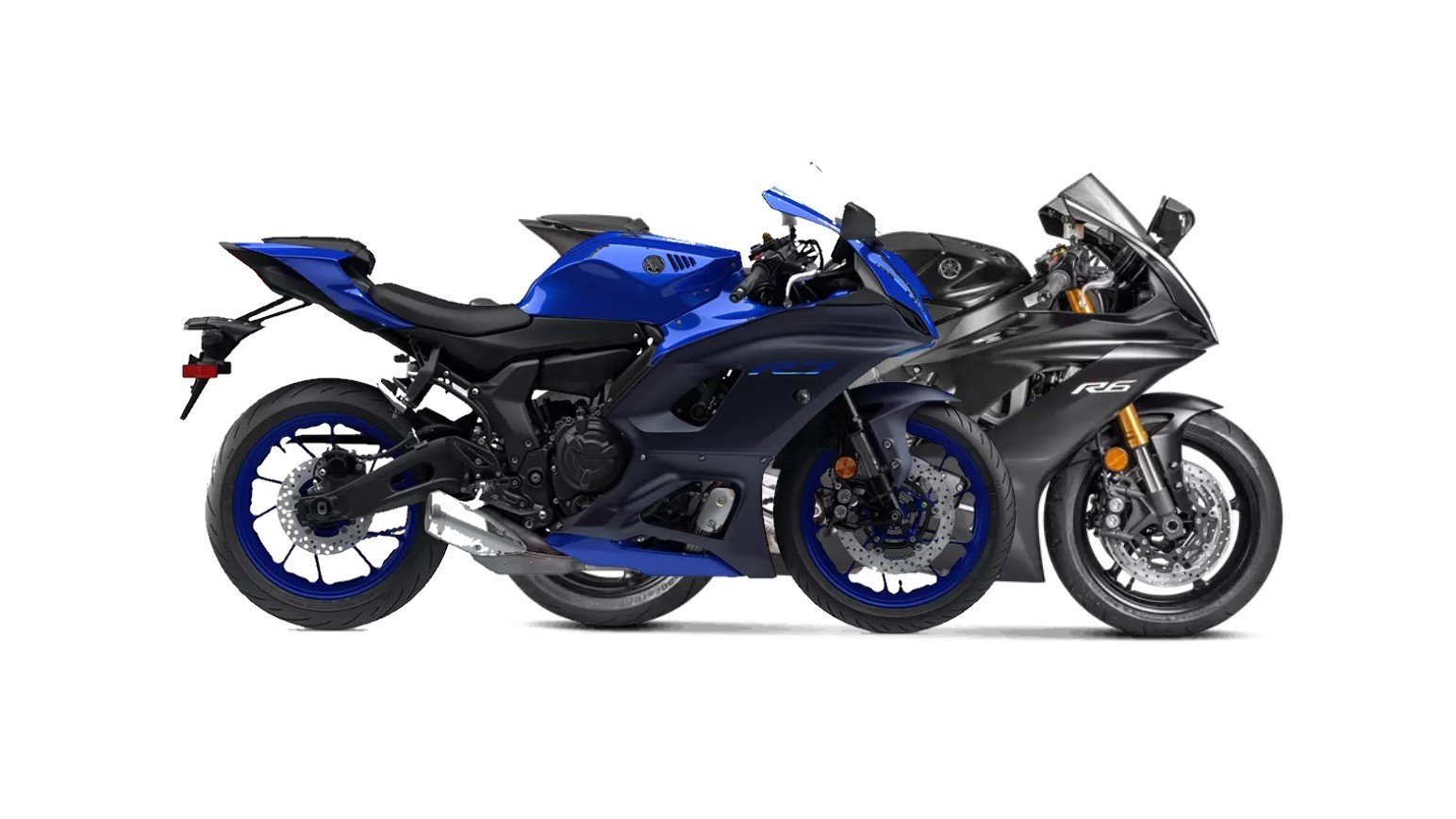
The new Yamaha YZF-R7 and the discontinued YZF-R6 are both middleweight supersport motorcycles with similar engine displacements, yet they could hardly be more different in character.
The R7 uses the familiar CP2 parallel-twin engine from the MT-07 and XSR700 – a 689 cc unit.
By contrast, the iconic YZF-R6 is powered by one of the highest-revving inline-four engines ever fitted to a mass-produced motorcycle.
From the factory, the R6’s 599 cc engine was the first production powerplant of any kind to achieve the magic 200 horsepower per litre mark.
While some Japanese 250 cc four-cylinder bikes from the 1990s may have reached similar specific output on paper, they were mainly sold domestically in Japan and only reached other markets as grey imports.
Despite their similar capacities, the two engines are worlds apart in terms of peak power and how they deliver it.
The Yamaha R6 is an extreme high-revving engine, producing 110 horsepower at the rear wheel at 14,900 rpm and 43 ft-lb of torque at 11,000 rpm.
Most Supersport 600s need high revs to perform, but the R6 is particularly demanding.
While many rivals will drive reasonably well from 6,000 rpm and start to pull strongly by 8,000-9,000 rpm, the YZF-R6 really requires you to keep the revs above 9,000 rpm if you want meaningful acceleration.
Even by Supersport 600 standards, the R6 has a very peaky engine.

The Yamaha YZF-R6 has always been this way, particularly the very last models. Emissions regulations gradually eroded what little bottom- and mid-range the R6 originally possessed, and it never had much to begin with.
A de-cat exhaust and ECU flash (or a proper custom dyno tune) make a huge difference, but in stock form, the engine feels lacking until you get it screaming near the redline.
Once you work the R6 hard, it transforms into a missile and accelerates with ferocious speed.
It remains one of the quickest 600 cc supersports ever made and can still embarrass many 750s and even some litre bikes from the 1990s.
By contrast, the new Yamaha YZF-R7 produces only around 70 horsepower at the rear wheel exactly the same as the MT-07 with which it shares its engine.
This is no surprise.
While the R7 is down around 40 horsepower on the R6, it makes significantly more torque around 48 ft-lb -and delivers it much lower down, at just 6,500 rpm.
The new R7 completely dominates the short-stroke, highly strung R6 anywhere below and up to 9,500 rpm.
At its peak, the R7 produces 20 horsepower more than the R6 at 7,000 rpm.
That is an extremely significant and very noticeable advantage when riding the two bikes back-to-back.
Between 3,000 and 4,000 rpm, the R7 produces roughly twice the torque of the R6. It is very impressive.
Of course, once you give the YZF-R6 room to breathe and let it use its incredibly long rev range, the engine eventually wakes up once the revs pass 9,500 rpm.
To illustrate the dramatic difference between these two engines, 9,500 rpm is roughly the point at which you would normally change gear on the YZF-R7, yet on the R6, the engine has barely started to come alive.
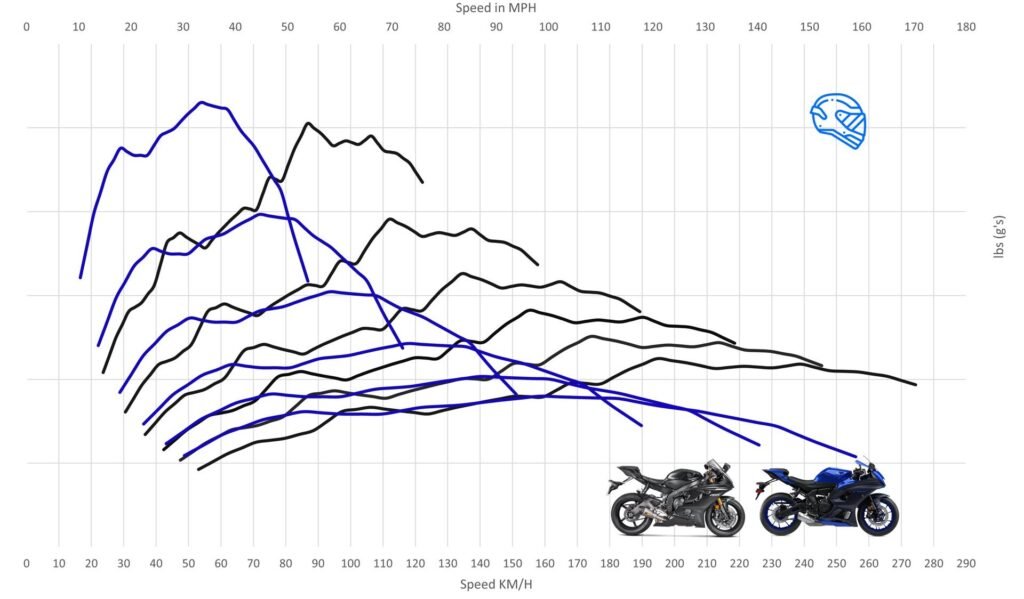
Yamaha R6 vs R7 in-gear acceleration comparison
– YZF-R7 – YZF-R6
The Yamaha YZF-R7 uses longer gearing than the YZF-R6. There are two main technical reasons for this.
Firstly, the R7 revs significantly lower than the R6, so longer gearing is required to ensure that its top speed in each gear is not limited by its relatively modest rev ceiling.
Secondly, the R7 produces much more power and torque at lower rpm. This means that acceleration is not compromised by the taller gearing.
The R7’s first gear is only around 4.5% longer than the R6’s, so the ratios are actually quite similar, despite the R7 making considerably more power and torque in the mid- and low-rpm ranges.
You can clearly see the benefit of this combination of stronger low-end grunt and taller gearing when comparing the thrust curves.
In first gear, the YZF-R7 produces more peak thrust and acceleration than the R6, even with its 40-horsepower deficit.
Anywhere below 45 mph in first gear, the R7 completely dominates the R6 for thrust, delivering instant, wheelie-inducing acceleration.
By contrast, the R6 takes longer to spool up, but once it does – around 50 mph in first gear, it takes off aggressively, with the front wheel eager to lift.
At 50 mph, the R7 would typically be looking to change up to second gear, while the R6 is still screaming hard and accelerating strongly in first.
This highlights the R7’s superior low-end grunt. In second gear, the R7’s thrust curve closely matches the R6’s first-gear thrust up to around 40 mph.
After that point, the R6 finally comes alive and starts to lay down serious acceleration.
The same pattern repeats when comparing the R7’s third-gear thrust with the R6’s second-gear curve — they are very similar up to around 50 mph.
Yamaha R7 vs R6 Speeds in each gear at 5000 rpm
| Speed at 5000 rpm | YZF-R7 | YZF-R6 |
| Speed 1st Gear | 25.6 mph | 24.5 mph |
| Speed 2nd Gear | 34.3 mph | 31.6 mph |
| Speed 3rd Gear | 44.7 mph | 38 mph |
| Speed 4th Gear | 56.1 mph | 43.8 mph |
| Speed 5th Gear | 66.9 mph | 49.2 mph |
| Speed 6th Gear | 75.7 mph | 55 mph |
On the road, this means the YZF-R7 can often run a gear higher than the YZF-R6 in the first four gears at speeds below 90 mph, while still delivering similar or even better acceleration.
To further illustrate the R7’s strength compared with the R6, in any same-gear roll-on from below 90 mph where the R6 is sitting below 9,000 rpm, the R7 comprehensively beats it.
It is only in fifth and sixth gears, and at speeds below 90–100 mph, that both bikes offer similar drive,
On the flip side, it does not matter which gear you are in on the R7 — if the R6 has its revs above 9,000 rpm, it will gap the R7 without much effort.
The R7’s key strengths shine on slow, technical roads with hairpins and very low-speed corners (typically below 50 mph). Here, its superior thrust and acceleration in the lower gears allow it to drive out of corners harder.
For the R6 rider to have any chance of matching the R7’s corner-exit acceleration below 50 mph, they would need to aggressively slip the clutch.
Even then, that advantage would be very short-lived.
Once out of the corner, if the following straight is long enough, the R6 would quickly claw back the initial deficit, catch the R7, and pull ahead.
As the roads open up and speeds increase, the advantage swings firmly in favour of the R6.
On faster roads, it can use more of its rev range.
For example, when accelerating out of a fast sweeping corner at 80 mph, the R6 can use second, third or even fourth gear and deliver more acceleration than the R7, regardless of which gear the R7 rider chooses.
And of course, once the road really opens up, the R6 will simply disappear, as clearly shown by the acceleration data.

Yamaha R6 vs R7: Acceleration and top speed
– YZF-R7 – YZF-R6
In an outright acceleration contest, it is a foregone conclusion that the Yamaha YZF-R6 is significantly faster than the YZF-R7.
Sorry if you were rooting for the R7!
From a standing start, however, the two bikes are surprisingly close, with the difference coming down largely to rider skill.
From 0-30 mph, the YZF-R7 actually has a small advantage of a few tenths. This is because the R7 is easier and more consistent to launch hard without bogging down.
The R6, on the other hand, requires precise revs, throttle and clutch control. If you do not get it exactly right, the engine will bog.
As the thrust curves show, the R7 produces more peak thrust in first gear, so one might expect it to be noticeably quicker through first gear – and it is, but only up to around 50 mph.
If both bikes could put all their thrust to the ground without wheelies, the R7 would be quite a bit faster to 40 mph than its one-tenth-of-a-second advantage suggests.
Despite the differences in peak thrust and delivery in first gear, their actual 0-60 mph times are very close.
When all is said and done, the YZF-R7 achieves 0-60 mph in 3.27 seconds, but the R6 edges it with a time of 3.19 seconds.
The R6 is quicker to 60 mph despite having less peak thrust in first gear. This is possible because it produces a greater average thrust over a wider speed range.
Looking at the thrust curves in first gear, the R6 can reach over 75 mph, while the R7 is limited to around 50 mph right at the rev limiter.
Crucially, the R6 can comfortably hit 60 mph in first gear without needing to change up.

The YZF-R7 may produce more peak thrust in first gear, but the rider must change up to second gear at around 50 mph to keep accelerating.
That extra gear change does hurt the R7’s 0-60 mph time.
At this point, the R7 (now in second gear) is producing significantly less thrust than the R6, which is still in first gear and laying down considerably more acceleration above 50 mph.
It is at 60 mph where the R6 really starts to get comfortable and quickly drives away from the R7, reaching 0-100 mph in just 6.08 seconds.
Taking all of this into account, the R6’s 0-60 mph time is a little more elastic.
The R7 launches harder but begins to run out of breath as it approaches 50 mph, while the R6 wakes up and delivers its peak thrust.
Thanks to its massive rev range, the R6 can almost reach 100 mph at the limiter in second gear, although most riders would normally shift into third.
The Yamaha YZF-R7, despite its longer gearing, requires more gear changes to reach 100 mph.
Even with three gear changes and reaching fourth gear, it manages 0-100 mph in an impressive 7.88 seconds.
However, you must nail the launch and execute perfect gear changes. If not, you will be lucky to break into the high 8s or low 9s.
As mentioned, when everything aligns, the R7 can dip into the 11-second bracket for the quarter mile, with our best time being 11.64 seconds at an impressive 116 mph terminal speed.
Eleven-second quarter-mile times on an R7 are about as good as it gets with a lightweight rider. Most competent riders will be running low to mid-12s, especially if they are of average weight.
The YZF-R6, on the other hand, can dip into the tens all day long – provided you get a good launch and avoid bogging.
I managed a best time of 10.89 seconds with a terminal speed of 133 mph.
The terminal speed for the R6 is about right, but a few tenths could probably be shaved off the elapsed time with more runs.
Either way, these times would still embarrass many late-90s 750s and 900s – very impressive.
Most decent riders will be running low to mid-11s on the R6 because it is not the easiest bike to launch cleanly.
Without enough revs, it bogs, and once you get the clutch fully engaged and open the throttle, it wants to wheelie as soon as it hits the powerband.
At the point the R7 crosses the quarter-mile line, the R6 is already around 55 metres ahead and pulling away convincingly.
If you keep it pinned, the R6 will top out at 161.3 mph. This is a little lower than many R6s are capable of – most will reach 165 mph or more.
While the R7 is impressively quick through the quarter mile, its acceleration tails off noticeably after 130 mph.
With a good tuck and favourable conditions, a real top speed of 139 mph is achievable, which equates to around 150+ mph on the speedometer.
Either way, for an entry-level sportbike, that is not hanging about.
In practice, the R7 works best below 110 mph but will happily pull to an indicated 130 mph, with the final stretch only coming with a committed, fully tucked riding position.
The YZF-R6 is clearly the faster bike overall, especially above 100 mph.
However, at legal speeds and on slower, twistier roads, the R7, despite being down 40 horsepower, punches well above its weight and can spank the R6 if the R6 rider is caught sleeping or in the wrong gear.
The Yamaha YZF-R7 is not a spiritual replacement for the YZF-R6, but it does take its place in Yamaha’s range as the new middleweight supersport offering now that the R6 has become largely track-only in most markets where it is still sold.
| Speed | Yamaha YZF-R7 | Yamaha YZF-R6 |
| 0-10 mph | 0.34 | 0.52 |
| 0-20 mph | 0.96 | 1.04 |
| 0-30 mph | 1.48 | 1.57 |
| 0-40 mph | 2.00 | 2.1 |
| 0-50 mph | 2.54 | 2.64 |
| 0-60 mph | 3.27 | 3.19 |
| 0-70 mph | 4.10 | 3.73 |
| 0-80 mph | 5.07 | 4.44 |
| 0-90 mph | 6.35 | 5.15 |
| 0-100 mph | 7.88 | 6.08 |
| 0-110 mph | 10.00 | 7.08 |
| 0-120 mph | 12.80 | 8.45 |
| 0-130 mph | 18.26 | 10.04 |
| 0-140 mph | N/A | 12.53 |
| 0-150 mph | N/A | 16.12 |
| 0-160 mph | N/A | 32.92 |
| 60-130 mph | 14.72 | 6.86 |
| 100-150 mph | N/A | 10.04 |
| SS/QM | 11.64@116mph | 10.89/133 mph |
| SS/KM | 22.40 @132.5 mph | 19.92/154 mph |
| SS/Mile | 32.48 @134mph | 28.46/159 mph |
| Top Speed | 139 mph | 161.3 mph |