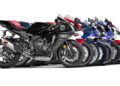
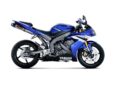
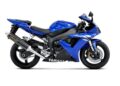
1998 Yamaha YZF-R1 0-60 mph in 2.93 seconds
At the time of writing, 23 years have passed since the original 1998 Yamaha YZF-R1 was launched.
This legendary machine caused a huge stir and remains one of the most significant motorcycles ever made.
What made the 1998 R1 such a showstopper was that it delivered open-class power in an extremely lightweight supersport chassis.
It’s a phrase that has been said to death, but “it’s the size of a 600” entered the motorcycle lexicon because of the ’98 R1.
Before the Yamaha R1 arrived in the superbike/open-class segment, Honda’s CBR900RR was the top dog (although technically it was not a superbike under the rules of the time).
The CBR900RR mainly competed against 750 cc machines such as the Suzuki GSX-R750, Kawasaki ZX-7R, and Yamaha YZF750, the actual superbikes of the era under World Superbike capacity rules for inline-fours.
Its other main rival was the Kawasaki ZX-9R, which at the time was the straight-line king among sub-900 cc bikes but was heavier and handled worse.
The 1998 revision of the ZX-9R brought it closer to the CBR900RR in terms of handling.
There were also other litre and litre-plus machines such as Yamaha’s own YZF1000 Thunderace and Suzuki’s legendary GSX-R1100, but they were heavier and far less sporty.
Hyperbikes of the day, such as Honda’s CBR1100XX Blackbird and Kawasaki’s ZZR1100, were faster in a straight line but heavy, bulky, and never considered true superbikes in the same way the 750s were.
The 750 cc bikes were literal superbikes, while the Honda CBR900RR combined the lightweight chassis, sharp handling, and strong brakes of a 750 with a larger, more powerful engine.
Thanks to the shape of the high-performance motorcycle market in the mid-1990s, the Honda CBR900RR enjoyed huge success.
Arguably, from an all-round performance perspective, the 1996 Suzuki GSX-R750 came closest to challenging it.
That bike made comparable peak power and was arguably better handling, but its engine and ergonomics were heavily track-focused rather than road-oriented.
The Honda CBR900RR’s engine, while similarly fast on top, offered significantly more mid-range and bottom-end torque than the GSX-R750.
This made the CBR900RR far more usable on the road, requiring fewer gear changes and less constant thrashing.
The introduction of the Yamaha YZF-R1 completely changed the 750–900 cc class and turned the open class on its head.
The 1998 R1 combined superbike-level handling with open-class engine performance and killer looks that still appear modern today. It was a recipe for massive success.
The 1998 Yamaha YZF-R1 effectively created the modern 1000 cc sports bike class.
It is very likely that the change in World Superbike rules, increasing the capacity limit for four-cylinder bikes from 750 cc to 1000 cc, was heavily influenced by the R1’s popularity and the way it redefined the sports bike segment.
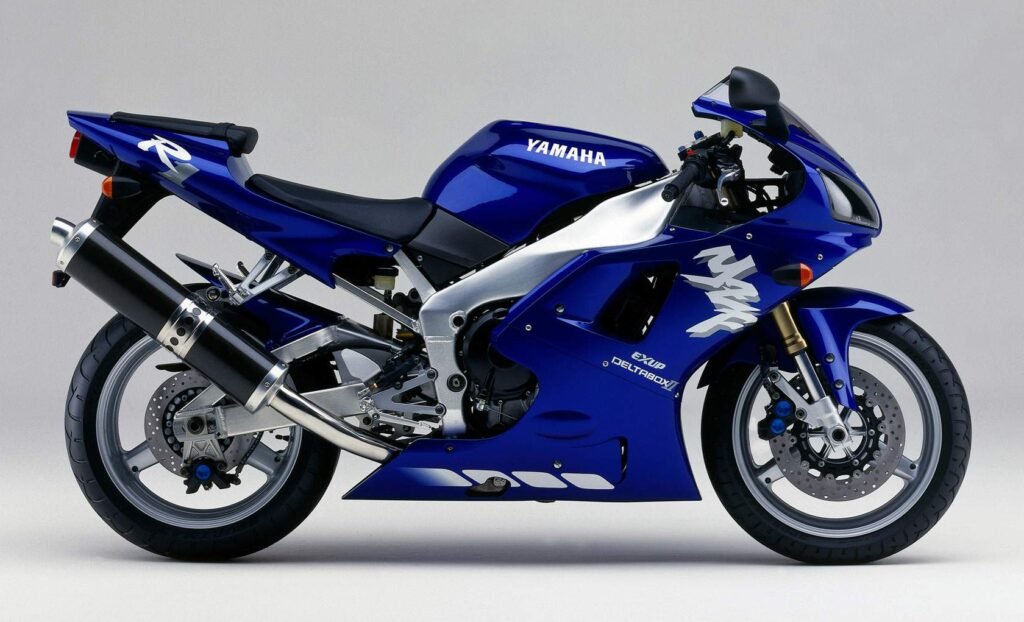
If you own a 1000 cc four-cylinder superbike today, you can thank the 1998 Yamaha YZF-R1 for not being a 750.
The Yamaha YZF-R1 featured an all-new 20-valve 998 cc engine producing a claimed 150 hp at the crank, packaged in a motorcycle weighing just 177 kg dry.
In terms of overall dimensions, it was smaller than any 600 cc supersport of the time.
To this day, the original R1 remains lighter and more compact than many current motorcycles.
Depending on the source, it is actually around 2 kg lighter than the current Yamaha R1.
The engine featured a stacked (cassette) gearbox — the first of its kind on a production bike.
This design has since been adopted by many manufacturers.
The idea behind the stacked gearbox was to shorten the engine, allowing Yamaha to fit a longer swingarm than would normally be possible with a conventional layout.
A longer swingarm helped maintain a short overall wheelbase (1,395 mm) for sharp handling while reducing the tendency to wheelie that often plagues high-power, short-wheelbase bikes.
The 1998 R1 is still a notorious wheelie machine, so it is debatable how effective the longer swingarm actually was.
Given the extremely short wheelbase and the massive power increase in such a light package, it might have wheelied even more with a conventional swingarm.
Who knows – but the technology clearly has merit, as stacked gearboxes on four-cylinder engines are now commonplace.
1998 Yamaha YZF-R1 engine performance
Once measured on a dyno and accounting for the typical 10–12% transmission losses, the 1998 R1 produced around 130–135 hp at the rear wheel.
Some magazine tests of the day showed figures over 140 hp, but a healthy, low-mileage 1998 YZF-R1 will usually make around 135 hp at the wheel today.
135 hp may not sound impressive by modern standards, where current litre bikes produce 180–200 hp at the wheel.
Do not be fooled, though…
We have to view this number in the context of 1998. Even today, a 1998 Yamaha YZF-R1 is still impressive, especially if you have just stepped off a new litre bike and onto the original R1.
Motorcycles of that vintage had no electronic throttle restrictions or power-softening maps. What you got was raw, direct power.

If you asked for 82% or 100% from the R1, you got exactly what you asked for. This made the motorcycle feel incredibly keen and responsive.
The 135 hp figure was around 15 hp up on the 1998 CBR900RR and 15–20 hp up on the 750 cc bikes.
The ZX-9R came closest in peak power but was generally 5–10 hp down at the top end and made significantly less power throughout the rest of the rev range.
That peak-power advantage might not sound huge, but the R1 was at least as light as the lightest of its competitors (the GSX-R750) and considerably lighter than most of the others.
The main thing that made the R1 engine so impressive was the sheer amount of usable grunt it delivered across the entire rev range.
That wonderful engine was also perfectly matched to relatively low gearing, which complemented its output characteristics beautifully.

1998 Yamaha YZF-R1 Dyno Curve
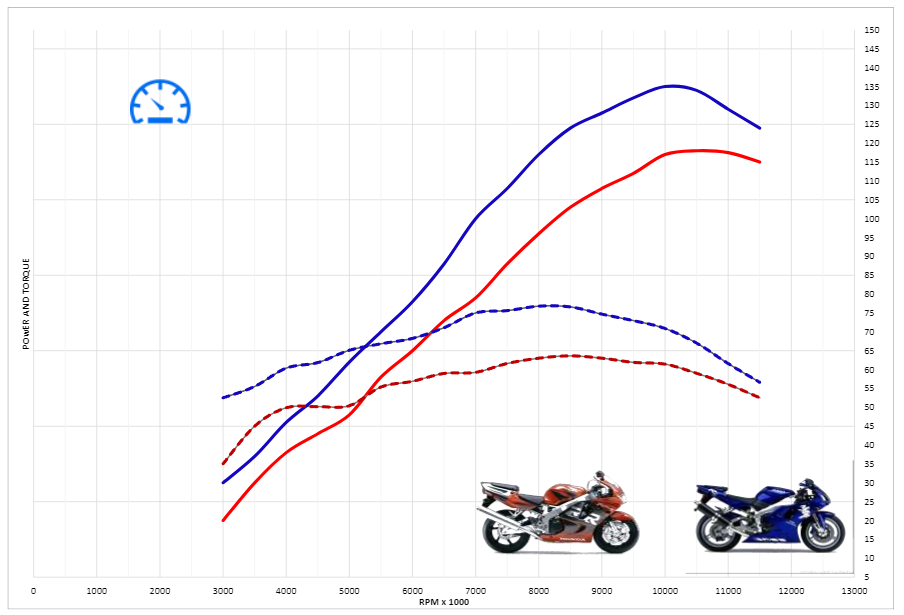
Our 1998 Yamaha YZF-R1 makes a solid 135 horsepower at just below 10,500 rpm.
Peak torque is an impressive 76.8 ft/lb at 8,000 rpm.
What is truly impressive is how much mid-range and bottom-end power the R1 had over its competitors.
It was already making almost 80 hp at 6,000 rpm – 15–20 hp more than its rivals at the time.
The 1998 Yamaha YZF-R1 is very much the roll-on king. Maybe not any more but certainly back in the day.
You can put it in top gear at 30 mph and, in what seems like just a few seconds, it will launch you past 100 mph.
Even today, the original R1 can beat many current litre bikes in a top-gear roll-on from any speed under 100 mph.
To put the 1998 R1 engine into context, look at the dyno curve below and see how it completely stomps the CBR900RR.
1998 Yamaha YZF-R1 Vs CBR900RR Dyno Curve
It is pretty obvious just by comparing the two graphs how great the 1998 Yamaha YZF-R1 engine really is.
Sure, other litre bikes – and even Yamaha’s own Thunderace- had similar peak power, but that motorcycle weighed almost 30 kg more and used a five-speed gearbox.
GSX-R1100s and other machines of the era were even heavier, some 50 kg more than the 1998 R1, which significantly impacts performance.
Never before had an engine with this level of output been fitted into such a light and nimble chassis package.
The 1998 R1 is only around 3 kg lighter than the 1998 CBR900RR, yet its engine produced almost 20 horsepower more at peak, 20 horsepower more from 7,000 rpm upward, and significantly more torque at lower rpm.
It simply dominates on the dyno.
This translated into the 1998 R1 being a much faster-accelerating motorcycle, both outright and in-gear, with far more explosive roll-on performance.
This is clearly shown in the thrust curve below, which plots in-gear acceleration/thrust against road speed for each gear.

1998 Yamaha YZF-R1 Vs CBR900RR in-gear acceleration
By studying the thrust/acceleration curve above, it is very clear just how dominant the 1998 Yamaha R1 engine is.
There is not a single speed in any gear where the 1998 CBR900RR even comes close to matching it, let alone beating it.
A great example of the 1998 R1’s astonishing in-gear acceleration is that, anywhere between 50–110 mph, the 1998 CBR900RR would need fourth gear to match the acceleration that the 1998 R1 produces in sixth gear.
That is incredible.
Equally impressive is that the 1998 R1 in fourth gear is slightly more accelerative than the 1998 CBR900RR in third gear.
The 1998 CBR’s first three gears are slightly shorter than the R1’s, but fourth, fifth, and sixth are longer.
Honda did not need to gear the 1998 CBR900RR so tall; it had no chance of reaching the rev limiter in top gear anyway, given the power it produced.
I suppose they felt they didn’t have to, because despite the long gearing, the engine still had enough torque to dominate the 750 cc bikes. It just couldn’t match the R1.
1998 Yamaha YZF-R1 Acceleration
The moment the R1 arrived in 1998, it instantly became the fastest-accelerating production motorcycle on the planet – at least up to around 160 mph.
It was even more accelerative than the Honda CBR1100XX Super Blackbird, which was arguably the fastest motorcycle at the time. Kawasaki fans might argue it was the ZZR1100, but either way, the R1 made similar peak power to both machines while weighing 40–50 kg less.
The Blackbird only held the advantage right at the very top end and above 160 mph, thanks to its superior aerodynamics and better wind protection from the fairing and screen.
It was only the arrival of Suzuki’s Hayabusa in 1999 that finally took the crown as the most accelerative production motorcycle.
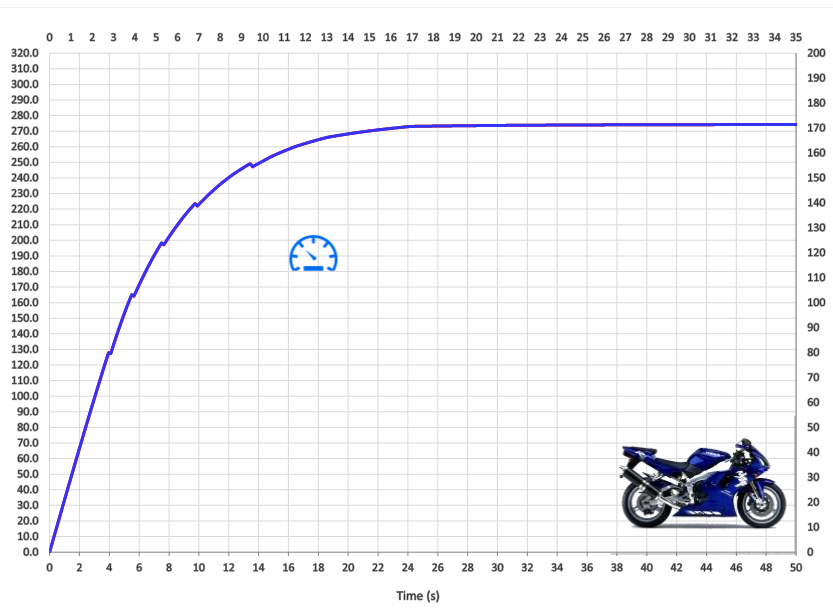
Even so, the 1998 Yamaha YZF-R1 remains incredible. It sprints from 0-60 mph in just 2.93 seconds and 0-100 km/h in 3.04 seconds.
The 1998 R1 is not the easiest bike to launch. With its relatively low first gear and strong mid-range torque, it loves to lift the front wheel.
There was no wheelie control or traction control back then, but the R1 benefits from excellent, smooth carburation.
With good throttle control, sub-3-second 0-60 mph times were more than achievable, and some magazine testers recorded even quicker runs.
The 1998 Yamaha YZF-R1 reaches 0-100 mph in 5.32 seconds and covers the quarter mile in 10.29 seconds at a terminal speed of 140 mph.
It hits 0-200 km/h in a flat 8 seconds and 0-150 mph in a very impressive 12.16 seconds – a time that is not far off many current litre bikes even today.
From there, the original R1 continues charging hard toward 160 mph before eventually running out of steam at a top speed of 171 mph.
Some R1s of this era have been recorded going faster, but the tiny screen and limited aerodynamics make it difficult for the rider to tuck effectively.
Even today, compared with the latest superbikes, the 1998 R1 stays surprisingly competitive up to around 140 mph. It is only beyond that point that modern bikes start to pull away convincingly.
In the real world, the R1’s low gearing and strong torque mean it blasts from corner to corner like a rocket.
These bikes also respond extremely well to tuning. It is not uncommon to see a healthy 1998 R1 making 145 hp at the wheel and over 80 ft/lb of torque.
The original R1 still impresses today. You would have a few problems keeping up with friends on newer bikes – unless you find yourselves on long highways racing toward 180 mph.
| 1998 Yamaha YZF-R1 Acceleration | |
| Speed | Time |
| 0-10 mph | 0.48 |
| 0-20 mph | 0.96 |
| 0-30 mph | 1.44 |
| 0-40 mph | 1.93 |
| 0-50 mph | 2.43 |
| 0-60 mph | 2.93 |
| 0-70 mph | 3.44 |
| 0-80 mph | 4.14 |
| 0-90 mph | 4.70 |
| 0-100 mph | 5.32 |
| 0-110 mph | 6.62 |
| 0-120 mph | 7.17 |
| 0-130 mph | 8.51 |
| 0-140 mph | 10.23 |
| 0-150 mph | 12.16 |
| 0-160 mph | 15.77 |
| 0-170 mph | 29.07 |
| 0-180 mph | n/a |
| 0-190 mph | n/a |
| 0-200 mph | n/a |
| 60-130 mph | 5.58 |
| 100-150 mph | 6.84 |
| SS/QM | 10.29/140.4 mph |
| SS/KM | 18.90/165 mph |
| SS/Mile | 26.86/169 mph |
| Top Speed | 171 mph |