CBR500R vs Ninja 400 acceleration and top speed
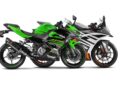
The Kawasaki Ninja 400 and Honda CBR500R compete against each other in the wildly popular and extremely diverse entry-level and learner motorcycle class.
If you are considering either of these motorcycles and are undecided, you will likely want to know how they compare in a straight line.
It is very close.
We have previously tested both machines, but we thought it would be useful to put their numbers side by side and compare their engine and straight-line performance in detail.

Ninja 400 vs CBR500 Dyno Curve
– Ninja – CBR
Both the Honda CBR500R and Kawasaki Ninja 400 use the same basic engine configuration: parallel-twin cylinders.
The Honda CBR500R holds a clear advantage in engine capacity, with an extra 73 cc over the Kawasaki’s smaller 399 cc unit.
Despite this roughly 20% capacity advantage, both motorcycles produce exactly the same peak power on the dyno – 44 horsepower each.
However, the two engines deliver their power very differently.
Honda’s 44 horsepower arrives at just over 8,000 rpm, while the Kawasaki produces its peak output between 9,500 and 10,500 rpm.
Although both bikes make the same peak power (albeit at different engine speeds), the CBR500R has a clear advantage in peak torque.
It delivers 32 ft-lb between 5,500 and 7,000 rpm, comfortably beating the Ninja 400’s 26 ft-lb, which is produced much higher up at 8,500 rpm.
Both engines are impressively smooth, despite some minor dips visible on the dyno graphs that are barely noticeable on the road.
There is a little vibration from each, but far less than many other parallel twins, with the Honda having a slight edge in refinement.
At first glance, the dyno curves suggest the CBR500R should feel significantly punchier thanks to its much stronger torque output and the fact that its power and torque arrive lower in the rev range. However, the dyno does not tell the whole story.
Ninja 400 vs CBR500 in-gear acceleration
– Ninja – CBR
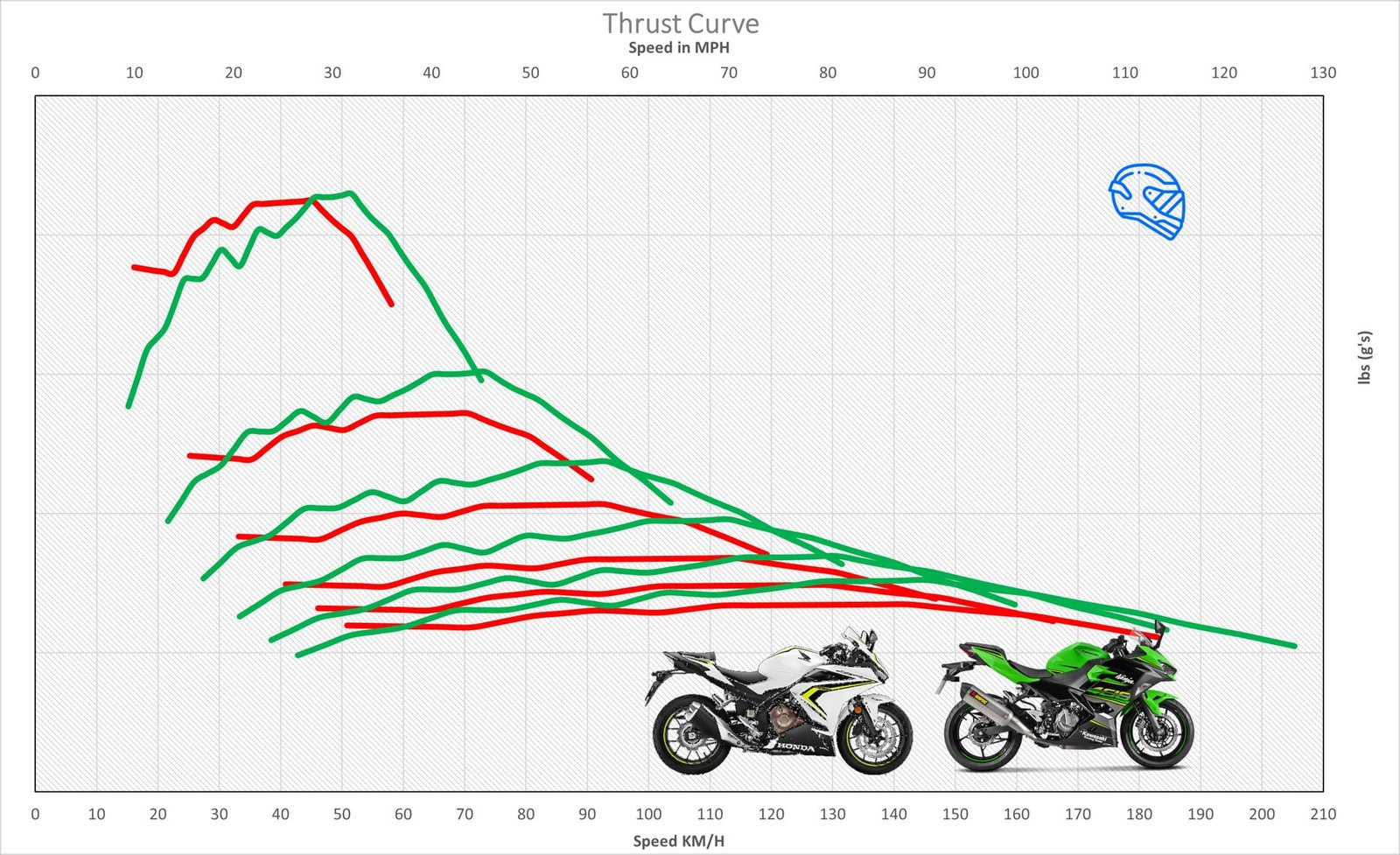
If we look at the in-gear thrust curves, we can see that things are quite different from what the dyno curves might suggest.
Despite giving away torque, the Kawasaki Ninja 400 provides more in-gear acceleration in almost every gear and at virtually any speed compared with the Honda CBR500R.
The CBR500R only appears to have the advantage in first gear and below 27 mph (45 km/h).
Beyond that point, the Ninja 400 dominates, delivering stronger acceleration throughout the usable speed range of each gear.
So why is this the case?
The Kawasaki Ninja 400 can rev approximately 3,000 rpm higher than the Honda CBR500R.
This higher rev limit allows Kawasaki to use lower overall gearing while still matching or even exceeding the theoretical top speed of the CBR500R in each of its six gears.
Lower gearing acts as a multiplier of the engine’s torque, which means more available thrust and stronger acceleration.
Engines that produce less torque but can rev higher can often compensate for the torque deficit through more aggressive gearing.
As a result, the Ninja 400 is able to close the gap and frequently surpass the CBR500R in in-gear acceleration, despite making less peak torque and less torque across the entire rev range.
For example, if both motorcycles were in second gear and rolling side by side at 30 mph, the Honda CBR500R would be showing approximately 4,7940rpm on the tachometer. At that engine speed, the Honda would be producing around 29 ft-lb of torque and 32 horsepower.
By contrast, the Kawasaki Ninja 400 at 30 mph in second gear would be revving at 5,592 rpm, making roughly 23 ft-lb of torque and about 24 horsepower.
Looking at those figures alone, one might assume the CBR500R would accelerate harder the moment the throttle is opened, thanks to its greater torque.
That seems legitimate at first glance, but it is not the whole picture.
Remember, gears act as a multiplier of torque, and the Kawasaki Ninja 400 has lower gearing than the Honda CBR500R.
Honda’s second gear, for example, is approximately 17% taller.
The weight of each motorcycle also plays a major role in the acceleration and thrust available in every gear.
The Kawasaki Ninja 400 is around 20 kg lighter than the Honda CBR500R, and this difference contributes significantly to its superior in-gear and outright acceleration.
The CBR500R could, in theory, run lower gearing to compensate, but because it only revs to around 9,000 rpm, doing so would reduce the top speed and overall usefulness of each gear.
Even with its current gearing, the Honda’s top speed in first gear is already lower than the Kawasaki’s, despite the Ninja 400 having a lower (shorter) first-gear ratio.
You can clearly see this speed difference when comparing the first-gear thrust curves of both bikes.
The table below compares the speed in each gear at 5,000 rpm. It shows that the Kawasaki Ninja 400’s first gear and all remaining gears are lower than the Honda’s.
This is because, at the same engine speed, the Ninja reaches lower road speeds in every gear.
If the Honda CBR500R were the same weight as the Kawasaki Ninja 400, it would likely produce at least the same level of thrust and acceleration in each gear at any given speed. At its current weight, it would also deliver even more thrust in first gear than it already does.
As things stand, the Ninja 400 offers slightly stronger in-gear acceleration when both motorcycles are side by side in the same gear at the same speed.
Because of its lower gearing, the Kawasaki will be showing slightly higher revs on the tachometer – typically between 500 and 1,000 rpm more, depending on the gear and road speed.
By contrast, the Honda CBR500R requires fewer revs to deliver similar (though ultimately slightly lower) in-gear performance.
This makes for a more relaxed riding experience, as you need less engine speed to get the job done.
Speed in each gear compared at 5000 rpm
| Speed at 5000 rpm | Honda CBR500R | Ninja 400 |
| Speed 1st Gear | 20.1 mph | 18.8 mph |
| Speed 2nd Gear | 31.3 mph | 26.8 mph |
| Speed 3rd Gear | 41.2 mph | 34.1 mph |
| Speed 4th Gear | 50.7 mph | 41.4 mph |
| Speed 5th Gear | 57.3 mph | 47.8 mph |
| Speed 6th Gear | 63.2 mph | 53.2 mph |
Both the Ninja 400 and the CBR500R produce the same peak power at the rear wheel, although the Honda makes a little more torque thanks to its 74 cc capacity advantage.
While their peak power figures are identical, the Ninja 400 holds a noticeable advantage in outright acceleration that becomes clear on the road.
The 0–60 mph times are close, with the Ninja 400 completing the sprint in 4.14 seconds compared with the CBR500R’s 4.72 seconds.
It is from 60 mph onwards that the Ninja 400 really starts to pull away. It reaches 0–100 mph in 11.90 seconds, comfortably beating the Honda’s time of 14.17 seconds.
In the quarter-mile, the Ninja 400 holds a half-second advantage, recording a very impressive 12.98 seconds with a terminal speed of 102 mph.
A late gear change just before the finish line hurts the Ninja 400’s terminal speed a little, but without it, the bike would hit the rev limiter.
The CBR500R manages a 13.5-second quarter-mile at 98 mph, trailing the Ninja 400 by roughly 20 metres.
Top speeds are strikingly close. If allowed to continue accelerating, the Ninja 400 will extend its lead until it reaches its measured top speed of 116.8 mph.
Surprisingly, the CBR500R matches the Ninja almost exactly for outright top speed.
At first glance, this seems surprising, but it makes sense when you consider that both bikes produce very similar peak power.
That said, I believe the Ninja 400’s 116.8 mph could be improved slightly with better conditions or a small tweak.
The Honda CBR500R, by contrast, is already at its absolute limit – sitting on the rev limiter in top gear with no more to give.
Overall, it is clear that the Ninja 400 is the faster motorcycle, whether accelerating from a roll or going flat-out through the gears.
The Kawasaki will gradually pull away from the Honda until both bikes reach their similar top speeds.
Both motorcycles were tested on different days but in very similar conditions. Even so, my feeling is that, on average, the Ninja 400 would record a slightly higher top speed more often than not.
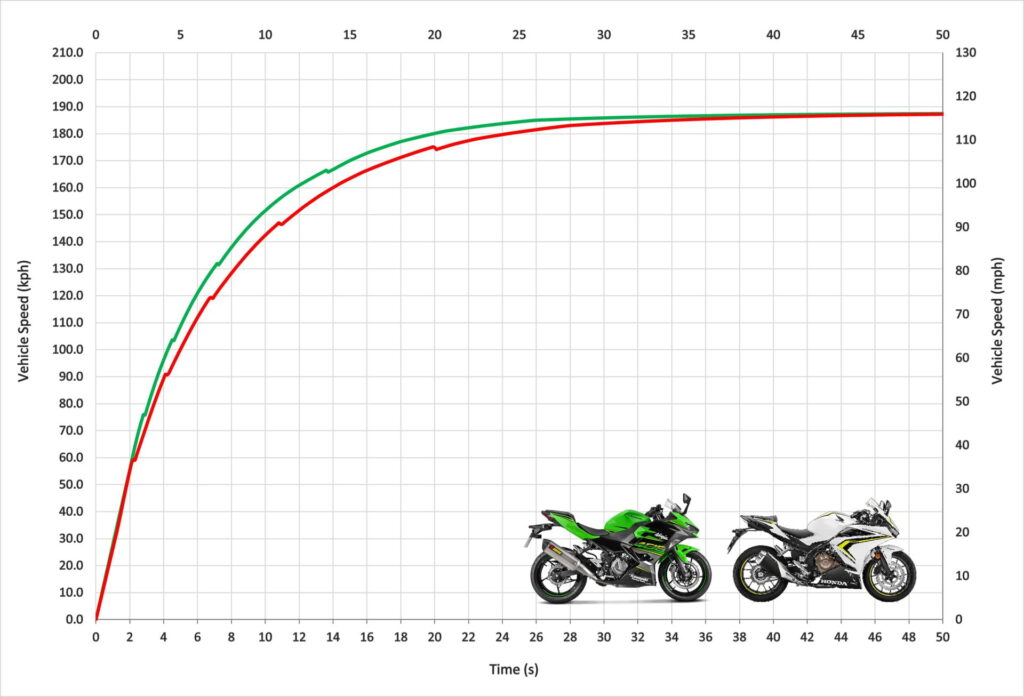 – Ninja – CBR
Ninja 400 vs CBR500R acceleration and top speed
| Speed | Honda CBR500R | Ninja 400 |
| Time | Time | |
| 0-10 mph | 0.64 | 0.62 |
| 0-20 mph | 1.24 | 1.24 |
| 0-30 mph | 1.75 | 1.87 |
| 0-40 mph | 2.62 | 2.49 |
| 0-50 mph | 3.46 | 3.28 |
| 0-60 mph | 4.72 | 4.14 |
| 0-70 mph | 6.03 | 5.39 |
| 0-80 mph | 8.06 | 6.83 |
| 0-90 mph | 10.31 | 9.93 |
| 0-100 mph | 14.17 | 11.90 |
| 0-110 mph | 21.74 | 17.51 |
| SS/QM | 13.5/98 mph | 12.98/102 mph |
| SS/KM | 26.01/113 mph | 25.12/114 mph |
| SS/Mile | 37.72/115 mph | 36.73/115 mph |
| Top Speed | 116.7 mph | 116.8 mph |