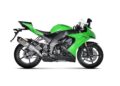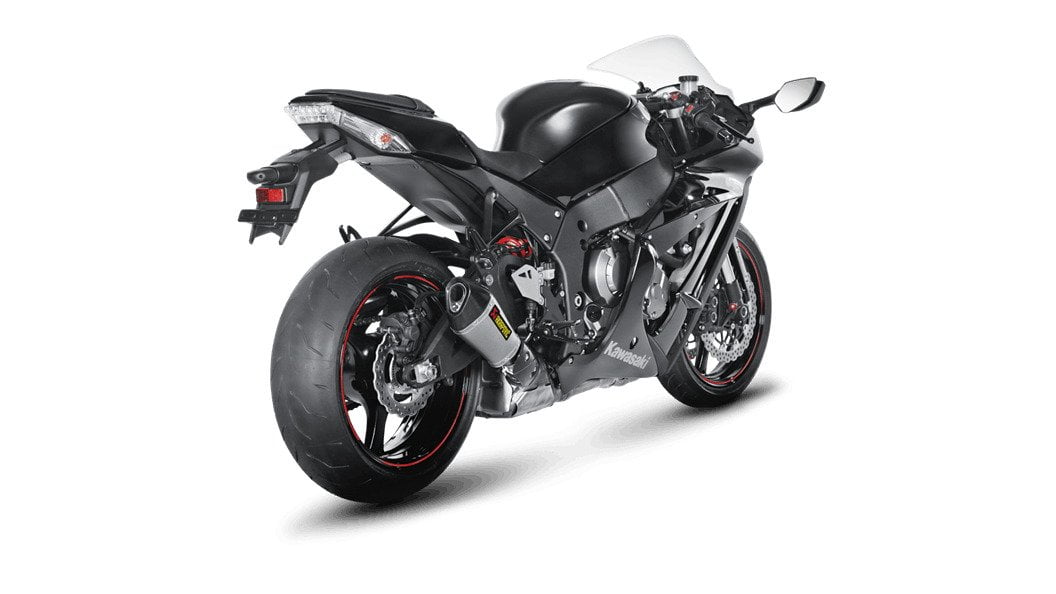
Kawasaki ZX-10R 0-60 mph in 2.91 Seconds
Kawasaki’s fourth-generation ZX-10R was introduced in 2011 as a direct response to the dominance of the BMW S1000RR that had arrived a couple of years before.
The 2008–2010 ZX-10R it replaced was not the complete package, but it arguably had the strongest engine of any Japanese litre bike until the BMW S1000RR surpassed it.
Kawasaki struck back with the 2011 ZX-10R, the most powerful version to date.
It produced a claimed 197.3 bhp at the crank – a figure that matched the S1000RR on paper but was often a little down when measured as rear-wheel horsepower on the dyno.
ZX-10Rs have always had great engines. I am not entirely sure that simply beating the S1000RR on paper was the main goal.
Kawasaki seemed more focused on creating a well-balanced motorcycle that combined strong engine performance with improved chassis behaviour, areas where previous ZX-10Rs had been criticised by the motorcycle press.
ZX-10Rs had long been more engine than chassis, but they were wildly fast and developed a strong cult following, largely thanks to the original 2004 model.
The 2011 (Gen 4) Kawasaki ZX-10R proved to be an excellent package and platform.
This bike, along with its revised variants, has since won seven World Superbike Championships from 2013 to the present day.
The only year it did not win was 2014, when Max Biaggi took the title on the Aprilia RSV4.

2011 Kawasaki ZX-10R Dyno Engine Performance
As noted already, the 2011 Kawasaki ZX-10R was the most powerful ZX-10R yet.
To extract close to 200 crank horsepower while retaining the same 76.0 mm × 55.0 mm bore and stroke that had been used since the first ZX-10R in 2004, Kawasaki had to look elsewhere for gains.
The marginal improvements over the 2008-2010 model came mainly from larger throttle bodies and a slightly higher compression ratio of 13.0:1 (up from 12.9:1).
Kawasaki also fitted more aggressive cam profiles made from chromoly steel instead of the previous cast iron.
Other significant engine changes included completely revised intake and exhaust porting, lighter pistons, lower-tension piston rings, and a repositioned crankshaft for better mass centralisation.
Depending on the dyno, these tweaks delivered an extra 5–7 hp at the top end. However, when compared back-to-back with the 2008–2010 model, the new engine actually made less power and torque throughout most of the rev range.
The 2008–2010 model itself had already given away some mid-range and bottom-end compared with the Gen 1 and Gen 2 ZX-10Rs.
The trend with each new ZX-10R seems to be “robbing Peter to pay Paul” – losing a little in the bottom and mid-range while gaining at the top end.
To put it simply, although the 2011 ZX-10R produced around 175 hp at the rear wheel, it only made more power than its predecessor once past 11,000 rpm.
It delivers a very impressive peak figure, but it is quite peaky: it only makes 170+ hp within a narrow 1,000 rpm window, which is tighter than most of its competitors – even if they produce less peak power.
ZX-10Rs have always been known for their exceptionally long gearing, some would argue unnecessarily long.
Kawasaki likely chose this gearing with long, sweeping racetracks in mind rather than road use.
The 2011 model’s gearing is remarkably similar to the outgoing version, with only minor variations between individual cogs.
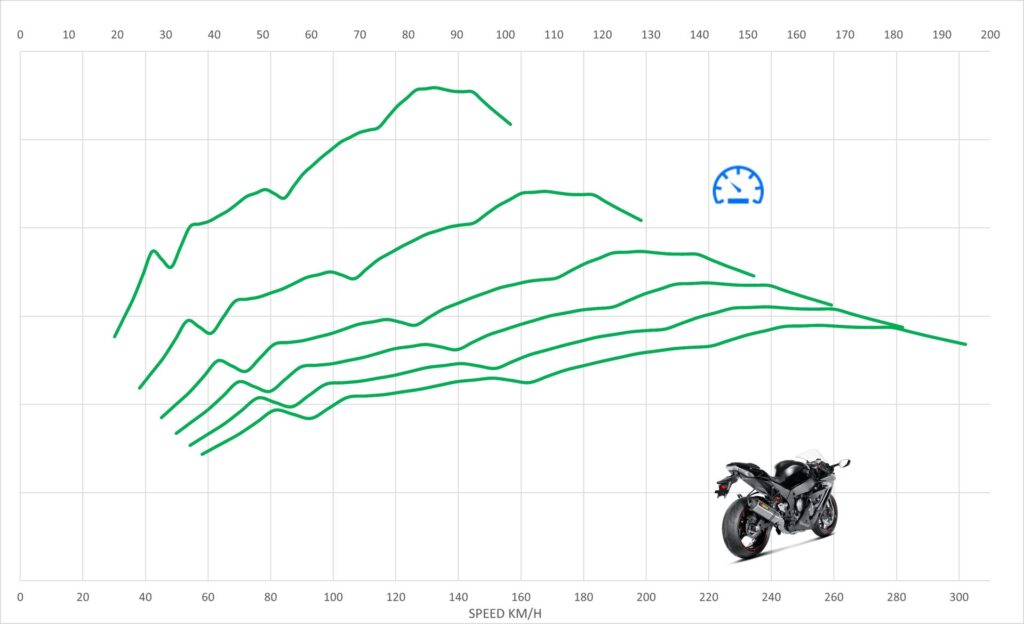
Some gears are longer, and some are shorter, but overall, the gearing is still probably too tall for the engine’s character and capability in stock form.
Being very long-geared by 1000 cc superbike standards, combined with a relatively weak bottom and mid-range, plus a very linear power build-up, makes the 2011 ZX-10R feel slow until the revs climb to and past 10,000 rpm.
The ZX-10R feels very much like a big 600 cc sportbike with an elastic powerband, only significantly faster.
In isolation, it is still rapid, but pretty much any litre bike from the last 20 years will stomp it below 10,000 rpm.
Even the original ZX-9R would surprise it in certain gears at certain rpm, and that bike only made around 125 hp from 900 cc.
The 2011 ZX-10R engine is a strong riser, though, and responds extremely well to a full exhaust system and a tune.
These modifications bring it much closer to its rivals in the bottom and mid-range while adding a solid chunk of extra horsepower at the top end.
As stock, however, the engine feels a little lacklustre if you are not constantly thrashing it, especially if you have just stepped off a rival such as any variant of the GSX-R1000, which all have explosive and highly responsive engines.

Kawasaki ZX-10R Acceleration and Top Speed.
After reading the above, you might think the ZX-10R is slow, but rest assured it is a ballistic motorcycle and faster than any previous ZX-10R.
You just have to work the engine a little harder to extract that extra speed.
It is difficult to get modern litre bikes off the line cleanly because they have so much power and are so light.
If a superbike could put all its power to the ground in first gear, we would be seeing 0-60 mph times under 2 seconds.
Even with electronics and anti-wheelie systems, it is still not possible due to the high centre of gravity and short wheelbase of sportbikes.
Lowering and strapping the bike would allow almost any litre bike to run exceptionally low 2-second 0-60 mph times, but in stock form, the best times are usually high 2s to low 3s.
The ZX-10R also has too much power to put down easily, but unlike many similar-powered litre bikes, its long gearing and relatively weak bottom and mid-range actually help it launch more consistently and with less drama than most.
While it will still wheelie in first gear, it does not try to lift the front with every small throttle input like some rivals, making it easier to lay the power down consistently.
This resulted in a 0-60 mph time of 2.91 seconds and 0-100 mph in 5.23 seconds. The Kawasaki ZX-10R was also able to dip under 10 seconds in the quarter mile with a strong 9.98 seconds at 151 mph.
That is an excellent time — anything under 10 seconds is next-level performance.
The ZX-10R reaches 0-200 km/h in 6.45 seconds, which is exceptional.
Shortening the gearing (without causing excessive wheelies) would likely yield even better times.
First gear could stay the same, but there is quite a big gap between first and second, and between second and third.
Bringing those ratios closer together would have been beneficial. I believe Kawasaki did exactly that with the 2015 revision of the ZX-10R.
The ZX-10R covers 0-150 mph in 9.70 seconds, which is right up there with the latest superbikes.
However, it starts to lag a little as it pulls through to 180 mph, which it achieves in 17.70 seconds — around 2–3 seconds slower than some of the newest machines.
The Kawasaki ZX-10R can accelerate from 0-300 km/h in 22.50 seconds.
The Dragy 60-130 mph benchmark is dispatched in a very impressive 4.50 seconds.
This is achieved from a standing start in first gear, which is difficult on many other litre bikes because of their aggressive wheelie tendency.
US-spec models, which are 15–20 hp down due to stricter emissions regulations, typically take over 5 seconds for the same 60-130 mph run.
The top speed of the ZX-10R is a very respectable 188.9 mph, which sits right at the limit of the 300 km/h gentlemen’s agreement.
On the road, the long gearing and relatively weak mid- and bottom-end mean the ZX-10R is not as responsive as its competitors.
Being in the wrong gear can easily cause other bikes to pull several bike lengths ahead.
However, once you get the engine singing above 10,000 rpm, it will beat or stay with most things on the road.
Adding a few teeth to the rear sprocket (or removing some from the front), flashing the ECU, and fitting a full exhaust system completely transforms the motorcycle.
It becomes a real weapon and puts it right up there with the latest superbikes. A well-fettled 2011 ZX-10R is no joke.
Kawasaki ZX-10R Acceleration and Top Speed.
| 11-15 Kawasaki ZX-10R Acceleration | |
| Speed | Time |
| 0-10 mph | 0.48 |
| 0-20 mph | 0.96 |
| 0-30 mph | 1.45 |
| 0-40 mph | 1.94 |
| 0-50 mph | 2.44 |
| 0-60 mph | 2.91 |
| 0-70 mph | 3.47 |
| 0-80 mph | 4.00 |
| 0-90 mph | 4.54 |
| 0-100 mph | 5.23 |
| 0-110 mph | 6.84 |
| 0-120 mph | 6.48 |
| 0-130 mph | 7.42 |
| 0-140 mph | 8.36 |
| 0-150 mph | 9.70 |
| 0-160 mph | 11.21 |
| 0-170 mph | 13.72 |
| 0-180 mph | 17.72 |
| 0-190 mph | N/A |
| 0-200 mph | N/A |
| 60-130 mph | 4.50 |
| 100-150 mph | 4.46 |
| SS/QM | 9.98/151 mph |
| SS/KM | 17.90/181 mph |
| SS/Mile | 25.1/188 mph |
| Top Speed | 188.9 mph |