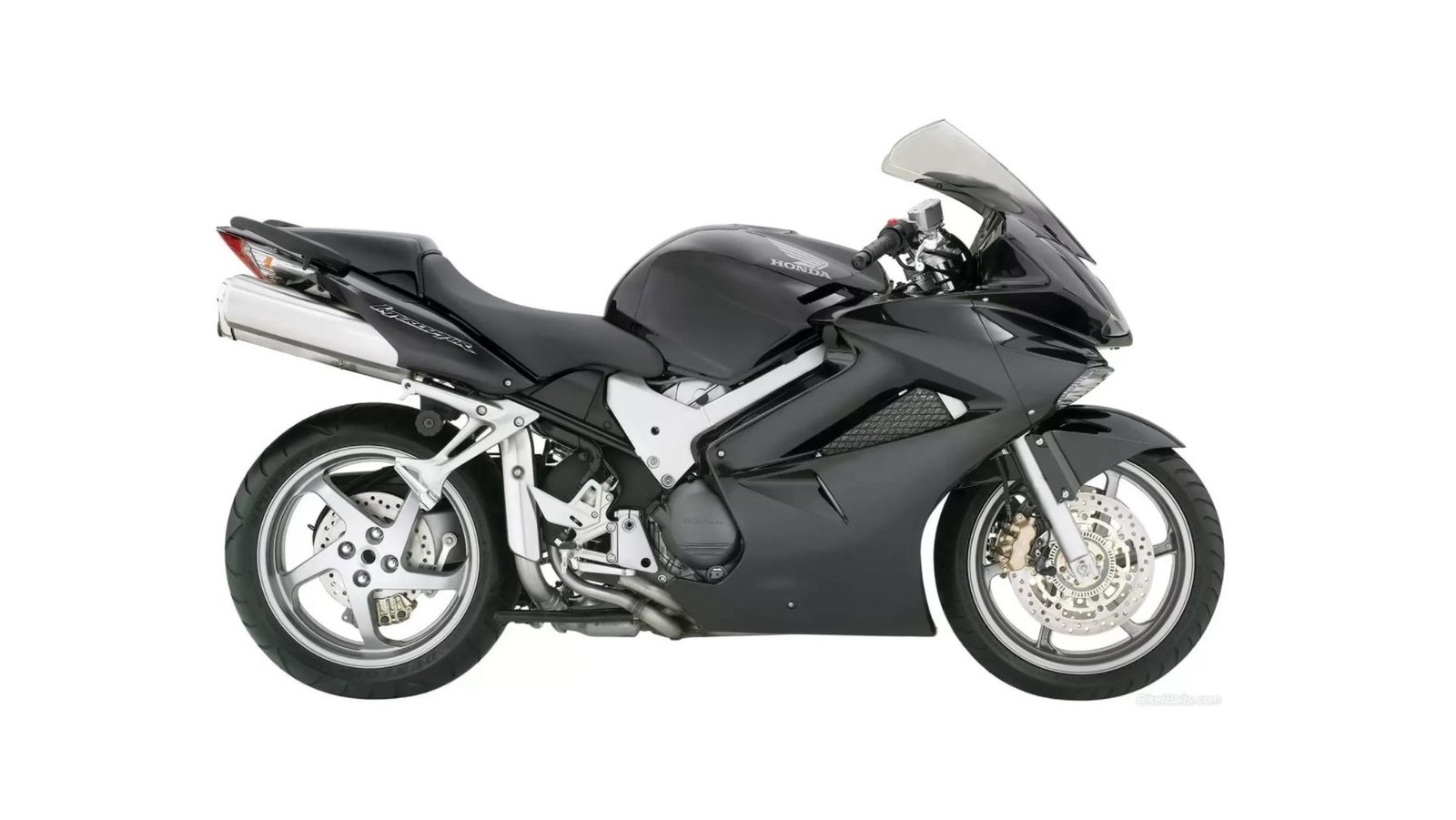
VFR800 0-60 mph in 3.01 seconds
The VFR has been with us for what seems like an eternity. Starting as a 750 and seeing various new versions and revisions, then growing into an 800 with VTEC ,and finally a 1200.
Despite sharing the same name, some don’t see the 1200 as a True VFR. There are small capacity VFRs too, but I am not sure if they count.
The bike we have for test today is a pretty 800 VTEC, which is not nearly as ugly as the bulbous Minecraft-looking model it replaced.
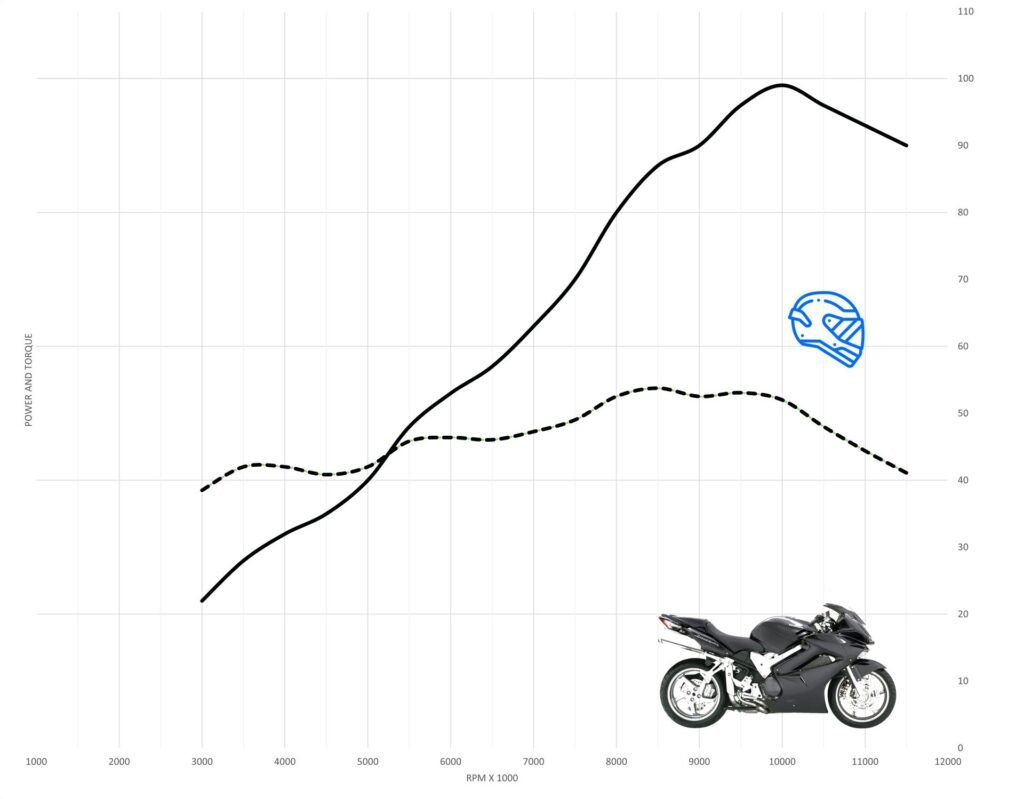
Honda VFR800 Dyno curve
It says 800 on the tin, but the engine in Honda’s VFR800 is actually a 785 cc V4.
It is an absolute peach.
Despite not setting the world alight with a modest 98 horsepower at the rear wheel – a figure lower than most 600 cc supersports, the still VFR800 delivers a very enjoyable experience in the engine front.
Peak torque is a respectable 54 ft-lb at 8,500 rpm, helped by its larger displacement compared with a 600.
That 185 cc advantage gives the VFR800 significantly more power and torque throughout the entire rev range.
The result is a much easier and less frantic riding experience that requires far less revving to make meaningful progress.
Although it does not rev particularly high, the VFR800 still encourages you to stretch it out, especially in the VTEC zone where the engine wakes up nicely and produces that glorious V4 soundtrack.
Overall, there is already plenty of usable power from as low as 3,000 rpm, but the engine truly comes alive between 5,000 and 9,000 rpm, where it delivers punchy drive.

Honda VFR800 In-gear acceleration
The VFR is geared relatively short in the first three gears, which makes the engine feel very responsive and torque-rich.
This helps it overcome its hefty kerb weight. Fourth, fifth, and sixth gears are noticeably longer, which makes sense considering that the VFR, while sporty, has touring duties to attend to, also.
While the VFR engine is generally responsive, you will probably want to drop a gear if you are in fifth or sixth and want to accelerate briskly from highway speeds.
At 70 mph in sixth gear, the VFR800 sits at around 4,700 rpm – right in a slight flat spot in the torque curve. So not ideal if you need to get an overtake done quickly.
| Speed at 5000 rpm | VFR800 |
| 1st Gear | 24.9 mph |
| 2nd Gear | 34.3 mph |
| 3rd Gear | 44.8 mph |
| 4th Gear | 54.8mph |
| 5th Gear | 63.7 mph |
| 6th Gear | 73 mph |
The last three gears are geared more like those of a 1,000 cc motorcycle, but the VFR800 as 750’sih torque, making the engine feel a little less eager than it should
The VFR800 would undoubtedly benefit from a larger rear sprocket for stronger mid-range drive in higher gears.
While that mod would provide more oomph, a consequence would be that it would make the lower three gears buzzier and increase fuel consumption on the motorway for riders who prefer a more relaxed cruising style.
If you’re on slower twists and you’re mostly in 3rd gear, the VFR is very effective. It drives very nicely right from 30 mph to a little over 100 mph.

Honda VFR800 acceleration through the gears
The VFR800 has spent most of its life in an era when 100 horsepower was considered more than enough.
It still is more than enough for most riders, yet today we are surrounded by naked bikes, adventure bikes and tourers producing 150-200 horsepower.
Even though the VFR800 is “only” a 100-horsepower motorcycle and sits around 50 kg heavier than a supersport 600, it can still move convincingly.
Thanks to its relatively short gearing and substantial weight, which actually works in its favour off the line, you can nail the throttle from a standing start without worrying too much about wheelies.
As a result, 0–60 mph times are very consistent.
The VFR800 comes tantalisingly close to breaking the three-second barrier, recording 3.01 seconds. The 0–100 km/h sprint takes 3.22 seconds, although it is slightly hindered by the need for a gear change.
Despite requiring three gears to reach 100 mph, the VFR800 still posts a very strong time of 6.75 seconds – dipping comfortably under the seven-second mark.
The quarter-mile is dispatched in the low 11s, with the VFR800 clocking 11.14 seconds at a terminal speed of 123 mph.
These are genuinely strong figures and objectively quick from any perspective.
From a standing start up to 130 mph, the VFR800 keeps even faster bikes in sight and feels every bit as quick as the best 600 cc supersports of its era.
It is only beyond 130 mph that more powerful and modern machinery starts to pull away.
The VFR800 reaches 0–140 mph in 16.82 seconds, while a typical modern 600 cc supersport will do it in under 13 seconds.
That said, the 0-130 mph range, although still well into illegal territory on the road, is the most usable and relevant speed range for most riders.
It is where we spend the majority of our time when blasting along favourite roads, and the VFR800 offers more than enough poke in this zone.
If you want significantly more performance, then you should look at the VFR1200 or the CBR1100XX Blackbird, but sub 100 mph, thanks to clever gearing, the VFR800 can hold its own
| Honda VFR800 Acceleration and Top Speed | |
| Speed | Time |
| 0-10 mph | 0.47 |
| 0-20 mph | 0.95 |
| 0-30 mph | 1.40 |
| 0-40 mph | 1.91 |
| 0-50 mph | 2.29 |
| 0-60 mph | 3.01 |
| 0-70 mph | 3.75 |
| 0-80 mph | 4.69 |
| 0-90 mph | 5.63 |
| 0-100 mph | 6.75 |
| 0-110 mph | 8.31 |
| 0-120 mph | 10.15 |
| 0-130 mph | 12.87 |
| 0-140 mph | 16.82 |
| 0-150 mph | 25.93 |
| 60-130 mph | 9.74 |
| 100-150 mph | 19.18 |
| SS/QM | 11.14@ 123 mph |
| SS/KM | 20.94 @ 145 mph |
| SS/Mile | 29.94 @ 152 mph |
| Top Speed | 154 mph |