Daytona 675 0-60 mph in 3.10 seconds
After the rather forgettable TT 600 and the better but still unremarkable Daytona 600 and 650 inline-four models, Triumph drew on its considerable triple-cylinder experience to create an all-new supersport contender.
At the time, World Supersport rules permitted larger engine capacities for two- and three-cylinder machines – 750 cc and 675 cc respectively.
Triumph duly delivered a 675 cc triple; an engine they should have given the world without wasting time with the previous Daytona and TT models.
This compact engine produced the same claimed peak power as the larger T595 despite its smaller displacement.
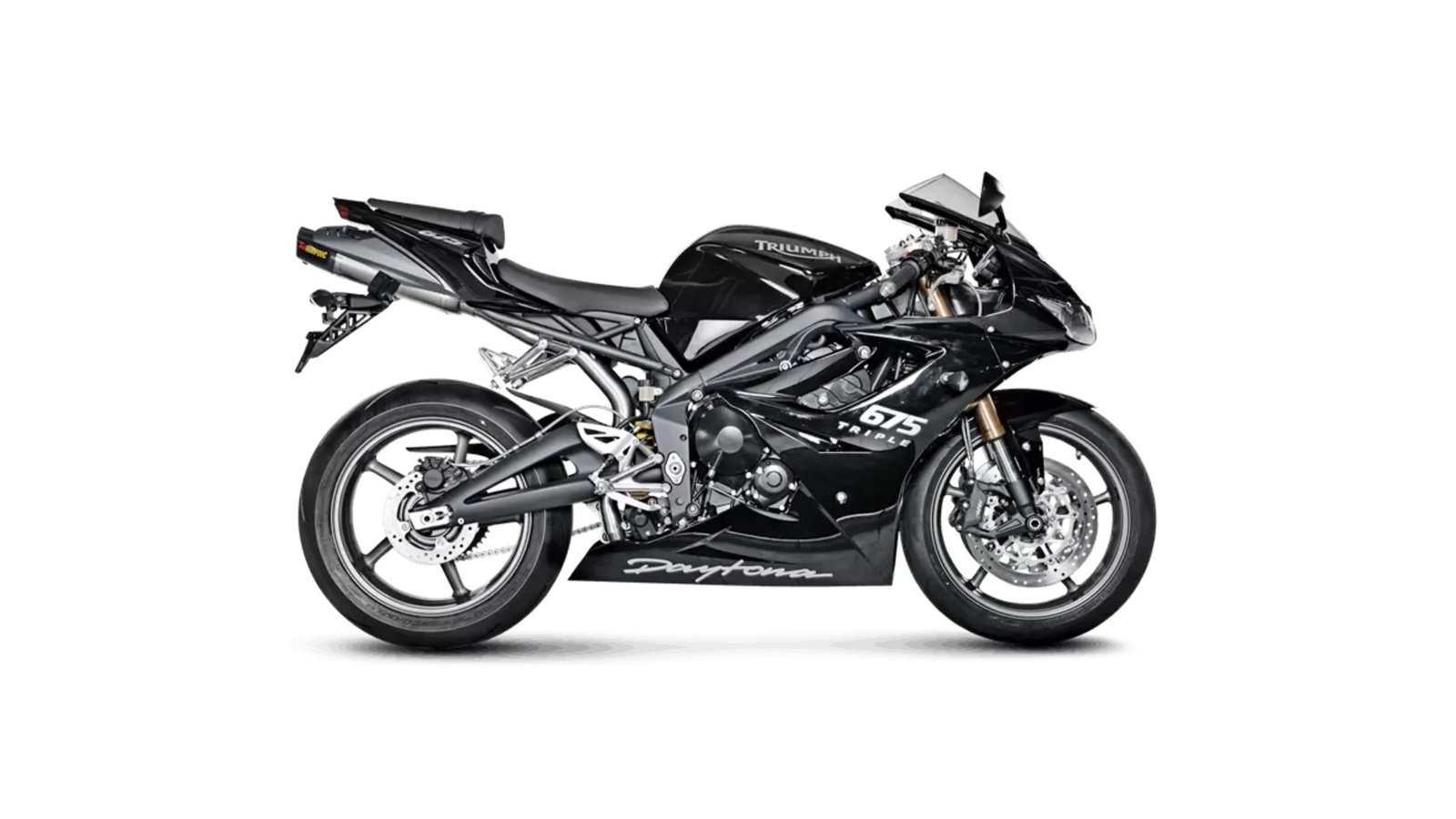
Beyond the impressive specifications, the new Daytona 675 was wrapped in a beautiful, timeless design.
It looked far superior to the dated TT 600, which at the time appeared as an awkward blend of CBR600 F3 and F4, only less attractive.
Not to mention it’s suspiciously looking Yamaha Dials and running gear.
The Daytona 600/650 was an improvement over the TT, but it still looked bulky and somewhat dated, with sharp, angular lines that were briefly fashionable in the early 2000s.
By contrast, the Daytona 675 was tiny, super-light at just over 160 kg, and styled in a way that still looks fresh and desirable today.
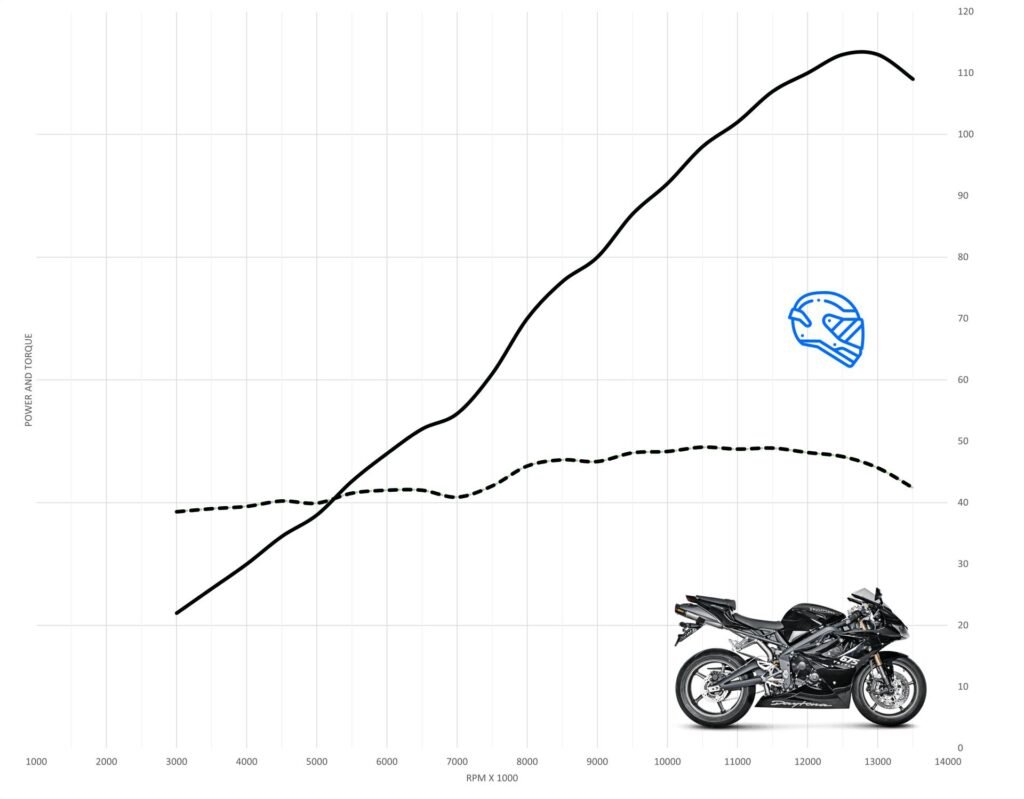
Triumph Daytona 675 Dyno curve
The 675 cc triple is a gem. Claimed power of 123 horsepower and 53 ft/lb of torque put it up there with its class, rival 600s of the time, and even today.
The Daytona 675 produces an impressive 112 horsepower at 12,800 rpm and 49 ft-lb of torque at 10,500 rpm at the rear wheel.
These are great numbers that put it right in the mix with other Supersport bikes.
Power and torque are spread very nicely across a wide rev range, producing pretty much 40 ft/lb from 3000 to 7000 rpm.
Unlike its four-cylinder 600 cc rivals, the Daytona 675 will pull comfortably from as low as 3,000, especially so in higher gears, while many 600s feel far more lethargic if expecting the same.
Although the 675 is a very tractable engine, like all supersport units, it loves to scream.
Beyond 7000 rpm, the engine takes it up a gear and becomes truly effective from 8,000 rpm onwards.
The little 675 continues strongly all the way to nearly 14,000 rpm – giving you almost a full 6000 rpm powerband to play with.
Wherever you find yourself in the rpm range, there is no urgent need to change down a gear when driving hard out of a corner, unlike peakier rivals that demand you are in exactly the right gear and at the precise rpm to deliver effective drive.
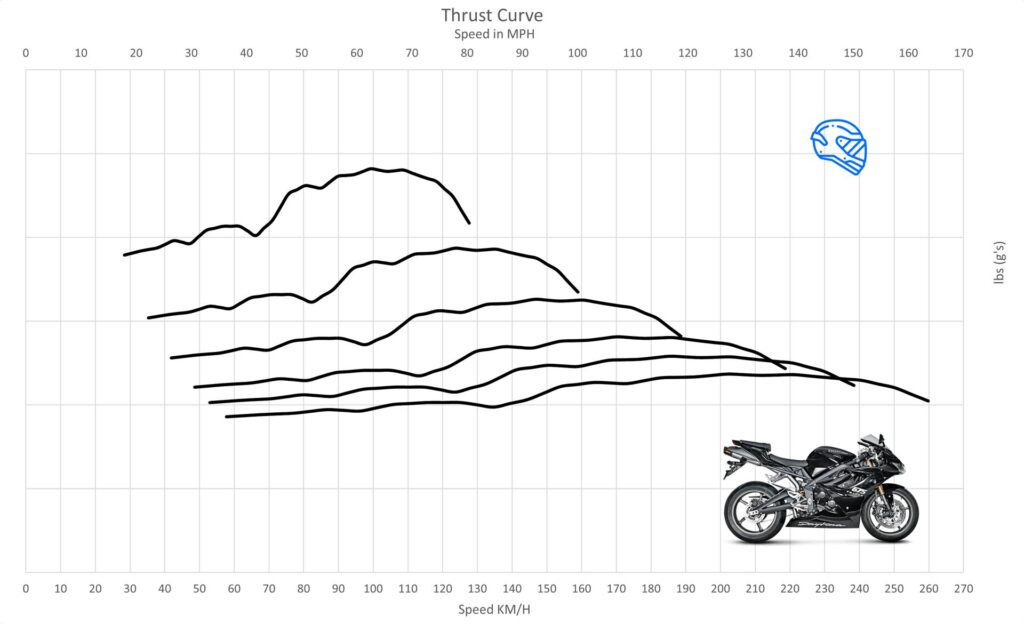
Triumph Daytona 675 in-gear acceleration
The flat acceleration curve is clearly visible in the in-gear thrust graph, which shows the torque curve translated through the gearbox.
This is exactly what you feel when you open the throttle at any given speed in your chosen gear.
Compared with rival 600 cc bikes, whose curves are very peaky and require frequent gear changes to stay in the powerband, the Daytona 675 is far more forgiving and flexible.
The revs can drop to 8,000 rpm or even lower in any gear, and the engine still delivers strong, usable thrust, almost as much as when revving higher.
This makes the 675 exceptionally easy to get the most out of. It requires fewer gear changes in most situations and allows you to ride a gear higher than 600 cc rivals when accelerating out of corners.
In many situations, the 675 delivers in-gear thrust that gets close to 750 cc machines, including the GSX-R750, only losing out right up top of the rpm.
The Daytona 675’s welcome engine flexibility has far more to do with the extra 75 cc of capacity than with “missing a cylinder”, as some people claim.
The same principle applied to the ZX-6R 636 – those extra 36 cc did wonders for that bike too.
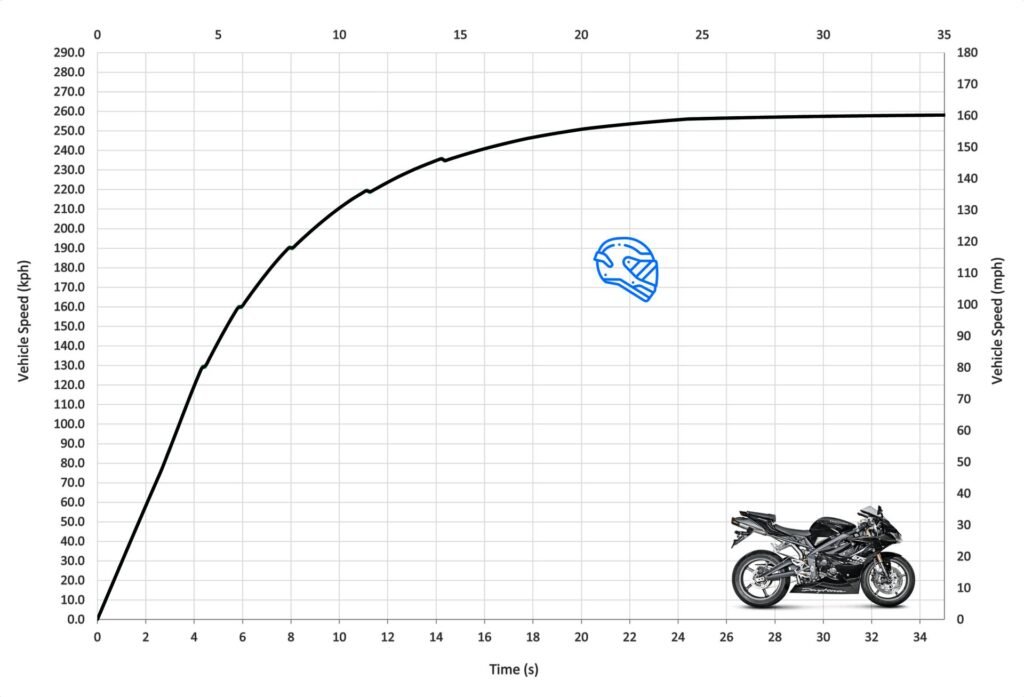
Triumph Daytona 675 Acceleration through the gears
| Triumph Daytona 675 Acceleration and Top Speed | |
| Speed | Time |
| 0-10 mph | 0.40 |
| 0-20 mph | 0.91 |
| 0-30 mph | 1.52 |
| 0-40 mph | 2.04 |
| 0-50 mph | 2.56 |
| 0-60 mph | 3.10 |
| 0-70 mph | 3.65 |
| 0-80 mph | 4.40 |
| 0-90 mph | 5.09 |
| 0-100 mph | 6.00 |
| 0-110 mph | 6.95 |
| 0-120 mph | 8.30 |
| 0-130 mph | 9.87 |
| 0-140 mph | 12.21 |
| 0-150 mph | 16.11 |
| 0-160 mph | 30.62 |
| 60-130 mph | 6.73 |
| 100-150 mph | 10.12 |
| SS/QM | 10.70 @ 134 mph |
| SS/KM | 19.82 @ 155 mph |
| SS/Mile | 28.29 @ 159 mph |
| Top Speed | 160.80 mph |