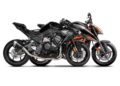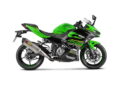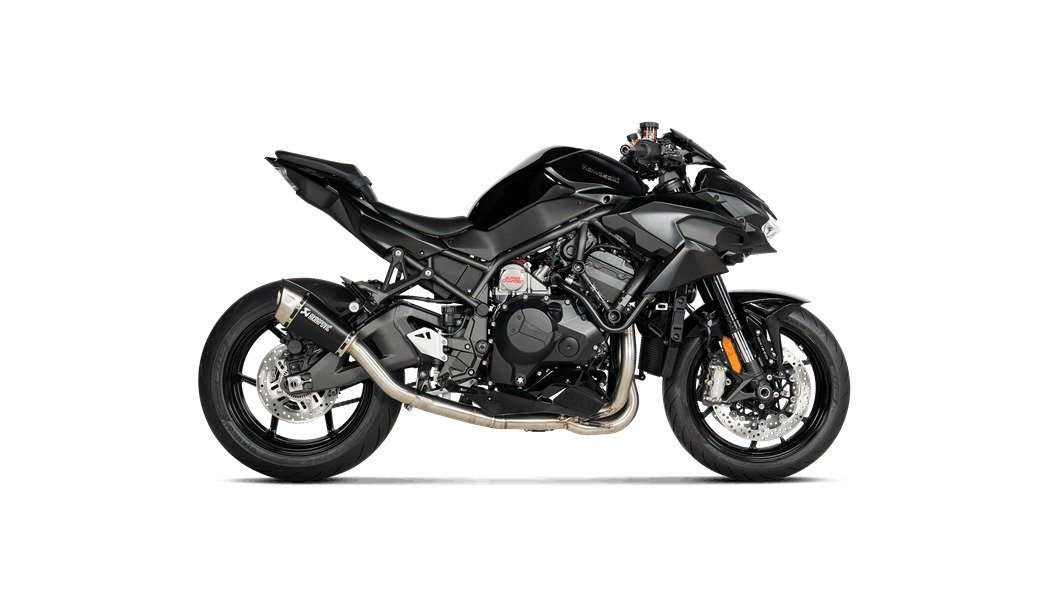
The Kawasaki Z H2 0-60 mph in 2.91 seconds
The Kawasaki Z H2 is a naked version of Kawasaki’s extremely capable H2 hyperbike.
Currently, the Kawasaki Z H2is one of the most powerful ‘Super Naked’ motorcycles on the market.
Below we have top speed and acceleration data through the gears, accompanied by Dyno Curve and Thrust Curve graphs.

Kawasaki Z H2 Dyno Curve
The Kawasaki Z H2 is powered by the same 998 cc supercharged engine found in the H2 SX and H2.
It produces a claimed 200 horsepower at the crank. In its current form, it delivers 178 horsepower at the rear wheel at 10,500 rpm and 92 ft-lb of torque at 9,000 rpm.
These figures are utterly bonkers for a naked motorcycle.
The engine is one of the silkiest big-bore units on the market. It drives exceptionally smoothly from tickover and throughout the entire rev range.
Its power delivery is unrivalled in its linearity and feels almost Honda-like, with very few, if any, peaks or troughs.
The Honda comparison ends there, however.
The more you ask of the engine, the more it builds in intensity, in a way that no other motorcycle can match apart from Kawasaki’s own H2 and H2 SX.
The Z H2 loves to be revved hard and sounds incredible as you thrash it through the gears.
There is something special about how Supercharged engines deliver their power and torque compared to stock.
Supercharging a motorcycle engine, unlike turbocharging, is much more suitable for a motorcycle in most situations.
It is possible to have a very normal and ‘stock’ looking power and torque delivery while having an engine that is super fast.
This is because, throughout the rpm range, supercharging delivers similar gains to boring out the engine.
Power and torque go up linearly, not wildly like a Turbo, where you get a massive dollop of power and torque, not necessarily where you want it.
Mildly supercharging will deliver something comparable to a 1200 cc engine in the bottom and midrange for a 1 litre engine like the ZH2.
For example, based on where a ZH2 makes its peak power, which is at 10,500 rpm.
Without supercharging, its dyno curve would look something like an old R1, and would probably produce 135-140 hp at the rear wheel.

Kawasaki Z H2 Thrust curve and in-gear acceleration
Thanks to its 998 cc displacement and supercharger, the Kawasaki Z H2 has one of the most responsive engines available.
While some rivals may have a slight edge in acceleration in the lower gears, any advantage is difficult to exploit in practice.
There is simply too much thrust available from both the rivals and the Z H2 in the lower gears. Everywhere else, the Z H2 is hugely dominant.
For example, the Z H2 offers stronger acceleration in any gear, at any speed below 140 mph, than a Gen 2 Hayabusa. That’s remarkable.
Either way, on the Z H2, you will never be left wanting more acceleration.
It really doesn’t matter what gear you’re in – simply open the throttle and the Z H2 responds instantly, firing you down the road.
It has almost too much acceleration for the road, but that won’t stop many owners from tuning the Z H2 in search of even more power.

Kawasaki Z H2 Acceleration through the gears
The Z H2 delivers some truly impressive acceleration times, exactly as you would expect from a Supercharged motorcycle producing close to 180 horsepower at the rear wheel.
The 0–60 mph time is limited by wheelies and could be significantly quicker if the bike were lowered or properly strapped down.
Even so, the Z H2 manages it in just 2.91 seconds. The 0–100 km/h sprint falls just outside the three-second barrier at 3.04 seconds.
As with many big, powerful bikes, the 0–60 mph and 0–100 km/h times are somewhat academic. It is beyond those speeds that the Z H2 really reveals its potential.
Taking second gear all the way to the rev limiter, the Z H2 reaches 0–100 mph in 5.32 seconds and dispatches 0–200 km/h in just 7.26 seconds.
With perfect conditions and launch, the Z H2 could probably dip into the high 9-second bracket for the quarter-mile.
In our testing, it recorded a strong 10.13 seconds with a terminal speed of 146 mph.
The terminal speed could have been higher were it not for the Z H2 being a naked bike.
I achieved several runs in the low 10s with terminal speeds in the low 140s mph, with the best of 146 mph coming when I was literally flat on the tank.
The Dragy 60–130 mph time is blistering – just 4.88 seconds.
If you have the nerve to hold on and your neck can cope with the wind blast, the Kawasaki Z H2 will reach a genuine top speed of 176.8 mph. In reality, though, most riders would probably not want to venture much beyond 150 mph.
The Z H2 will keep up with the very best out there and is only limited by the fact that it is naked.
Thanks to its relatively low gearing, which perfectly complements its incredible engine, there is very little out there that can worry it point-to-point if you are even slightly lazy with the gears.
| Kawasaki Z H2 Acceleration and Top Speed | |
| Speed | Time |
| 0-10 mph | 0.48 |
| 0-20 mph | 0.96 |
| 0-30 mph | 1.445 |
| 0-40 mph | 1.93 |
| 0-50 mph | 2.43 |
| 0-60 mph | 2.91 |
| 0-70 mph | 3.45 |
| 0-80 mph | 4.09 |
| 0-90 mph | 4.63 |
| 0-100 mph | 5.32 |
| 0-110 mph | 5.97 |
| 0-120 mph | 6.88 |
| 0-130 mph | 7.81 |
| 0-140 mph | 9.16 |
| 0-150 mph | 10.67 |
| 0-160 mph | 13.20 |
| 0-170 mph | 17.14 |
| 60-130 mph | 4.88 |
| 100-150 mph | 5.34 |
| SS/QM | 10.13 @146 mph |
| SS/KM | 18.40 @172 mph |
| SS/Mile | 26.07 @176 mph |
| Top Speed | 176.8 mph |