Suzuki GSX1300R Hayabusa vs Kawasaki H2R Acceleration And Top Speed
The Hayabusa has held the crown as the fastest production motorcycle since its release in 1999.
Whether deserved or not, this machine has always (by many) been regarded as the undisputed top-speed king.
Its supremacy was officially challenged by Kawasaki’s own ZX-12R and later the ZX-14R.
Depending on which side of the fence you sit on, you will no doubt be adamant that one or the other is the fastest.
Since then, litre bikes have appeared with more power than the Hayabusa and would arguably be faster were it not for the 300 km/h (186 mph) top-speed limiters that all motorcycles capable of such speeds have been forced to adopt.
None of the official challengers ever quite achieved the same cult status as the Hayabusa – at least not until the release of the Kawasaki H2 and H2R back in 2015.
On paper, the H2 had similar specs, but the H2R blew the Hayabusa away with a claimed 300-plus horsepower. The H2R, without doubt, would gap the Hayabusa. It was not a question.
Hayabusa vs H2R Dyno Curve

– H2R – Hayabusa
The Suzuki GSX1300R Hayabusa produces 180 horsepower at the rear wheel at 9,500 rpm.
Peak torque is very impressive at 107 ft-lb at 7,500 rpm.
The Hayabusa engine is a gem, power and torque everywhere, thanks to its almost 1.4 litre displacement, and kicking out 180 horsepower at the wheels.
By comparison, Kawasaki’s H2R completely stomps it on the dyno with 246 horsepower at 13,000 rpm, while matching the Hayabusa’s 107 ft-lb of torque (though delivered much higher up at 11,500 rpm).
The 1000 cc H2R engine giving away 340 cc can only match the Hayabusa torque output thanks to the Supercharger.
Despite the forced iduction that the H2R is blessed with, on the dyno, the Hayabusa dominates below 10,000 rpm and clearly offers a more usable and flexible power delivery.
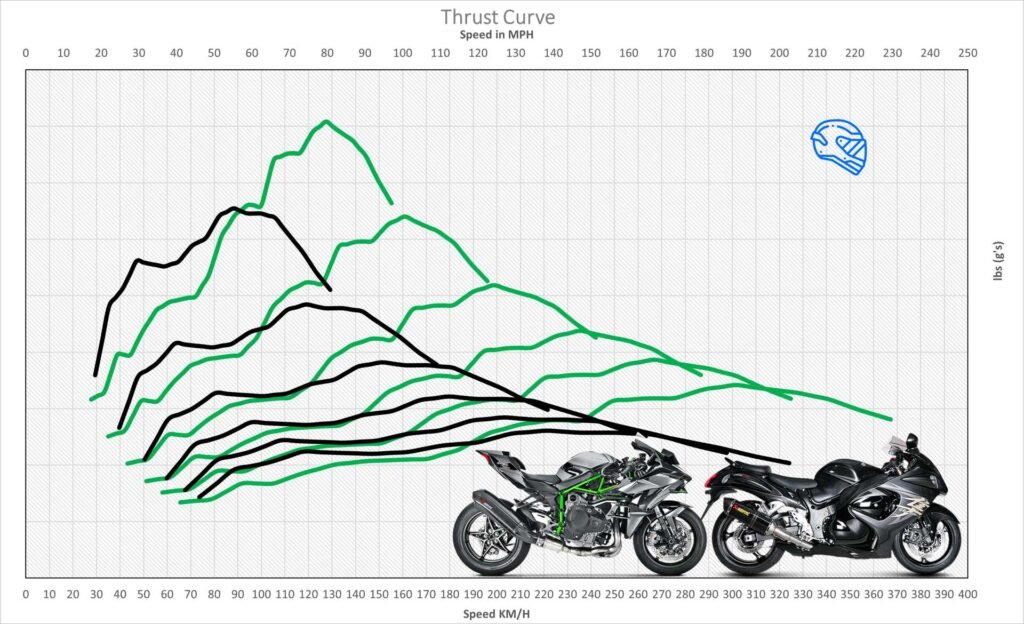
On the road, however, it is only stronger in-gear below around 6,000 rpm, as the thrust/acceleration curve below shows.
Above that point, the H2R is far more explosive in the top end, which ensures that the Hayabusa feels comparatively flat, which is something I never thought I would say about a Hayabusa engine.
Hayabusa vs H2R in-gear Acceleration Curve
– H2R – Hayabusa
The graph above shows each motorcycle’s torque curve translated through the gears.
It represents the actual acceleration available to the rider in each gear, plotted against road speed.
Thanks to its stronger power and torque in the lower rpm range, the Hayabusa delivers more acceleration in the first half of each gear/speed range.
This advantage could be even greater, but the Hayabusa is geared significantly taller than the H2R. As a result, its bottom- and mid-range torque advantage is not as pronounced as it would be if the Suzuki ran lower (or the same) gearing as the H2R.
By contrast, the H2R provides considerably more thrust and acceleration in the second half of each of its six gears, as clearly shown above.
Despite the Hayabusa’s longer gear ratios, the H2R actually achieves higher top speeds in every gear. This is simply because the H2R can rev all the way to 14,000 rpm, compared with the Hayabusa’s 11,200 rpm limit.
This allows it to spin gears faster, meaning higher top speeds.
Hayabusa vs H2R Gear Speed 5000rpm
| Speed at 5000 rpm | H2R | Hayabusa |
| Speed 1st Gear | 34.5 mph | 36.5 mph |
| Speed 2nd Gear | 43.5 mph | 49.3 mph |
| Speed 3rd Gear | 53.7 mph | 62.6 mph |
| Speed 4th Gear | 63.6 mph | 74.3mph |
| Speed 5th Gear | 72.1 mph | 84.1 mph |
| Speed 6th Gear | 81.5 mph | 91.5 mph |
Hayabusa vs H2R Acceleration through the gears

– H2R – Hayabusa
The GSX1300R Hayabusa and Kawasaki H2R are closely matched from a standing start, with the Hayabusa holding a slight advantage.
Paradoxically, this is because the Hayabusa is heavier, longer, and has less power.
The extra weight and length help control wheelies and, in some cases, improve traction.
It is possible to have too much power for a clean launch.
While the H2R is not superbike-light, it is around 40 kg lighter (wet) than the Hayabusa and has 60 horsepower more.
This combination makes launching it far from easy.
Once moving, the H2R only really begins to translate its extra 60 horsepower advantage effectively from halfway through third gear, at around 120 mph.
Even then, it will still happily lift the front wheel in third and fourth gear, though it is noticeably easier to control than in the lower gears.
Despite its significant power deficit, the Hayabusa beats the H2R to 60 mph in 2.77 seconds compared with the H2R’s 2.93 seconds.
It also reaches 100 mph quicker, dipping under five seconds at 4.95 seconds versus the H2R’s 5.12 seconds.
Quite simply, the Hayabusa is much easier to launch consistently, while the H2R feels like riding a wild bull – far more difficult to get repeatable results from all that explosive power.
The Hayabusa runs the quarter-mile in 9.91 seconds at 150 mph, which is only a fraction behind the H2R’s 9.76 seconds.
However, the H2R crosses the line with a much higher terminal speed of 164 mph and is clearly getting into its stride.
At the strip, the Hayabusa initially pulls several bike lengths ahead and holds that lead up to around 120–130 mph. The H2R then begins chasing it down while simultaneously fighting to keep the front wheel on the ground.
Near the end of the strip, the H2R, pulling like a train, quickly closes the gap and overtakes the Hayabusa just before the line, carrying an extra 14 mph of speed.
The H2R goes on to reach 0–180 mph in only 11.77 seconds, with the Hayabusa trailing by just over five seconds at 16.81 seconds.
To put things into perspective, the H2R is faster than the Hayabusa in much the same way that a litre bike is faster than a 600.
The difference is not immediately obvious from a standing start because the Hayabusa can use far more of its power effectively, while the H2R spends more than half the length of the quarter-mile strip battling wheelies.
From a rolling start, the Kawasaki H2R would be far more dominant and would walk away from the Hayabusa in the same way a litre bike would walk away from a 600.
| Acceleration and Top Speed | ||
| Kawasaki H2R | Suzuki Hayabusa | |
| Speed | Time | Time |
| 0-10 mph | 0.48 | 0.46 |
| 0-20 mph | 0.96 | 0.91 |
| 0-30 mph | 1.44 | 1.37 |
| 0-40 mph | 1.93 | 1.83 |
| 0-50 mph | 2.43 | 2.3 |
| 0-60 mph | 2.93 | 2.77 |
| 0-70 mph | 3.44 | 3.24 |
| 0-80 mph | 3.97 | 3.89 |
| 0-90 mph | 4.5 | 4.4 |
| 0-100 mph | 5.12 | 4.95 |
| 0-110 mph | 5.7 | 5.79 |
| 0-120 mph | 6.3 | 6.53 |
| 0-130 mph | 6.99 | 7.38 |
| 0-140 mph | 7.66 | 8.62 |
| 0-150 mph | 8.38 | 9.82 |
| 0-160 mph | 9.31 | 11.61 |
| 0-170 mph | 10.31 | 13.55 |
| 0-180 mph | 11.77 | 16.81 |
| 0-190 mph | 13.57 | 21.4 |
| 0-200 mph | 16.83 | N/A |
| 60-130 mph | 4.01 | 4.61 |
| 100-150 mph | 3.24 | 4.86 |
| SS/QM | 9.76/164 mph | 9.91@150 mph |
| SS/KM | 17.01/201mph | 17.82@183 mph |
| SS/Mile | 23.508/208 mph | 24.91@194 mph |
| Top Speed | 212 mph | 199 mph |