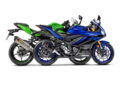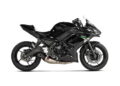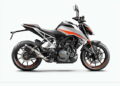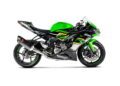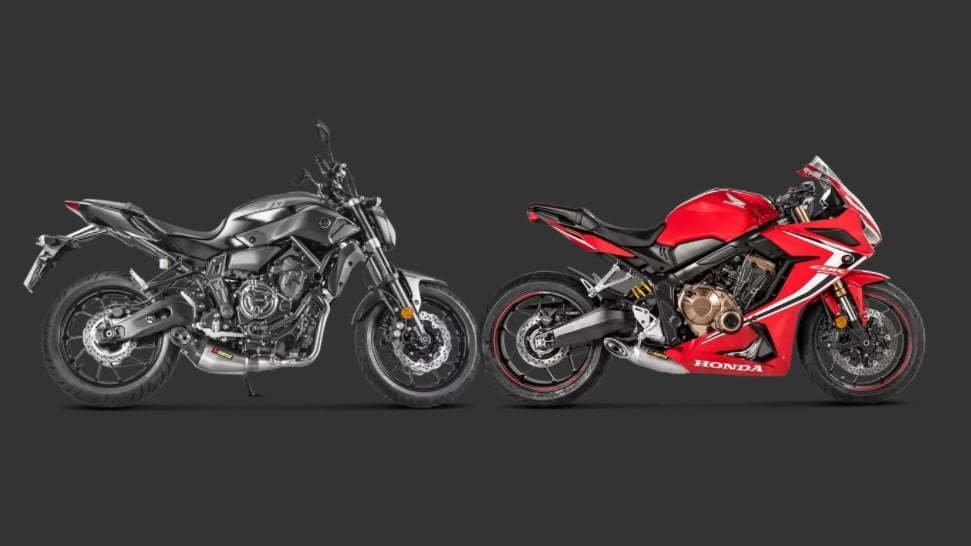
Both of these middleweight motorcycles are hugely popular and often sit near the top of the list for anyone looking for an entry-level sporty bike, whether naked or faired.
While the CBR650R and MT-07 occupy slightly different categories, one being a faired sport-tourer and the other a naked bike, they compete directly in the same class due to similar pricing and performance.
Styling, handling, and ergonomics are all important when choosing a motorcycle, but engine character and performance are often the deciding factors.
Although they sit in the same class, the Honda CBR650R and Yamaha MT-07 deliver very different riding experiences thanks to their contrasting engine types.
The Honda uses a traditional inline-four, while the Yamaha uses a parallel-twin with a crossplane firing order that gives it a subjectively much nicer sound than a conventional parallel-twin.
We often hear that two-cylinder bikes of similar capacity offer more torque in the mid and low rev range, where it matters most on the road.
While four-cylinder engines tend to shine at higher rpm. Let’s see how this theory stacks up between the CBR650R and the MT-07.
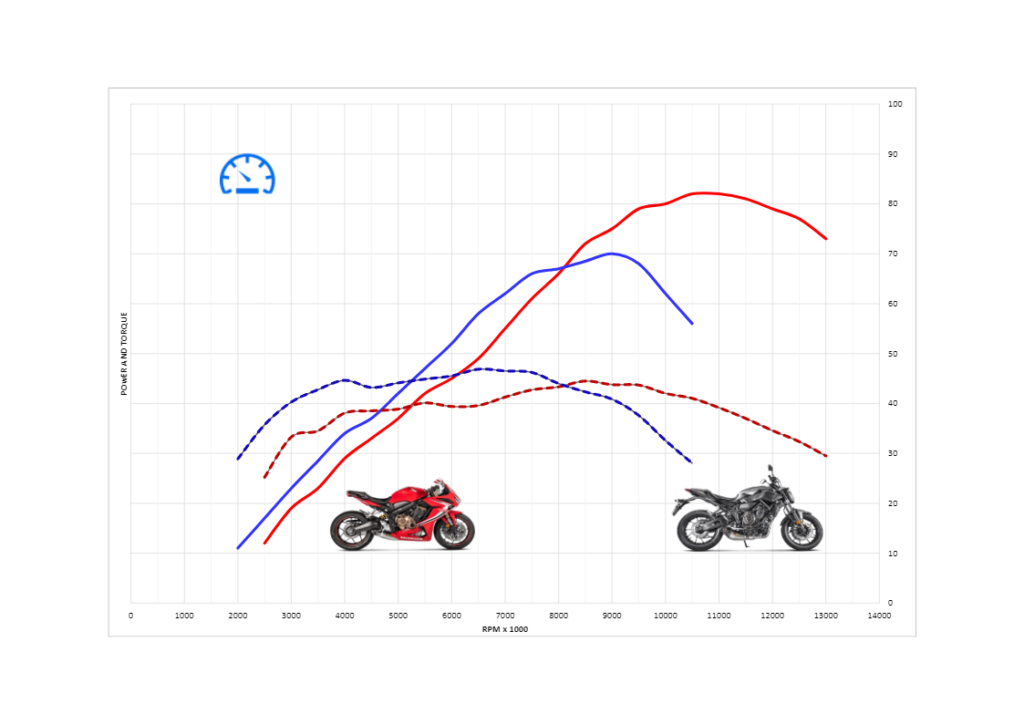
CBR650R vs MT-07 Dyno Curve
– CBR – MT
Both engines are similar in capacity, though the MT-07 has a 40 cc advantage.
This gives the Yamaha a slight but measurable edge in torque production throughout the rev range.
The dyno results are no surprise. The MT-07 makes more power and torque right through the rpm range and is only bettered by the Honda above 8,000 rpm.
The MT-07 peaks at 70 horsepower just before 9,500 rpm, after which power falls off quite sharply.
In typical inline-four fashion, the CBR650R continues pulling enthusiastically all the way to its peak of 82 hp at 10,500 rpm and does not drop off as quickly as the MT-07.
The MT-07 delivers strong torque from very low down and will happily wheelie in first and second gear as if it had a much bigger, more powerful engine.
The Honda CBR650R offers good bottom- and mid-range torque for its engine configuration and capacity.
However, you really need to keep it above 3,000 rpm; below that, the motor feels a little sluggish, both in isolation and especially when compared with the MT-07.
From there, it delivers classic smooth, turbine-like inline-four performance, with a pleasant kick at 6,500 rpm.
That is where the engine really comes alive. Keep it above this point for the best progress, and it will happily scream all the way to 13,000 rpm.

CBR650R vs MT-07 Thrust Curve/In-Gear Acceleration
– CBR – MT
Thrust curves are really what we should be looking at, because power and torque curves alone only tell us what the engine is doing.
Engine performance has to be translated through the gearbox and each of the six gears before it becomes the acceleration the rider actually feels.
Gears act as torque multipliers, so correct gearing makes the best use of the engine’s torque and turns it into real-world acceleration at the rear wheel.
In the graph above, you are looking at the acceleration (thrust) available to each motorcycle in every gear, plotted against road speed.
There are six lines for each bike: red for the Honda CBR650R and blue for the Yamaha MT-07.
The highest line for each bike represents first gear (the lowest gear, therefore the most thrust).
The second-highest line is second gear, and so on, with the lowest line being sixth gear.
The lower the gear, the more acceleration/thrust is available.
You will notice that the shape of each thrust curve in every gear for a particular bike is essentially the same. If you compare the torque curve to the thrust curve of any gear, they share the same shape, peaks, and troughs.
This is because the thrust curve is simply the torque curve multiplied and translated through each individual gear ratio.
Each gear has a finite maximum speed, limited by both the gear ratio and the engine’s rev limiter.
For example, if two motorcycles had identical gearing but one had a rev limiter of 6,000 rpm, and the other 12,000 rpm, the bike that revs to 12,000 rpm would have twice the theoretical top speed in first gear.
The thrust/acceleration curves shown here take into account the weight of the motorcycle plus the rider (with rider weight kept the same for a fair comparison).
Since the Yamaha MT-07 is approximately 20 kg lighter than the Honda CBR650R, it produces more thrust in every gear, even if the torque and gear ratios were identical.
Note that these curves do not factor in aerodynamics or wind resistance.
Looking at the graph, the MT-07 reaches approximately 85 km/h in first gear at the rev limiter.
The MT-07 has more thrust available in first gear right up to around 75 km/h. Beyond that point, the CBR650R takes over and maintains stronger acceleration until it hits its own rev limiter at about 105 km/h in first gear.
The two bikes have very similar first-gear ratios, but the CBR650R achieves a much higher top speed in first simply because it revs significantly higher.
This trend repeats across all gears. The MT-07 holds a substantial advantage in acceleration at almost any speed in any gear, although the advantage becomes smaller in the higher gears, particularly fifth and sixth.
Even there, the MT-07 still offers a slight edge.
Impressively, the MT-07 in second gear produces almost as much thrust as the CBR650R does in first gear.
| Speed at 5000 rpm | MT-07 | CBR650R |
| Speed 1st Gear | 25 mph | 25.4 mph |
| Speed 2nd Gear | 33.6 mph | 33.1 mph |
| Speed 3rd Gear | 43.7 mph | 41.3 mph |
| Speed 4th Gear | 54.8 mph | 50 mph |
| Speed 5th Gear | 65.4 mph | 56.9 mph |
| Speed 6th Gear | 73.9 mph | 64.2 mph |
The reason the MT-07’s thrust/acceleration advantage is not as large in the higher gears as it is in the lower gears is simple: the CBR650R has substantially shorter gearing in the last three gears.
Shorter gearing equals more thrust and acceleration at the wheel, which helps the Honda compensate for its torque and weight deficit.
As the table above shows (speeds in each gear at 5,000 rpm, the higher the speed, the longer the gear), the first three gears are quite similarly spaced on both bikes.
However, in 4th, 5th, and especially 6th gear, the CBR650R runs noticeably shorter gearing, allowing it to claw back some of the torque and weight disadvantage.
If the CBR650R were the same weight as the MT-07, it would likely offer equal or even more thrust in 4th and 5th gear, despite producing less torque, because its shorter gearing would largely make up for the difference.
You might wonder why the MT-07’s last three gears are so much longer while the CBR650R’s are shorter.
The MT-07 can get away with taller gearing in the top three gears without hurting top speed, because it has no chance of reaching the rev limiter in sixth anyway.
As a general rule, higher-revving, lower-torque engines have more flexibility to run shorter gearing.
Their larger rev ceiling means they lose less top speed in each gear when using shorter ratios.
Lower-revving engines, on the other hand, tend to use longer gearing in the higher gears so they don’t sacrifice too much top-speed potential due to their inability to rev as high.
So, what does all of this mean?
As the power and torque curves suggest, the MT-07 is the more accelerative motorcycle in most situations, in any gear, and at almost any speed.
The thrust curves confirm this clearly.
The Honda CBR650R only offers more acceleration when it can reach the upper end of its rev range or the upper speed range of a particular gear.
This is what gives the CBR650R stronger outright acceleration figures, as shown in the graph below.
In most real-world situations, however, the Yamaha MT-07 will pull a good few bike lengths ahead on the initial roll-on if both bikes are in the same gear at the same speed.
The MT-07 does this from almost any speed in that gear, but the advantage is especially noticeable below 100 mph.
Above 100 mph, the advantage tends to swing back toward the CBR650R, as higher road speeds usually mean higher rpm.
If you ride a CBR650R and want to keep the MT-07 in sight after that initial hit, you will usually need to drop a gear and work the engine harder.
If you rev out each gear fully, the CBR650R will close the gap and eventually pass the MT-07.
The CBR650R’s relative lack of low- and mid-range grunt compared with the MT-07 can be significantly improved by simply adding a few teeth to the rear sprocket.
This would bring the Honda much closer in the lower gears and could even let it surpass the MT-07 in the higher gears.
The downside is that shorter gearing would reduce top speed in each gear (depending on how aggressive you go), and you would likely burn more fuel.
Reducing some of the CBR650R’s 20 kg weight disadvantage – or simply being a lighter rider than the person on the MT-07- would also help close the gap.
Of course, all the same modifications available to improve the CBR650R’s in-gear acceleration are equally available to the MT-07 rider.

CBR650R vs MT-07 Acceleration Review
– CBR – MT
When it comes to outright acceleration, these two motorcycles are pretty evenly matched below 100 mph.
The difference usually comes down to rider skill and which bike is easier to launch cleanly.
The MT-07 makes so much more thrust in the lower gears that it is noticeably harder to launch effectively; the bike really wants to wheelie.
The CBR650R, on the other hand, is much easier to get off the line.
Its thrust is less aggressive in each gear’s speed range, so while it can and will wheelie, you usually have to encourage it rather than fight to keep the front wheel down.
Both bikes will run 0-60 mph in under 4 seconds, with the MT-07 achieving 3.73 seconds and the CBR650R managing 3.3 seconds.
The MT-07 reaches 100 mph in 8.14 seconds, while the CBR650R pips it with 7.50 seconds.
With a perfect launch and ideal conditions, both can dip into the 11-second bracket for the quarter mile.
The MT-07 manages 11.97 seconds at 115 mph, and the CBR650R runs 11.45 seconds at 119 mph – impressively close to a supersport 600 such as the Yamaha R6.
Most average riders will run mid- to high-twelve-second quarter miles on either bike.
If you pin them through the gears and hold on long enough, the MT-07 tops out at 133.8 mph – around 10 mph slower than the CBR650R.
Much of the CBR650R’s top-speed advantage comes from its extra power and the better aerodynamics provided by its full fairing and screen.
From traffic light to traffic light and corner to corner at speeds below 100 mph, the MT-07 generally has the edge. You can worry less about gear choice, work the engine less, and still get stronger drive.
Of course, if you use the full rev range of the CBR650R and ride at speeds above 100 mph, it will be quicker overall.
But you have to work the engine noticeably harder to match or beat the MT-07, and that performance is often only available at speeds that risk landing you in trouble with the law.
Either way, both bikes are fast and offer more real-world performance than most riders will ever need.
They are also quicker than the vast majority of cars you will encounter on the road.
Performance is very close overall. It ultimately comes down to whether you prefer the punchier, more immediate character of the MT-07 or the CBR650R, which requires you to work it a little harder to extract its best.
| Speed | CBR650R | MT-07 |
| Time | Time | |
| 0-10 mph | 0.51 | 0.6 |
| 0-20 mph | 1.01 | 1.2 |
| 0-30 mph | 1.53 | 1.8 |
| 0-40 mph | 2.04 | 2.42 |
| 0-50 mph | 2.57 | 3.05 |
| 0-60 mph | 3.33 | 3.73 |
| 0-70 mph | 3.99 | 4.56 |
| 0-80 mph | 5.03 | 5.44 |
| 0-90 mph | 6 | 6.7 |
| 0-100 mph | 7.5 | 8.14 |
| 0-110 mph | 9.03 | 10.36 |
| 0-120 mph | 11.55 | 13.49 |
| 0-130 mph | 14.73 | 22.04 |
| 0-140 mph | 22.43 | N/A |
| 60-120 mph | 8.21 | 9.75 |
| SS/QM | 11.45/119mph | 11.97/115.8mph |
| SS/KM | 21.64/134mph | 22.698/130mph |
| SS/Mile | 31.08/143mph | 32.864/133.2mph |
| Top Speed | 144 mph | 133.8mph |