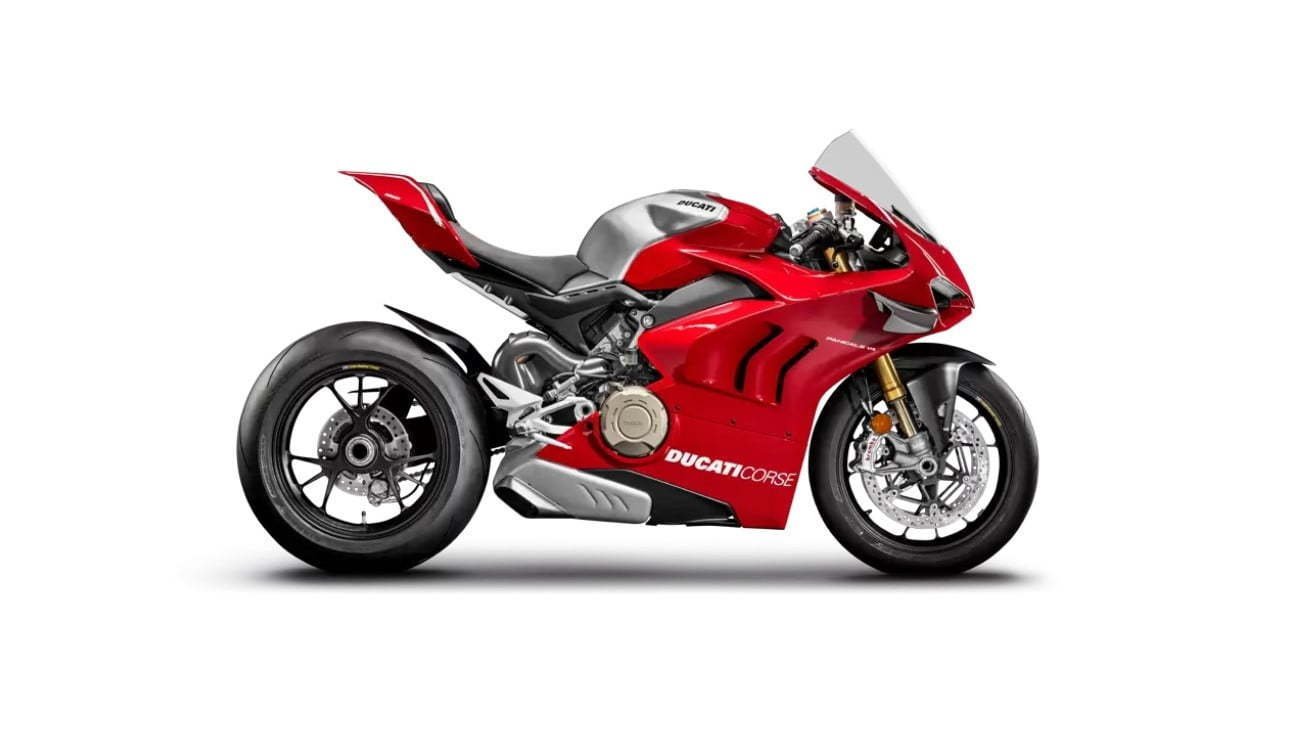
Ducati Panigale V4R Acceleration Times
For many years Ducati has offered an “R” version of its flagship superbike. The R is a homologation special – a highly focused variant of the standard model developed specifically to meet World Superbike racing regulations.
We have seen this approach many times before with iconic machines such as the Panigale 1199 R, 1098 R, 999 R and others.
By producing a limited-run, more expensive and competition-oriented version, manufacturers can homologate upgrades and modifications that make the bike more competitive on the racetrack.
The standard Panigale V4’s 1,103 cc engine exceeds the capacity limit for twins in World Superbike. To comply with the rules, Ducati created a very special 998 cc V4 engine purely for racing homologation.

Ducati Panigale V4R Dyno Curve
In short, Ducati reduced the capacity of the V4 engine by shortening the stroke from 53.5 mm to 48.4 mm. This made an already extremely short-stroke engine even more oversquare.
The resulting 998 cc Panigale V4 R engine is the most powerful and highest-revving normally aspirated production motorcycle engine ever released.
Ducati claims 221 horsepower at 15,250 rpm and 83 ft-lb of torque at 11,500 rpm. With the optional Ducati race kit, power climbs to over 237 horsepower at the crank – an astonishing 237 hp per litre.
That figure surpasses even the legendary Yamaha YZF-R6, which was the first production motorcycle to break the 200 hp-per-litre barrier.
On the dyno, the Panigale V4 R delivers 205 horsepower at the rear wheel at an incredible 15,500 rpm. Peak torque is a very strong 79 ft-lb at 11,500 rpm – impressive numbers for such a high-revving 1,000 cc engine.
Perhaps even more remarkable than the peak power is the rev range. Maximum power arrives above 15,500 rpm, and in top gear, the V4 R will happily spin beyond 16,000 rpm.
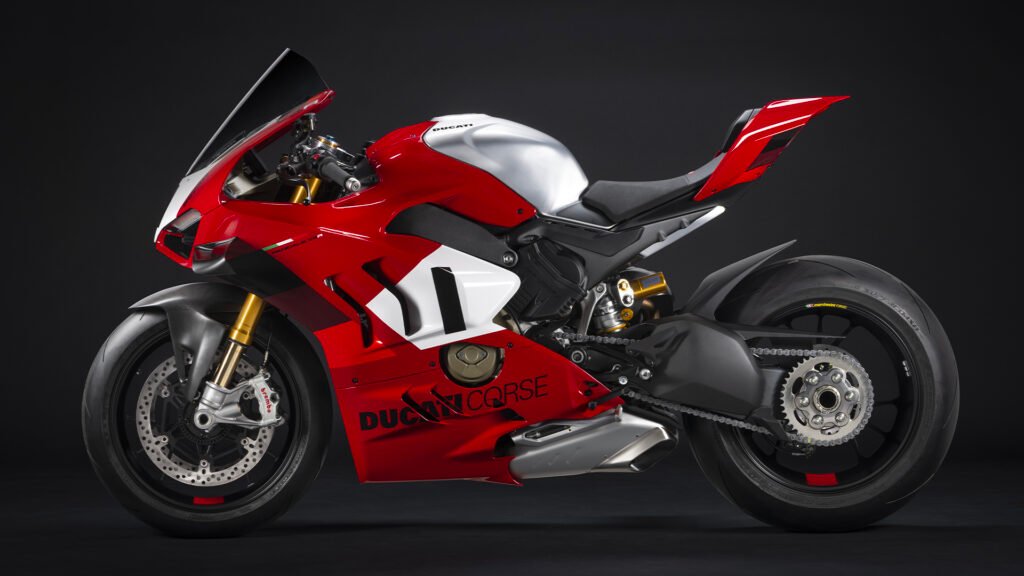
The only other current motorcycle that can match the Ducati Panigale V4 R’s extraordinary rev potential is the Honda CBR1000RR-R.
From years gone by, the old Japanese 250 cc four-cylinder bikes of the 1990s also come close.
The Yamaha YZF-R6 and Kawasaki ZX-6R can approach similar heights, although their rev counters are known to be optimistic and can over-read by as much as 1,000 rpm.
Compared with the standard Panigale V4, the V4 R has sacrificed a significant amount of power and torque across the entire rev range.
This is the inevitable result of losing 100 cc of capacity and making the engine even shorter-stroked.
Its power delivery feels more like a supercharged 600 cc bike than a conventional litre superbike.
After a very linear and flat torque curve between 3,000 rpm and 7,000 rpm, the engine then delivers an absolute avalanche of power.
Thanks to its incredibly wide rev range, the delivery feels almost endless.
On the standard 1,100 cc Panigale V4, you would typically change gear at around 13,000 rpm or slightly higher. On the V4 R, you can (and should) scream it all the way to 15,000 rpm and beyond.
If you flash the ECU, you can access the full 16,000+ rpm in every gear instead of just sixth. As if 15,500 rpm wasn’t already extreme enough!
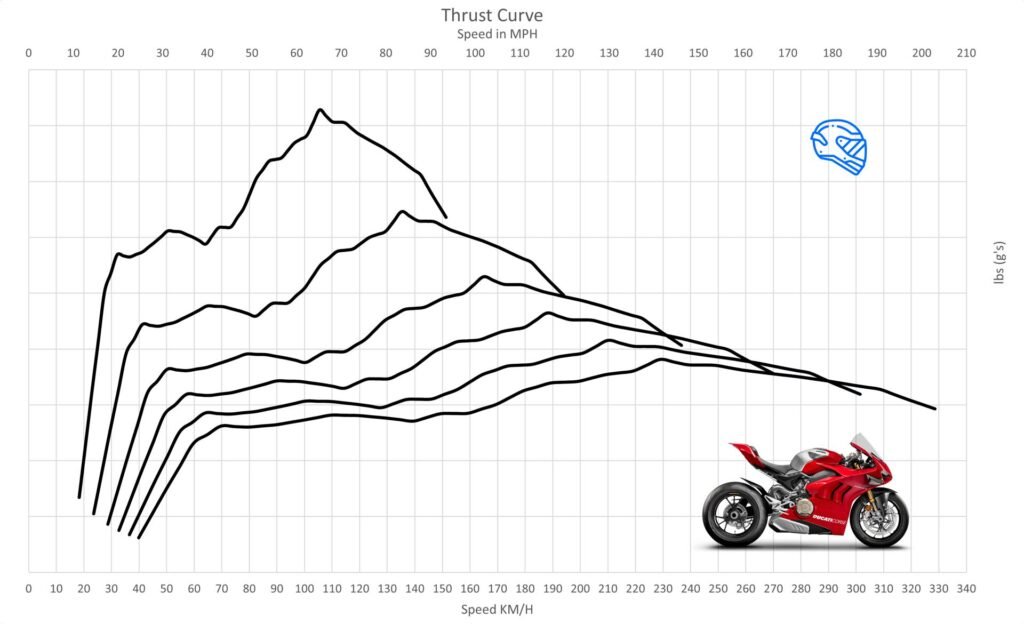
Ducati Panigale V4R Thrust Curve
Although the V4 R has less peak horsepower and torque than the 1,100 cc V4, its ability to rev significantly higher allows Ducati to fit lower overall gearing.
The individual gear ratios are the same, but the V4 R runs a 42-tooth rear sprocket paired with a 15-tooth front sprocket, compared with a 41-tooth rear and 16-tooth front on the standard V4.
This shorter final drive means that, despite lower torque and power figures throughout the rev range, the V4 R can match the standard V4 for in-gear acceleration – it simply does so at higher rpm.
Rev for rev, the Panigale V4 R is not as punchy as the bigger V4, but side-by-side in the same gear it pulls just as hard and then pulls stronger once past 13,500 rpm.
Despite its extremely high-revving nature, the V4 R delivers as much – and in many cases more in-gear acceleration than some of the best bikes in the class.
This is thanks to its class-leading low weight and the very short gearing.
For perspective, the Ducati Panigale V4 R is geared lower than a Suzuki GSX-R750.

And of course, the Ducati Panigale V4 R produces significantly more torque and peak power throughout the entire rev range than the smaller-capacity Suzuki GSX-R750.
Combined with its shorter gearing and class-leading low weight, the V4 R is almost untouchable on the road in gear-to-gear, speed-for-speed comparisons.
For example, from 70 mph, a current Yamaha YZF-R1 would need fourth gear to beat the Panigale V4 R in a 70–100 mph roll-on.
In second gear, the Ducati Panigale V4 R produces almost the same peak thrust and acceleration as the Yamaha YZF-R1 does in first gear.
If you have ever ridden a 2015 or later YZF-R1, you will know just how savage its first gear is.
The Panigale V4 R’s second gear pulls with comparable ferocity, albeit starting from a higher road speed.
This is possible because the V4 R’s second gear ratio is almost identical to the R1’s first gear ratio.
The Ducati Panigale V4 R is lighter than the R1 and produces more power with slightly higher peak torque. When you combine these factors, it delivers the same level of thrust and acceleration in second gear as the R1 does in first.
It is quite incredible.
Ducati Panigale V4R speed in gears at 5000 rpm
| Speed at 5000 rpm | V4R | 22-YZF-R1 | GSX-R750 |
| 1st Gear | 28.8 mph | 34.5 mph | 28.4 |
| 2nd Gear | 36.9 mph | 41.2 mph | 38.5 |
| 3rd Gear | 44.9 mph | 48.7 mph | 46.2 |
| 4th Gear | 51.2 mph | 56.8 mph | 52.8 |
| 5th Gear | 57.7 mph | 64.9 mph | 58.7 |
| 6th Gear | 62.4 mph | 71.7 mph | 65.5 |

Ducati Panigale V4R acceleration through the gears
The Ducati Panigale V4 R is arguably (excluding the Superleggera) one of the fastest-accelerating motorcycles in the world.
Perhaps not from a standing start, but once rolling and especially from zero to 180–190 mph, very little can touch it other than a Kawasaki H2R.
From a dig, the V4 R is fairly ordinary for a modern superbike. It reaches 0-60 mph in 3.03 seconds and 0-100 mph in 5.30 seconds.
These times are fairly typical for 1000 cc superbikes and super nakeds producing over 180 horsepower at the crank.
The 0-200 km/h sprint takes a little over seven seconds at 7.09 seconds. Sub-seven seconds is certainly possible with a perfect launch.
The Ducati only really starts to put its power down effectively once it hooks into third gear. As it charges towards the quarter-mile and selects fourth, it crosses the line in a blistering 9.95 seconds with a remarkable terminal speed of 159 mph.
This highlights the V4 R’s ferocious top-end power.
Like all 1000 cc superbikes, quarter-mile times are heavily limited by how difficult they are to launch cleanly. It is simply not possible to use all of their 200-plus horsepower in first gear without wheelies or wheelspin.
The Panigale V4 R suffers from this even more than most because of its huge power, short gearing and low weight.
The effectiveness of wheelie control varies between motorcycles. They all do a good job, but on many bikes producing 180 horsepower or more, you still do not get full power until third gear.
The Ducati Panigale V4 R is no exception – the wheelie control still intervenes in third gear. It remains wild, but it becomes noticeably easier to lay the power down once you are out of second gear.
With wheelie control switched on, it is much easier to be consistent and achieve good elapsed times.
With it off, quicker times are possible, but consistency suffers.
Even with the front wheel in the air for most of the run, it is relatively easy to post high 10-second or low 11-second quarter-mile times.
With more practice launching the V4 R, mid-9-second quarter-mile times would likely be achievable while maintaining a similar trap speed.
Once the quarter-mile is behind it, the Panigale V4 R charges extremely hard – harder than almost anything else on the road except for a Kawasaki H2R.
It reaches 0-180 mph in just 13.54 seconds and will go on to a top speed of 198 mph. With ECU tweaks and the electronic restrictions removed, 210–215 mph would easily be possible with a small, committed rider.
Ducati Panigale V4R Acceleration From A Stop
| Ducati Panigale V4R | |
| Speed | Time |
| 0-10 mph | 0.49 |
| 0-20 mph | 0.99 |
| 0-30 mph | 1.49 |
| 0-40 mph | 1.99 |
| 0-50 mph | 2.50 |
| 0-60 mph | 3.03 |
| 0-70 mph | 3.56 |
| 0-80 mph | 4.10 |
| 0-90 mph | 4.66 |
| 0-100 mph | 5.30 |
| 0-110 mph | 5.91 |
| 0-120 mph | 6.54 |
| 0-130 mph | 7.28 |
| 0-140 mph | 8.00 |
| 0-150 mph | 8.96 |
| 0-160 mph | 10.03 |
| 0-170 mph | 11.56 |
| 0-180 mph | 13.54 |
| 60-130 mph | 4.25 |
| 100-150 mph | 3.65 |
| SS/QM | 9.95@159 mph |
| SS/KM | 17.48@189 mph |
| SS/Mile | 24.38@197 mph |
| Top Speed | 198 mph |