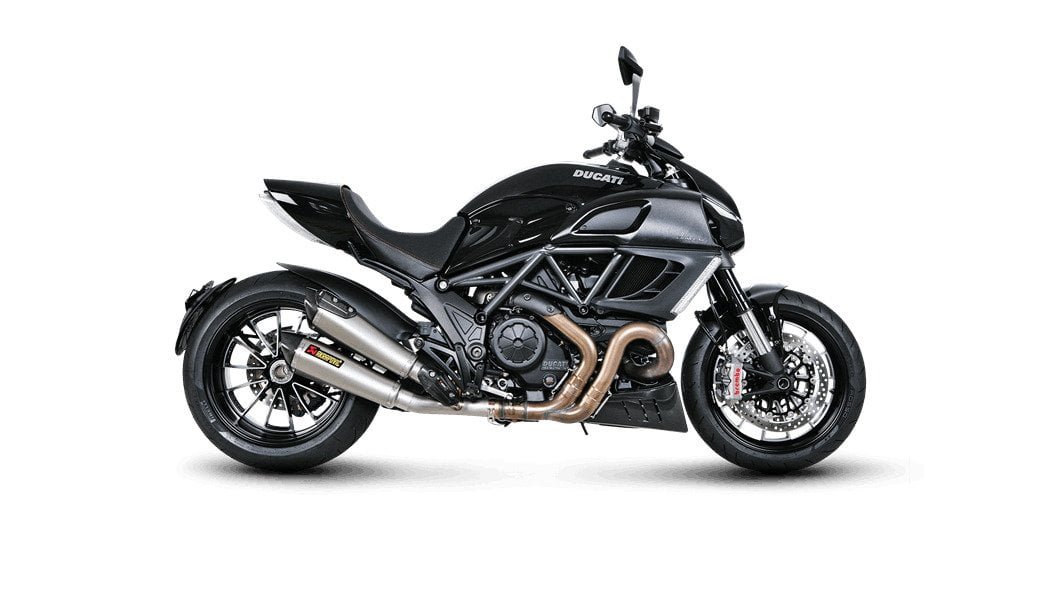
Ducati Diavel 0-60 mph in 2.7 seconds
The Ducati Diavel was launched in 2011 and is a motorcycle that is difficult to categorise. It is a curious hybrid of cruiser and naked sportbike.
It was not initially well received by the motorcycle community or the press, particularly by Ducati purists, who were shocked that the company would dare to design, manufacture and sell what they saw as a cruiser.
Ducati has traditionally been a Superbike-focused brand, with only a few models, most notably the Monster series, that broke the mould.
The decision to diversify into the cruiser segment, therefore, came as a surprise to many enthusiasts and journalists alike.
At the end of the day, Ducati is a business, and like any business, it must consider its bottom line.
 Like many motorcycle brands, Ducati noticed a clear shift in the market. Riders were moving away from pure Superbikes and seeking more practical alternatives that still offered strong performance in a friendlier package.
Ducati spotted the opportunity and moved to fill the gap.
The Diavel shook up the cruiser segment, which had long been dominated by heavy, low-powered Harley-Davidsons.
To be fair, the Diavel cannot really be compared to most Harleys with the possible exception of the V-Rod.
In fact, many argue that Ducati drew direct inspiration from Harley’s V-Rod when creating the Diavel.
Both bikes share a similar low, aggressive stance with cruiser-style ergonomics, yet deliver brutish dragster-like performance and surprisingly sharp handling that feels anything but traditional cruiser.

Ducati Diavel Engine Performance and Dyno
The Ducati Diavel is powered by a 1198 cc 90° L-twin Testastretta engine taken directly from the ferocious Ducati 1198 Superbike, Ducati’s flagship at the time.
In the Diavel, the engine is in a lower state of tune, giving away around 15-20 horsepower at the top end, but it has been carefully retuned to deliver noticeably more mid-range and bottom-end torque.
Claimed output at the crank is 162 horsepower at 9,250 rpm and a healthy 96 ft-lb of torque at 8,000 rpm.
The individual gear ratios remain the same as in the 1198, but Ducati fitted a rear sprocket with five extra teeth.
This change lowers the overall gearing and reduces top speed by approximately 20 mph at 10,000 rpm compared with the donor Superbike.

Ducati Diavel in-gear acceleration
These gearing changes were made to compensate for the Diavel’s greater weight and slightly lower peak power compared with the 1198 Superbike.
However, they were also deliberate. Ducati clearly wanted the Diavel to feel more responsive and accelerative in real-world riding situations.
On the dyno, the Diavel delivers a very respectable 136 horsepower at just over 9,000 rpm and 82 ft-lb of torque at 8,000 rpm.
Compared with the 1198, the power delivery is flatter and more linear overall, but it picks up strongly from 5,000 rpm and is noticeably stronger between 4,000 and 6,000 rpm.
Above 6,000 rpm, it does not pull quite as hard as the Superbike due to the milder state of tune. It remains a superb engine.
Despite the Diavel’s considerable weight, it feels explosive in the lower gears and often accelerates more instantly than the 1198 itself.
They probably should have called it the “Dragster”, given how brutally it launches off the line, although that name has already been used plenty of times in the motorcycle world.
“Diavel” (meaning “devil” in Bolognese dialect) is more than fitting.
The bike has a truly wicked turn of speed and can get you into trouble very quickly.
Very few superbikes can match a Diavel in a 0-60 mph sprint. While they are theoretically capable of similar times, in practice, superbikes are much harder to launch cleanly because of their extreme power, tall gearing, low weight, and short wheelbases.
They also sit with a higher centre of gravity, which hurts traction off the line.
As a result, most modern 1000 cc+ superbikes typically record 0-60 mph times between 3.0 and 3.3 seconds, with occasional quicker runs when conditions are perfect.
The Ducati Diavel, by contrast, is long, low-slung, and equipped with a massive 240-section rear tyre that puts the power down exceptionally well.

Motorcycles with the Ducati Diavel’s low, long stance and strong power are often weapons off the line, and the Diavel is no exception.
It storms from 0-60 mph in just 2.70 seconds, all in first gear.
The Diavel is a proper animal when launched hard: it will wheelie and wheelspin at the same time.
Trying to hold on as this rocket fires off the line is incredibly impressive and huge fun.
Ducati’s DTC traction control is best switched off if you are chasing the quickest times. Even the impressive 2.70-second 0-60 mph run is not the absolute limit the Diavel is capable of.
Getting it off the line is surprisingly easy once you adapt.
You simply need to dump the clutch more aggressively than you would on a typical Superbike.
Instead of flipping upright, the Diavel’s long, low-slung design means it just squats, spins the rear tyre, and rockets forward in a controlled power wheelie.
Thanks to its dimensions and traction, you can consistently achieve flat 3-second 0-60 mph times with very little drama.
For reference, the 0-100 km/h time is 2.89 seconds.
The Diavel continues charging hard, reaching 100 mph in 5.57 seconds — genuine 1000 cc Superbike territory — and it does so in third gear.
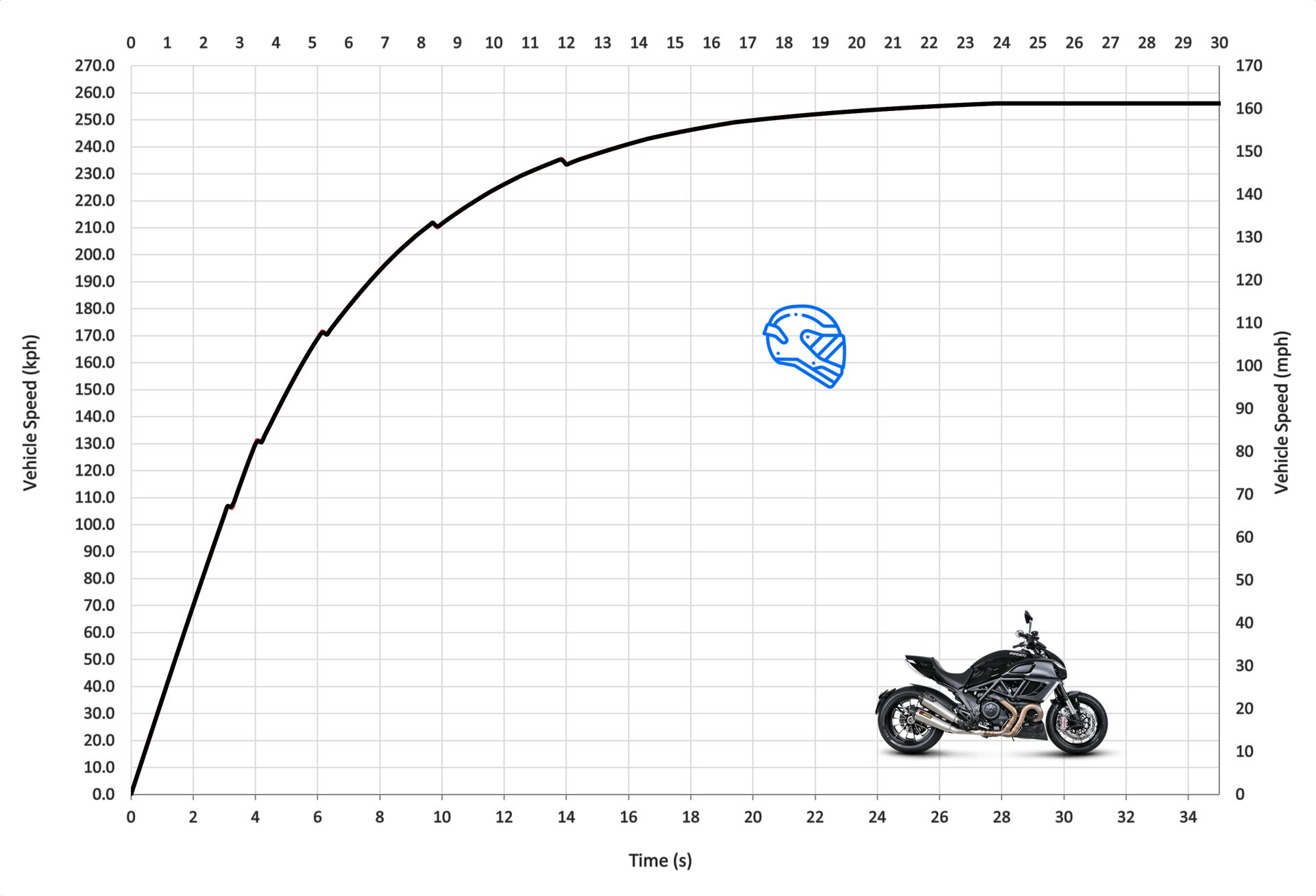
If the Diavel could reach 100 mph in second gear, it’d be 0.2 seconds quicker, but it needs 3rd.
It covers 0-200 km/h in 8.47 seconds, a metric often quoted by car manufacturers, which matches or beats many high-powered cars.
As I mentioned earlier, the Diavel is essentially a drag bike in disguise, and it shows in the quarter-mile. It runs a strong 10.46 seconds at 133 mph.
This elapsed time is right up there with many superbikes from the last 20 years, although the terminal speed is a little lower when it crosses the line.
The Dragy 60–130 mph sprint is completed in 6.62 seconds, making the Diavel quicker than even the fastest 600 cc Supersport bikes in this test.
Above 130 mph, aerodynamics begin to take their toll, and the lack of meaningful wind protection for the rider becomes very apparent.
Even so, it reaches 0-150 mph in 16.20 seconds.
To achieve that time, you really need to get into a tight tuck and make yourself as flat as possible; otherwise, you can easily add two or three seconds.
A strong headwind will also kill the top-end speed.
For the best acceleration times, the Diavel is not particularly fussy about shift points. You can change up anywhere between 9,500 and 10,000 rpm and still post consistent results.

The Diavel is not about outright top speed, yet it will still reach a genuine 159 mph – a very respectable figure by any standard.
That said, you need to be fully committed and prepared to adopt an uncomfortable tuck while the wind tries to rip your helmet off your head.
For most riders, a more realistic top speed when blasting through the gears is around 150 mph.
An aftermarket screen is a worthwhile addition and can help extract a few extra mph.
Overall, the Ducati Diavel’s outright acceleration is very similar to that of a 600 cc Supersport bike such as the Honda CBR600RR or Yamaha YZF-R6.
However, from a standing start, you will almost always beat any 600 thanks to its stronger low-down drive.
At higher speeds, the 600s can often keep up or even edge ahead because of their superior aerodynamics.
Many of them may just pip the Diavel at the very top end.
Despite the raw numbers being similar to a 600, the Diavel feels much faster in almost every real-world situation.
This is mainly because it has a larger engine, shorter gearing, and delivers strong, instant drive from as low as 3,000 rpm.
On a 600 cc Supersport, you usually need to keep the revs above 9,000 rpm to access meaningful performance, whereas the Diavel pulls hard and willingly from much lower in the rev range.
In short, the Diavel is a true weapon blessed with a superb engine and genuinely thrilling performance.
Ducati Diavel Acceleration and top speed
| 2017 Ducati DIavel Acceleration | |
| Speed | Time |
| 0-10 mph | 0.45 |
| 0-20 mph | 0.91 |
| 0-30 mph | 1.30 |
| 0-40 mph | 1.81 |
| 0-50 mph | 2.31 |
| 0-60 mph | 2.70 |
| 0-70 mph | 3.68 |
| 0-80 mph | 3.96 |
| 0-90 mph | 4.82 |
| 0-100 mph | 5.57 |
| 0-110 mph | 6.73 |
| 0-120 mph | 7.92 |
| 0-130 mph | 9.40 |
| 0-140 mph | 11.90 |
| 0-150 mph | 16.20 |
| 60-130 mph | 6.62 |
| 100-150 mph | 10.62 |
| SS/QM | 10.46 @ 133 mph |
| SS/KM | 19.60 @ 155 mph |
| SS/Mile | 28.13 @ 159 mph |
| Top Speed | 159.1 mph |